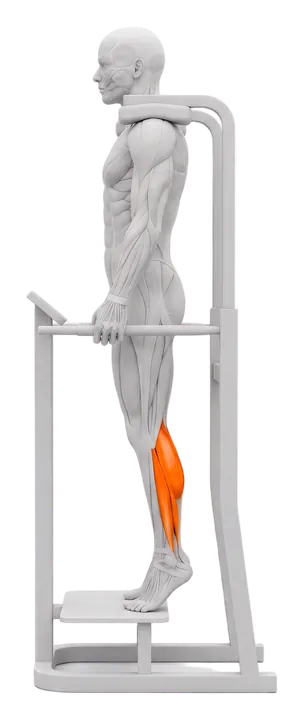
Calf anatomy: two muscles, two positions
What most people call the calf is two muscles that share the Achilles tendon. Both point the foot down, but one of them also crosses the knee, and that decides which exercise trains it best.
| Muscle | Where it is | Works most when | Best exercise |
|---|---|---|---|
| Gastrocnemius | The visible two-headed muscle at the top of the calf, crosses the knee and ankle | The knee is straight | Standing calf raise, leg press calf raise |
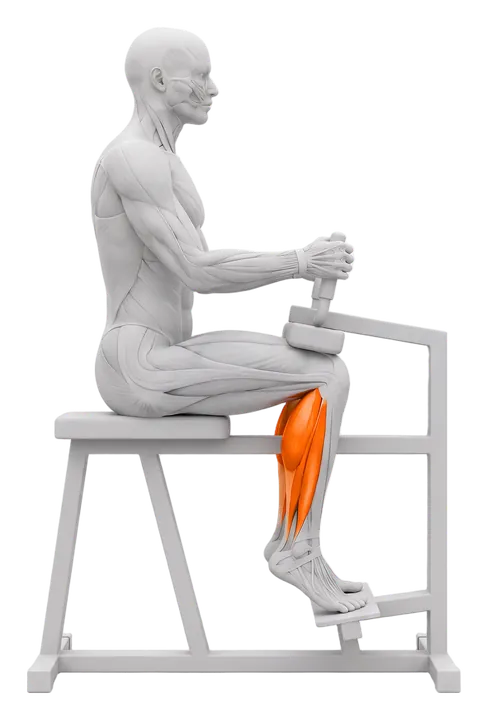
| Soleus | A flat muscle under the gastrocnemius, crosses only the ankle | The knee is bent, when the gastrocnemius is slack | Seated calf raise |
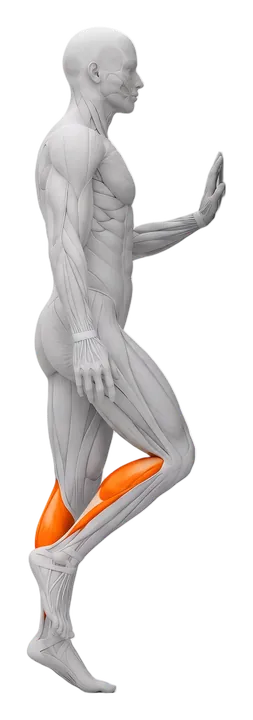
| Tibialis anterior | Front of the shin, lifts the toes | You pull the toes up | Tibialis raise with your back on a wall |
For full calves you want both a straight-knee and a bent-knee raise in your week. The shin muscle at the front is not part of the calf, but training it a little balances the lower leg and many runners like it.
All calf exercises
Best calf exercises, ranked
- Standing calf raise (machine or Smith machine): loads the gastrocnemius heavily through a long range. The main calf builder in most gyms. Form and foot position are in the calf raise guide.
- Single-leg calf raise on a step: the best calf exercise at home. Your whole bodyweight on one leg is a serious load for most people, and you can hold a dumbbell to add more.
- Seated calf raise: knee bent at about 90 degrees, so it trains the soleus. Go slow, the range is short and easy to bounce.
- Leg press calf raise: balls of the feet on the bottom edge of the platform, knees nearly straight. A good option when the standing machine is taken. Keep a slight bend in the knees and never let the sled slip off the toes.
- Dumbbell calf raise: a dumbbell in one hand, the other hand on a wall, on a step. Easy to load in small jumps.
- Donkey calf raise: hinged forward at the hips, which puts the gastrocnemius in a deep stretch. Use the machine if your gym has one.
- Jump rope and pogo hops: train the calves to be springy rather than big. Good for runners and athletes, in small doses.
Calf workout for the gym
| Exercise | Sets x reps | Rest | Focus |
|---|---|---|---|
| Standing calf raise | 3 x 8 to 12 | 60 to 90 s | Gastrocnemius, heavy |
| Seated calf raise | 3 x 12 to 15 | 60 s | Soleus |
| Single-leg calf raise on a step, bodyweight | 1 x as many as possible per leg | None | Finisher, full stretch |
Put it at the end of a leg workout, or move it to the start of a session if your calves are a weak point. On a leg machine workout the standing and seated calf machines fit in naturally, and the leg press doubles as a calf station when the gym is busy.
Calf exercises at home and with dumbbells
Calves are one of the easiest muscles to train hard at home: you need a stair, a wall and possibly one dumbbell.
| Exercise | Sets x reps | Rest | How |
|---|---|---|---|
| Single-leg calf raise on a stair | 3 x 10 to 20 per leg | 45 s | Heel drops below the step, 1 second pause at the bottom |
| Bent-knee single-leg calf raise | 2 x 12 to 20 per leg | 45 s | Knee bent about 30 degrees all set, more soleus |
| Dumbbell calf raise, two legs | 2 x 15 to 25 | 45 s | Hold one or two dumbbells, stand on a step |
| Tibialis raise | 2 x 15 to 20 | 30 s | Back on a wall, heels forward, lift the toes |
Once you can do 20 slow single-leg raises, hold a dumbbell or a full backpack. A complete bodyweight leg session with calves at the end is in the leg workout at home, and the dumbbell leg workout adds them to a dumbbell day.
Calf raise form: why your calves are not growing
Calves have a reputation for being stubborn. Some of that is genetics: calf size and where the muscle sits on the tendon vary a lot between people. But most stalled calves are a technique problem.
- Bouncing. The Achilles tendon is springy and takes over if you bounce. Pause 1 to 2 seconds at the bottom of each rep.
- Half reps. Go from a full stretch with the heel below the toes to all the way up on the big toe. The bottom half is where the work is.
- Too heavy, too fast. If the machine is loaded to the stack and each rep takes half a second, take weight off and slow down.
- Rolling to the outside of the foot. Push through the ball of the foot near the big toe.
- Doing them as an afterthought. Two quick sets after a hard leg day are easy to skip. Treat calves like any other muscle and log them.
Sets, reps and frequency for calves
| Level | Calf sessions per week | Hard sets per week | Reps |
|---|---|---|---|
| Beginner | 2 | 4 to 8 | 10 to 15 |
| Intermediate | 2 to 3 | 8 to 12 | 8 to 20 |
| Advanced or lagging calves | 3 to 4 | 10 to 16 | 6 to 25, heavy standing plus lighter seated |
These are typical ranges. Calves recover quickly, so short sessions spread over the week work well. Mix heavier standing raises with higher rep seated and single-leg work. Add a small jump in weight, 2.5 to 5 kg (5 to 10 lb), once every set reaches the top of the range. The progressive overload guide shows how to keep adding load, and the double progression method suits calf machines well.
Gripp keeps your calves on the plan
Gripp is coming to iPhone. Log your calf raises like any other lift and Gripp tells you what to do next session: last time 12 reps at 60 kg (130 lb), today go for 13. When every set hits the top of the range, it moves the weight up, and each exercise gets an estimated 1RM on a progress chart.
Join the waitlistCalves work alongside the rest of the lower body; see the glute exercises hub for the hips, or browse every lift in the exercise library.