What is double progression in lifting?
The name comes from the two variables you progress, one after the other: reps, then load. Every exercise gets a fixed number of sets and a rep range, for example 3 sets of 6 to 8. The bottom of the range is the minimum you accept; the top is the signal to go heavier.
That makes the double progression method a decision rule more than a program. It tells you exactly when to increase weight, the question most lifters get wrong. Increase too early and your reps collapse; wait too long and you waste weeks on a weight you have outgrown. The broader idea behind it, getting a little harder over time, is explained in our guide to progressive overload. This page is about running the method itself, set by set.
The rules of double progression
- Choose a rep range and a set count for each exercise, and keep them for the whole block.
- Start with a weight that lets you reach at least the bottom of the range in every set, with one or two clean reps left over.
- Each session, beat your last performance by one rep, usually on the first set that is still below the top. You do not need to add a rep to every set.
- When every set reaches the top of the range with good form, add the smallest weight jump available at the next session.
- If a set falls below the bottom of the range, the weight is too heavy. Keep it and try again; if it happens twice, go lighter.
- Keep the standard of a rep the same: same depth, same tempo, same rest. Otherwise the numbers lie.
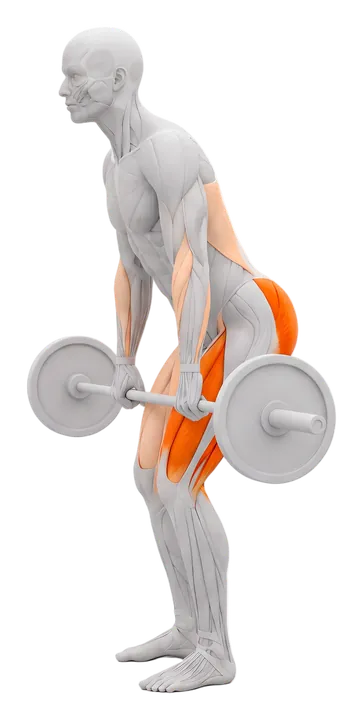
Worked example 1: Romanian deadlift over 8 weeks
Here is the method on the Romanian deadlift, 3 sets of 6 to 8, trained once a week, with 5 kg (10 lb) jumps. Look at the target column: it is always one rep more than the last session, never a guess.
| Week | Weight | Reps done | Target next session |
|---|---|---|---|
| 1 | 105 kg (230 lb) | 7, 6, 6 | 8, 6, 6 |
| 2 | 105 kg (230 lb) | 8, 7, 6 | 8, 8, 6 |
| 3 | 105 kg (230 lb) | 8, 7, 7 | 8, 8, 7 |
| 4 | 105 kg (230 lb) | 8, 8, 8 | All sets at 8: add 5 kg |
| 5 | 110 kg (240 lb) | 7, 6, 6 | 8, 6, 6 |
| 6 | 110 kg (240 lb) | 7, 7, 6 | 8, 7, 6 |
| 7 | 110 kg (240 lb) | 8, 7, 7 | 8, 8, 7 |
| 8 | 110 kg (240 lb) | 8, 8, 7 | 8, 8, 8 |
Week 3 only added one rep, and week 6 did not hit the planned target. That is normal. The weight still went up once in eight weeks, and the rep total at 110 kg climbed every week. Plug your best sets into the 1RM calculator and you will see the estimated max move up even in weeks where the bar weight stood still.
Worked example 2: dumbbells with big weight jumps
Dumbbells are where double progression earns its keep. Going from 8 kg to 10 kg dumbbells on the lateral raise is a 25 % jump, far bigger than adding 5 kg to a 105 kg deadlift. A narrow range like 8 to 10 cannot absorb that, so use a wide one: 12 to 20.
| Session | Dumbbells | Reps done |
|---|---|---|
| 1 | 8 kg (17.5 lb) | 14, 13, 12 |
| 2 | 8 kg (17.5 lb) | 16, 14, 13 |
| 3 | 8 kg (17.5 lb) | 17, 16, 14 |
| 4 | 8 kg (17.5 lb) | 19, 17, 16 |
| 5 | 8 kg (17.5 lb) | 20, 19, 18 |
| 6 | 8 kg (17.5 lb) | 20, 20, 20 |
| 7 | 10 kg (22.5 lb) | 14, 13, 12 |
After the jump the reps fell from 20 to 14, but they stayed inside the range, so the cycle simply starts again. With a range of 8 to 10, the same jump would have dropped you below the bottom on day one.
How to choose the rep range
Two things decide the range: what kind of exercise it is, and how big your weight jumps are compared with the load. Heavy compound lifts suit lower, narrower ranges; small isolation exercises suit higher, wider ones. For the bigger question of which reps build what, see the rep ranges guide.
| Exercise type | Typical range | Examples |
|---|---|---|
| Heavy barbell compounds, strength focus | 4 to 6 or 4 to 8 | Squat, bench press, deadlift |
| Compounds, muscle focus | 6 to 10 or 8 to 12 | Romanian deadlift, rows, overhead press |
| Machines and cables | 8 to 12 or 10 to 15 | Leg press, lat pulldown, chest press machine |
| Small isolation with dumbbells | 12 to 20 | Lateral raise, curls, rear delt fly |
The 4 to 8 double progression method that some lifters search for is just the first row with a wide window: it gives a heavy lift enough room to absorb a 2.5 kg jump. A useful check comes from common 1RM formulas: at moderate reps, one extra rep is worth roughly 3 % of the load. A 5 % jump therefore costs you about one or two reps, and a 25 % dumbbell jump can cost five or more. Make the range at least that wide.
How big should the weight jump be?
Always use the smallest jump you have. Bigger jumps feel like faster progress, but they push your reps below the range and you end up repeating the weight anyway.
| Equipment | Jump | Tip |
|---|---|---|
| Barbell, lower body | 2.5 to 5 kg (5 to 10 lb) | 5 kg is fine on squats and deadlifts early on, 2.5 kg later |
| Barbell, upper body | 1 to 2.5 kg (2.5 to 5 lb) | Fractional plates make presses far easier to progress |
| Dumbbells | Next pair, often 1 to 2.5 kg | Use a wide rep range |
| Machines and cables | Next pin | Some stacks have add-on plates for half steps |
| Bodyweight | Reps first, then load | Add a weight belt or vest once you reach the top |
A plate calculator shows which plates make up the new total, which helps when your gym only has certain plates.
Dynamic double progression
In standard double progression, the whole exercise moves up together: all sets must reach the top before any of them get heavier. In dynamic double progression, each set is progressed on its own. When set one reaches the top, only set one gets the new weight, while sets two and three stay where they are until they also get there.
| Session | Set 1 | Set 2 | Set 3 |
|---|---|---|---|
| 1 | 50 kg x 12 | 50 kg x 10 | 50 kg x 9 |
| 2 | 52.5 kg x 9 | 50 kg x 11 | 50 kg x 10 |
| 3 | 52.5 kg x 10 | 50 kg x 12 | 50 kg x 11 |
| 4 | 52.5 kg x 11 | 52.5 kg x 9 | 50 kg x 12 |
Double progression vs dynamic double progression: the dynamic version moves a little faster and suits experienced lifters who log carefully. The standard version is simpler, needs one weight per exercise, and is easier to stick with. If you are unsure, start with the standard version.
Double progression vs linear progression
Linear progression means adding weight every session at fixed reps, for example 3 sets of 5 with 2.5 kg more each time. It is the fastest way for a true beginner to get stronger, which is why Starting Strength and StrongLifts 5x5 are built on it. It stops working once you can no longer recover from a heavier bar every session.
| Linear progression | Double progression | |
|---|---|---|
| What goes up | Weight, every session | Reps, then weight |
| Reps | Fixed (e.g. 5) | A range (e.g. 6 to 8) |
| Best for | The first months of lifting | Beginners after the first months, intermediates, isolation work |
| When it stalls | Usually within months | Much later, because small rep gains keep it moving |
You do not have to choose one forever. Many lifters run linear progression on the main barbell lifts early on and double progression on everything else, then switch the main lifts over once linear progress stops. Programs like GZCLP mix several progression models in one plan.
What to do when you stall
A stall is when a lift has not gained a rep or any weight for three sessions in a row. Work through these in order:
- Check the basicsSleep, food, stress and missed sessions explain most stalls. Fix those before you change the plan.
- Check your effortIf your sets end with three or four reps left, you are not giving the method a real test. Aim for about one or two reps left; the RPE calculator helps you rate it.
- Reset the weightTake about 10 % off and climb back up through the range. You will usually pass your old best within a few weeks.
- Change the range or the variationMove from 6 to 8 to 8 to 12 for a block, or swap to a close variation, for example a front squat for a back squat.
- Take a deloadIf several lifts stall at once, fatigue is the likely cause. A deload week often solves it.
Does adding reps work as well as adding weight?
A 2022 study by Plotkin and colleagues in PeerJ compared two 8 week programs in trained people: one added load while keeping the rep range fixed, the other added reps while keeping the load fixed. Both produced similar muscle growth, with a small advantage for adding load on maximal strength. Double progression uses both, so you get the rep gains in between weight jumps and still move the load up over time.
How Gripp runs double progression for you
Doing double progression on paper means looking up last session's numbers for every exercise and working out the target in your head. Gripp does that part.
Your next target, set by set
Gripp logs the reps and weight of every set and tells you what to lift next: last time 7 reps at 105 kg, today go for 8. Hit the top of your rep range in every set and Gripp puts the weight up. Each exercise keeps an estimated 1RM with a chart over time, and the AI coach can suggest a new rep range when you stall, which you approve. Gripp is coming soon to iPhone.
Join the waitlistWhatever you use, a notebook or a workout tracker app, the rule is the same: know last time's numbers before you start the set.