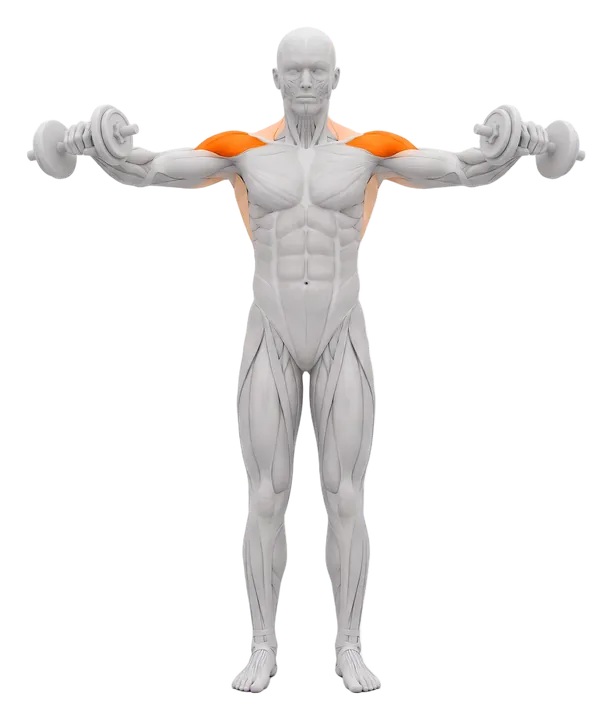
Lateral raise muscles worked
| Muscle | Role | How much |
|---|---|---|
| Side delts (lateral deltoid) | Lifts the arm out to the side | Primary |
| Front delts | Help, more if the arms drift forward | Secondary |
| Upper traps | Help near the top and hold the shoulder blade steady | Secondary |
| Rear delts | Help a little, more with a slight forward lean | Secondary |
| Supraspinatus (rotator cuff) | Works with the side delt through the raise and keeps the joint centred | Stabiliser |
Presses like the overhead press hit the front delts hardest. Rows and pulldowns lean on the rear delts. The side delts get some work from both, but they are the one part of the shoulder that really needs a dedicated exercise, and the lateral raise is the simplest one.
Dumbbell vs cable lateral raise muscles worked
Both versions train the same muscles. The difference is where the exercise is hard. With a dumbbell, gravity pulls straight down, so the bottom of the rep is almost free and the top is the hardest part. A cable set low and across the body pulls sideways, so the side delt is already working from the first centimetre of the lift. Many lifters use both: dumbbells for heavier work, cables for a steadier load through the whole range.
How to do a dumbbell lateral raise
- Pick a light pairChoose dumbbells you could lift for about 20 strict reps. Most people start with 4 to 8 kg (9 to 18 lb). Stand tall with the weights at your sides, palms facing in.
- Soften the elbowsBend the elbows slightly and keep that angle fixed for the whole set. Lean your torso a few degrees forward from the hips.
- Raise out, not upLift the dumbbells out to the sides in a wide arc, as if you are pushing the weights away from you towards the walls. Lead with the elbows.
- Stop at shoulder heightStop when your arms are about level with your shoulders, or just below. Pinkies and thumbs stay roughly level, with the hands not higher than the elbows.
- Lower slowlyTake 2 to 3 seconds to lower the weights. Stop just before they touch your thighs, so the side delts stay under tension, then start the next rep.
Lateral raise form cues
- "Arms long, push the walls apart." Thinking about width instead of height keeps the side delts working and the traps quieter.
- "Elbows lead." The elbow should be level with or slightly above the wrist at the top.
- "Shoulders down, neck long." If your shoulders creep up towards your ears, the upper traps are taking over.
- "Arms in the scapular plane." Raise the arms slightly in front of your body, about 20 to 30 degrees forward, instead of straight out to the sides. Most people find this more comfortable for the shoulder.
- "No swing." The torso stays still. If you have to rock to start the rep, the dumbbells are too heavy.
Common lateral raise mistakes
- Going too heavy. The side delt is a small muscle working on a long lever. Heavy dumbbells turn the set into a shrug and a swing. Drop the weight and slow down.
- Shrugging the weight up. You feel it in your neck instead of the side of the shoulder. Keep the shoulders down and stop slightly lower.
- Raising far above shoulder height. Past shoulder height the traps and rotation of the shoulder blade take over. It is not wrong, but it does not add much for the side delts.
- Bending the elbows more as you lift. This shortens the lever and makes the rep easier. Fix the elbow angle at the start.
- Dropping the weights. A fast lowering phase wastes half of every rep.
Dumbbell, cable or band lateral raise?
| Variation | Hardest point | Good for |
|---|---|---|
| Dumbbell lateral raise | Top of the rep | Simple setup, easy to load, any gym or home |
| Cable lateral raise | Even through the range | Steady tension, one arm at a time, low starting point |
| Band lateral raise | Top of the rep, rising as the band stretches | Home and travel, warm ups, very high reps |
| Lean-away lateral raise | Bottom and middle | Holding a post with one hand, more stretch for the side delt |
| Seated lateral raise | Top of the rep | Removes leg drive and body swing |
| Machine lateral raise | Depends on the machine | Easy to go close to failure safely |
There is no single best version. If your gym has a cable tower, a cable lateral raise done one arm at a time, with the handle starting by the opposite hip, is a good second exercise after dumbbells. A band is a solid option at home: stand on it with both feet, or one foot for less resistance.
Partials, drop sets and supersets
Because the lateral raise uses light weights and a small muscle, it suits intensity techniques better than most exercises. They let you get more hard work out of a set without much fatigue spilling over to other lifts.
Lateral raise drop set
Do a set to 1 rep short of failure, put the dumbbells down, pick up a pair about 20 to 30 percent lighter and keep going. One or two drops per set is plenty. A dumbbell rack makes the switch quick. Keep drop sets for the last set only.
Lateral raise mechanical drop set
A mechanical drop set keeps the same weight but switches to an easier version when you tire. For example: strict lateral raises with straight arms until you are close to failure, then bend your elbows to 90 degrees (shorter lever) and keep going, then finish with a few partial reps from the bottom.
Lateral partials
Partials are short reps, often in the bottom half of the range, done after full reps are no longer possible. They keep the muscle working when you can no longer lift to shoulder height. Use them at the end of a set, not as a replacement for full reps.
Lateral raise superset
A common pairing is lateral raises with a rear delt exercise such as the face pull, or with a triceps exercise at the end of a push day. Both muscles are small and recover fast, so a superset saves time without hurting either one.
Lateral raise sets and reps
| Goal | Sets x reps | Rest | Notes |
|---|---|---|---|
| Side delt growth | 3 to 4 x 12 to 20 | 60 to 90 s | 1 to 2 reps short of failure |
| Heavier work | 3 x 8 to 12 | 90 s | Strict form, no swing |
| Drop set finisher | 1 to 2 x 12 to 15, then drops | 90 s | Last set of the session |
| Beginner | 2 to 3 x 12 to 15 | 60 s | Light, slow lowering |
| Warm up or rehab | 2 x 15 to 20 | 45 to 60 s | Band or very light dumbbells |
How many sets of lateral raises? For most people, 6 to 12 hard sets per week for the side delts works well, split over two or three sessions. On a push pull legs split they fit at the end of each push day; on an upper lower split, put 3 sets on each upper day after your presses.
How many reps for lateral raises? Most people do best between 12 and 20. Below about 8 reps the weights tend to get heavy enough that form breaks down.
Lateral raise vs overhead press
| Lateral raise | Overhead press | |
|---|---|---|
| Type | Isolation | Compound |
| Main target | Side delts | Front delts and triceps |
| Typical load | Light dumbbells | Heavy barbell or dumbbells |
| Best rep range | 12 to 20 | 3 to 10 |
| Main purpose | Shoulder width | Overall pressing strength |
The two do not compete. The press builds strength and size in the front of the shoulder and the triceps; the lateral raise fills in the side. A balanced shoulder routine usually has one press, such as the dumbbell shoulder press, plus lateral raises and a rear delt exercise.
How to progress the lateral raise
Dumbbell jumps are large for this exercise. Going from 8 to 10 kg is a 25 percent increase, which is too much to make in one go. Add reps first: when you can do all sets at the top of your rep range with clean form, move up one dumbbell and start again at the bottom of the range. This double progression is a simple form of progressive overload. Cables and machines often have smaller steps, which makes them easier to progress.
Gripp tracks the small steps
Gripp is coming to iPhone. Log the reps and weight for every set and Gripp tells you what to aim for next session, so you know when to add a rep and when to move up a dumbbell. Your estimated max per exercise builds into a progress chart, and Gripp rates your shoulder strength against people of your age and bodyweight.
Join the waitlistLateral raise alternatives
- Cable or band lateral raise: the same movement with a different resistance curve.
- Upright row with a wide grip: trains the side delts and traps together. Pull only to lower chest height if your shoulders are sensitive.
- Y-raise on an incline bench: lying chest down, raise the arms in a Y shape. Hits the side and rear delts and the lower traps.
- Machine lateral raise: fixed path, easy to train close to failure.
- Overhead pressing: not a replacement, but presses train the side delts too. See the barbell overhead press guide.
Similar exercises
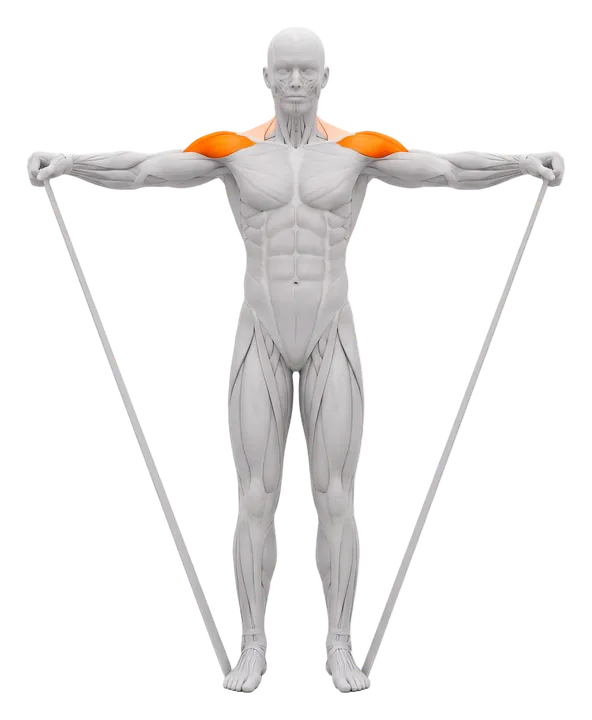 Band lateral raiseSide delts