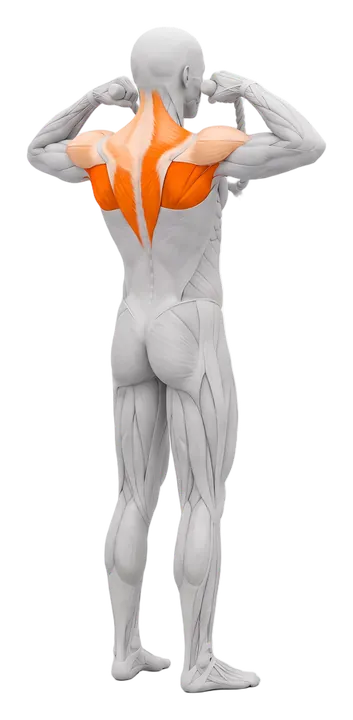
Face pull muscles worked
| Muscle | Role | How much |
|---|---|---|
| Rear delts | Pull the upper arm back and out | Primary |
| Middle traps and rhomboids (upper back) | Squeeze the shoulder blades together | Primary |
| Infraspinatus and teres minor (rotator cuff) | Rotate the upper arm outward at the end | Secondary |
| Lower and upper traps | Control the shoulder blades | Secondary |
| Side delts | Help keep the elbows high | Secondary |
| Biceps and forearms | Hold and pull the rope | Stabiliser |
Why face pulls for shoulder health? Most training programs have plenty of pressing: the bench press, push-ups, overhead work. The face pull trains the opposite direction and the outward rotation that pressing barely uses. It is not a cure for shoulder pain, but it is an easy way to keep the back of the shoulder strong alongside the front.
Face pull setup: rope, height and grip
- Attachment: a rope with two ends is the standard choice. Two separate rope handles or a pair of straps give your hands more room to pull apart at the end.
- Cable height: set the pulley at about face height or slightly higher. A high pulley pulling slightly down is easier on the neck and makes the external rotation clearer. Very low settings turn the exercise into a row.
- Grip: overhand with the thumbs pointing back towards you, or an underhand grip with the thumbs facing out. The overhand grip is more common; an underhand grip lets some people rotate further.
- Stance: stand a step or two back from the pulley in a split stance, or sit on a bench facing the cable for less body sway.
How to do a cable face pull
- Take the ropeGrab the rope ends with your arms straight out in front of you at shoulder height. Step back until the weight lifts off the stack.
- Set your bodyStand tall in a split stance, ribs down, a slight lean back of a few degrees at most. Your torso stays still for the whole set.
- Pull to your facePull the middle of the rope towards your forehead or nose. Drive the elbows out and back, keeping them at or slightly above shoulder height.
- Rotate and pull apartAs the rope reaches your face, pull the ends apart and rotate your hands back so your knuckles point up and your hands end up beside your ears, like a double biceps pose.
- Pause and returnHold for a second, feel the squeeze between the shoulder blades, then let the arms return straight under control.
Face pull exercise form cues
- "Elbows high, hands higher at the end." At the finish your hands sit above your elbows. If they end below, you skipped the rotation.
- "Pull the rope apart." Think of splitting the rope, not just pulling it in.
- "Shoulders away from your ears." Shrugging moves the work to the upper traps.
- "Stand still." The arms move, the body does not. Leaning back to move the weight is the most common way to cheat.
- "Light and slow." The rear delts and rotator cuff are small. Quality reps matter more than the number on the stack.
External rotation: the part most people skip
Without the rotation at the end, a face pull is a high row. That still trains the rear delts and upper back, but you miss the rotator cuff work that makes the exercise popular for shoulder health. The rotation happens in the last part of the rep: once the elbows are back, the forearms turn up and back while the elbows stay roughly in place.
If you cannot rotate at the end, the weight is too heavy or your grip is too narrow. Lower the weight, try the underhand grip or switch to two handles. Lifters with very limited shoulder rotation can do the pull without the full rotation and build it up over time.
Common face pull mistakes
- Too much weight. The body leans back, the elbows drop and the rep becomes a row. Start lighter than you think.
- Elbows dropping. Low elbows shift the work from the rear delts to the lats and biceps.
- Pulling to the chest. Aim for the face, between the forehead and the chin.
- No pause at the end. Rushing through skips the position where the rear delts and rotator cuff work hardest.
- Cable set too low. Pulling up towards the face from a low cable makes it hard to keep the elbows up.
Face pull sets and reps
| Goal | Sets x reps | Rest | Notes |
|---|---|---|---|
| Rear delt and upper back growth | 3 to 4 x 12 to 20 | 60 to 90 s | 1 to 2 reps short of failure |
| Shoulder health and posture work | 2 to 3 x 15 to 20 | 60 s | Pause at the end of every rep |
| Warm up before pressing | 1 to 2 x 15 to 20 | 30 to 60 s | Light, focus on rotation |
| Rehab | 2 to 3 x 12 to 20 | 60 s | Very light, pain free range |
Face pulls recover fast, so you can train them two or three times a week. On a push pull legs split they fit on pull day, and many lifters also add a light set to the warm up on push day. On an upper lower split, add 2 to 3 sets at the end of each upper day. Lifters on 5/3/1 often use face pulls as a pull assistance exercise after the press or bench.
A simple pairing at the end of a push day: face pulls superset with lateral raises. That covers the rear and side delts in a few minutes.
How to progress face pulls
Progress slowly and by reps. When you can do every set at the top of your rep range with high elbows, a full rotation and a pause, add the smallest weight step the machine allows. If the jump is too big, add a rep per set first or slow down the return. Read more on progressive overload for small exercises.
Gripp keeps your small lifts moving
Gripp is coming to iPhone. Accessory exercises are easy to forget in a log. Gripp records every set's reps and weight, tells you what to lift next time and shows your estimated max on a progress chart. It also rates your strength per muscle group, so you can see if your back keeps up with your chest.
Join the waitlistFace pull alternatives
| Alternative | Equipment | Notes |
|---|---|---|
| Band face pull | Resistance band anchored at face height | Closest match, good at home |
| Band pull-apart | Light band | Simple, can be done daily as a warm up |
| Rear delt fly | Dumbbells or reverse pec deck machine | More direct rear delt work, less rotation |
| Prone Y-raise | Incline bench and light dumbbells | Lower traps and rear delts |
| Dumbbell external rotation | Light dumbbell, lying on your side | Isolates the rotator cuff |
| High row with rope | Cable | Same pull without the rotation |
For more upper back exercises, see the back exercises hub, which also covers rows and the lat pulldown.
Similar exercises
 Band pull-apartRear delts and upper back
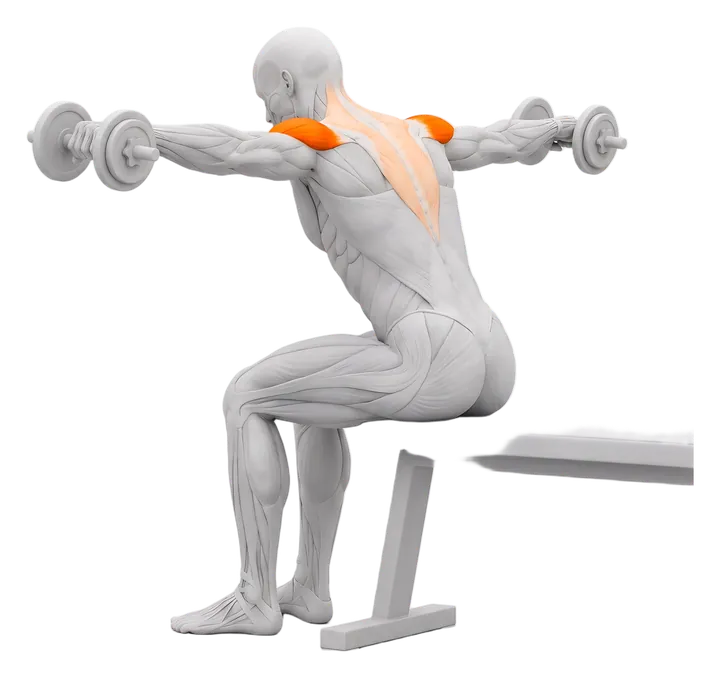 Bent-over rear delt flyRear delts