How 5/3/1 works
The 5/3/1 plan rests on four principles from Wendler's book. Use the big multi joint lifts. Start lighter than you think you should. Progress slowly. Break personal records often. Everything in the program serves those ideas.
Each training day has one main lift. You do three work sets of that lift at set percentages, and the last set is an AMRAP set (as many reps as possible, marked with a +) where you push for a rep record. After the main lift comes supplemental and assistance work to build muscle and fill gaps. Then you go home.
- Training max: all percentages come from a number set below your real one rep max, so the work is always doable with good form.
- The + set: the final set of each day lets you beat old rep records even when the weight on the bar is moderate.
- Small jumps: the training max goes up only 2.5 kg (5 lb) on upper body lifts and 5 kg (10 lb) on lower body lifts per cycle.
Step 1: set your training max
The training max (TM) is the most important number in 5/3/1. Getting it wrong, almost always too high, is the most common reason the program fails.
- Find your one rep maxUse a recent max, or estimate it from a hard set of 3 to 5 reps with the 1RM calculator. For bench, the bench press calculator works too.
- Take 90 %The standard rule is 90 % of your one rep max. Wendler's later books often use 85 %, which is a good choice if your max is uncertain or you run a high volume template like Boring But Big.
- Round downRound down to a weight you can load. A 1RM of 120 kg gives a training max of 108 kg at 90 %, so use 107.5 kg (or 102 kg at 85 %, so use 100 kg).
The 5/3/1 percentages: the 4 week cycle
Every lift follows the same four weeks. The percentages below are of your training max, not your 1RM. The example column uses a training max of 100 kg.
| Week | Set 1 | Set 2 | Set 3 | Example (TM 100 kg) |
|---|---|---|---|---|
| 1 (5s week) | 65 % x 5 | 75 % x 5 | 85 % x 5+ | 65, 75, 85 kg |
| 2 (3s week) | 70 % x 3 | 80 % x 3 | 90 % x 3+ | 70, 80, 90 kg |
| 3 (5/3/1 week) | 75 % x 5 | 85 % x 3 | 95 % x 1+ | 75, 85, 95 kg |
| 4 (deload) | 40 % x 5 | 50 % x 5 | 60 % x 5 | 40, 50, 60 kg |
Warm up before the work sets, for example 40 %, 50 % and 60 % of the training max for 5, 5 and 3 reps. On the + sets, stop when your form starts to slip, usually with one rep left in you. Hitting the minimum is a success. Anything above it is a bonus and a record to beat next cycle.
Some lifters skip the deload after every cycle and take it every second or third cycle instead. Wendler's later templates do the same. If you are new to the program, keep the deload.
5/3/1 schedules: 4, 3 and 2 days
- 4 day (original): overhead press, deadlift, bench press, squat, one main lift per session.
- 3 day (rotating): week 1 is press, deadlift and bench, week 2 starts with squat, and the order keeps rolling.
- 2 day: squat and bench press on day 1, deadlift and overhead press on day 2.
The 4 day version, Monday, Tuesday, Thursday and Friday, is the most common and works as an upper lower split. On 3 days, one cycle takes a little over five weeks because the lifts rotate. On 2 days, you do two main lifts per session and keep the assistance work short.
Templates: Boring But Big and more
The 5/3/1 sets are only part of each session. What you do after them is the template, and the choice depends on whether you want more size, more strength or shorter workouts.
| Template | Supplemental work | Best for |
|---|---|---|
| Boring But Big (BBB) | 5 x 10 of the same lift at 50 to 60 % of TM | Building muscle, off season size |
| First Set Last (FSL) | 3 to 5 x 5 to 8 at the first set's weight | Strength with moderate volume |
| Second Set Last (SSL) | 3 to 5 x 5 at the second set's weight | More strength work, shorter sessions |
| The Triumvirate | Two assistance lifts, 5 sets each | Simple, time efficient training |
| Main lifts only (no assistance) | Main sets only | Very busy weeks, minimum effective dose |
5/3/1 Boring But Big
BBB is the most popular 5/3/1 workout routine. After the main sets, do 5 sets of 10 reps of the same lift at 50 to 60 % of your training max. Start at 50 %. The volume is high, and the last sets of squats or deadlifts are harder than they look on paper. Run BBB with a training max of 85 % or lower.
Assistance work
Wendler's guideline is 50 to 100 total reps in each of three categories per session: push (dips, push-ups, dumbbell press), pull (rows, chin-ups, face pulls) and single leg or core (lunges, Bulgarian split squats, ab wheel, hanging leg raises). Keep it simple and consistent rather than chasing fatigue.
How to progress on 5/3/1
Progress on 5/3/1 is slow and steady, on purpose. It is progressive overload spread over months instead of sessions.
- After each cycle, raise the training maxAdd 2.5 kg (5 lb) to the bench and overhead press and 5 kg (10 lb) to the squat and deadlift, then start the next cycle at week 1.
- Use the + sets to judgeAs long as you beat the minimum reps on the 95 % set, the training max keeps going up. Rep records at the same weight are progress too.
- When a lift stalls, lower the training maxIf you miss the minimum reps on a + set, take about 10 % off that lift's training max and build back up. You will usually pass your old numbers within a few cycles.
Do not expect the training max increase to show up on the bar one for one. Over a year, some cycles end with a reset, and that is part of the plan. It keeps you moving forward when a program built on bigger jumps would have left you grinding out failed sets.
Run 5/3/1 in Gripp
Log every set, including your + sets, and Gripp keeps an estimated 1RM per lift on a progress chart. That makes it easy to see whether your training max still fits your real strength, and Gripp tells you what to lift next session on your assistance work.
Join the waitlistIs 5/3/1 right for you?
- Good fit: lifters with at least a few months of training who have stopped adding weight every session and want a plan for the long run.
- Good fit: people who want strength without a complicated program, and those combining lifting with sport.
- Less ideal: complete beginners, who can progress much faster on a simple full body workout or StrongLifts 5x5, which add weight each session.
- Less ideal: lifters whose main goal is muscle size and who prefer lots of exercises. A bodybuilding style push pull legs split may suit them better, though BBB covers much of the same ground.
Common 5/3/1 mistakes
- Using your true max instead of a training max. The program is designed around the lower number. Using the real max makes week 3 a grind and leads to early stalls.
- Grinding every + set to failure. Push hard, but stop with good form. Ugly reps add fatigue and little else.
- Raising the training max faster than the plan says. The small jumps are the point. Patience is what makes 5/3/1 work for years.
- Overloading the assistance work. Fifty to one hundred reps per category is enough. Adding more mostly makes you too tired for the main lifts.
- Skipping conditioning and recovery. Wendler recommends some walking, sled work or other conditioning every week. Sleep and food matter more than any template.
The exercises
 Barbell back squatQuads and glutes
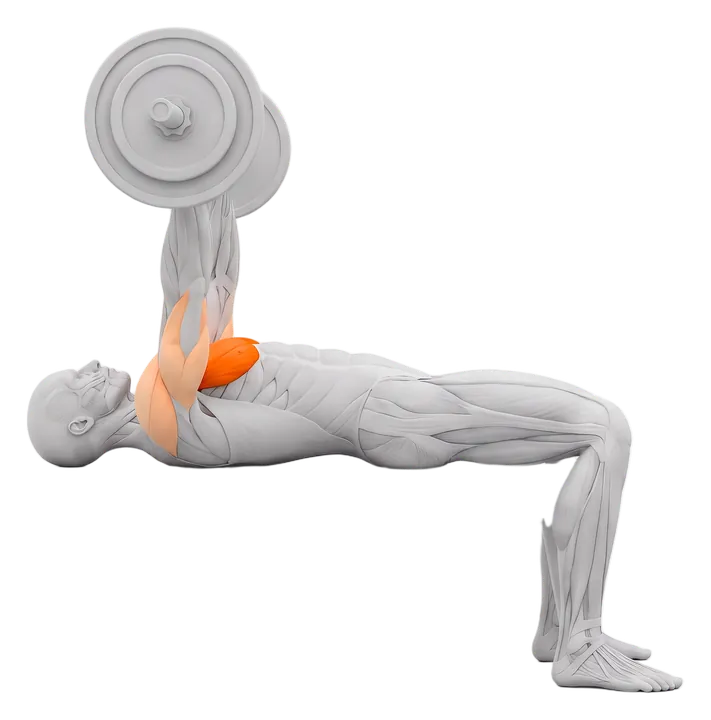 Barbell bench pressChestGuide
 Barbell deadliftGlutes and hamstringsGuide
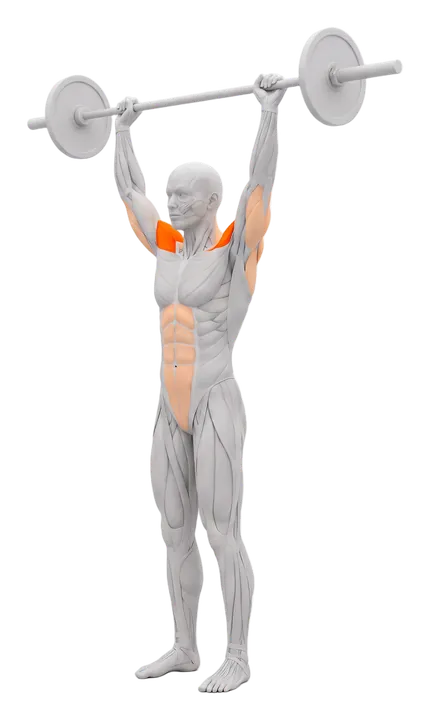 Barbell overhead pressFront deltsGuide
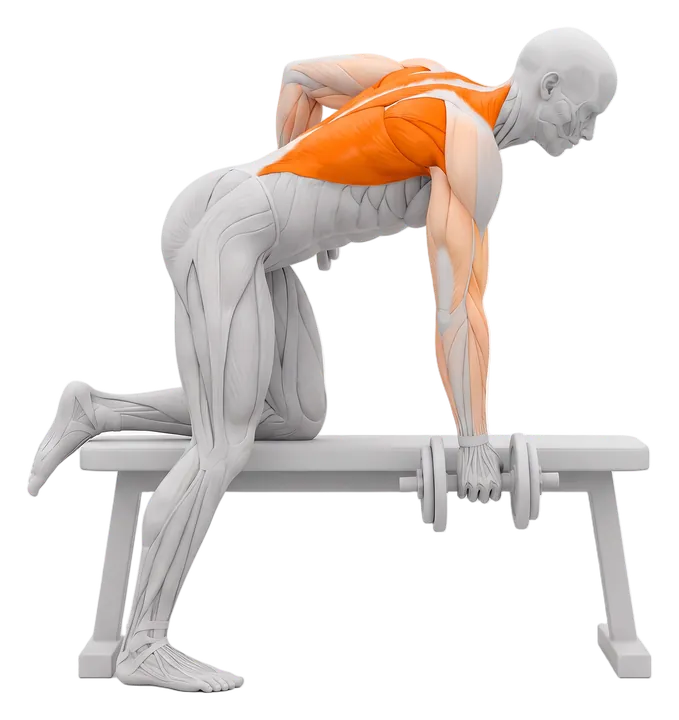 One-arm dumbbell rowLats and upper back
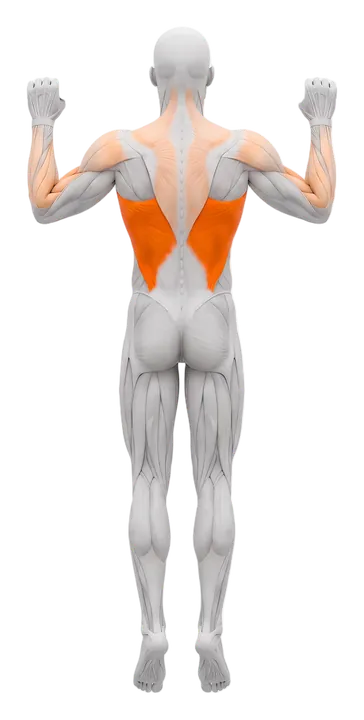 Pull-upLatsGuide
 Parallel bar dipChest and triceps
 Hanging knee raiseAbs