How much can the average man or woman bench?
Ask how much the average man can bench and you will find numbers everywhere, usually without a source. The honest answer is that nobody has tested a bench press max in a representative sample of the whole population, and most people never bench at all. Numbers online mostly come from lifters who log their lifts, which skews them towards people who already train.
A more useful question is how your bench compares with other people who train, at your bodyweight and age. Gripp's model describes regular gym-goers with at least a few months of training. In that group the median man benches about his bodyweight and the median woman about 60 % of hers, at age 18 to 35. Someone who has never trained will usually start well below that.
How Gripp's bench press standards work
Each level is a percentile band of the modelled spread of bench press maxes among gym-goers. Novice starts at the 25th percentile, Intermediate at the median, Advanced at the 80th percentile and Elite at the 95th, so Intermediate means you bench more than half of the people who train.
| Level | Percentile of gym-goers | Men | Women |
|---|---|---|---|
| Beginner | Bottom 25 % | under 0.85 × BW | under 0.50 × BW |
| Novice | 25th to 50th percentile | 0.85 × BW | 0.50 × BW |
| Intermediate | 50th to 80th percentile | 1.00 × BW | 0.60 × BW |
| Advanced | 80th to 95th percentile | 1.23 × BW | 0.76 × BW |
| Elite | Top 5 % | 1.50 × BW | 0.95 × BW |
The median is anchored on general-population bench norms from the Cooper Institute and a study of experienced recreational lifters. The Elite line sits a little below the median drug-tested competitive powerlifter, so the top 5 % of gym-goers is roughly where competition starts.
Do not know your max? Put a recent hard set into the bench press calculator and use the estimate. You do not need to test a true max to see where you stand.
Bench press standards for men by bodyweight
Find your bodyweight and read across. Values are the one rep max where each level starts, rounded to 2.5 kg (5 lb). Heavier lifters bench more in total but less per kilo of bodyweight, so the ratios shrink as bodyweight goes up.
| Bodyweight | Beginner | Novice | Intermediate | Advanced | Elite |
|---|---|---|---|---|---|
| 60 kg (130 lb) | Under 50 kg (110 lb) | 50 kg (110 lb) | 60 kg (130 lb) | 72.5 kg (160 lb) | 90 kg (200 lb) |
| 70 kg (155 lb) | Under 60 kg (130 lb) | 60 kg (130 lb) | 70 kg (155 lb) | 87.5 kg (195 lb) | 105 kg (230 lb) |
| 80 kg (175 lb) | Under 67.5 kg (150 lb) | 67.5 kg (150 lb) | 80 kg (175 lb) | 97.5 kg (215 lb) | 120 kg (265 lb) |
| 90 kg (200 lb) | Under 75 kg (165 lb) | 75 kg (165 lb) | 87.5 kg (195 lb) | 107.5 kg (235 lb) | 130 kg (285 lb) |
| 100 kg (220 lb) | Under 80 kg (175 lb) | 80 kg (175 lb) | 92.5 kg (205 lb) | 115 kg (255 lb) | 140 kg (310 lb) |
| 110 kg (245 lb) | Under 85 kg (185 lb) | 85 kg (185 lb) | 100 kg (220 lb) | 122.5 kg (270 lb) | 150 kg (330 lb) |
| 120 kg (265 lb) | Under 87.5 kg (195 lb) | 87.5 kg (195 lb) | 102.5 kg (225 lb) | 127.5 kg (280 lb) | 155 kg (340 lb) |
For most men who train, benching their bodyweight is the first big milestone: it is the median of gym-goers. About 1.25 times bodyweight is Advanced, and 1.5 times bodyweight is the Elite line, a bench most lifters never reach.
Bench press standards for women by bodyweight
Women carry relatively less of their muscle mass in the upper body, so bench standards for women sit lower relative to bodyweight than their squat standards or deadlift standards. Same rounding as above.
| Bodyweight | Beginner | Novice | Intermediate | Advanced | Elite |
|---|---|---|---|---|---|
| 50 kg (110 lb) | Under 27.5 kg (60 lb) | 27.5 kg (60 lb) | 32.5 kg (70 lb) | 40 kg (90 lb) | 50 kg (110 lb) |
| 60 kg (130 lb) | Under 30 kg (65 lb) | 30 kg (65 lb) | 35 kg (75 lb) | 45 kg (100 lb) | 57.5 kg (125 lb) |
| 70 kg (155 lb) | Under 32.5 kg (70 lb) | 32.5 kg (70 lb) | 40 kg (90 lb) | 50 kg (110 lb) | 62.5 kg (140 lb) |
| 80 kg (175 lb) | Under 35 kg (75 lb) | 35 kg (75 lb) | 42.5 kg (95 lb) | 52.5 kg (115 lb) | 65 kg (145 lb) |
| 90 kg (200 lb) | Under 35 kg (75 lb) | 35 kg (75 lb) | 40 kg (90 lb) | 52.5 kg (115 lb) | 65 kg (145 lb) |
A standard Olympic barbell weighs 20 kg (45 lb), which is below the Beginner line for most women but can still feel heavy in the first sessions. If it does, start with dumbbells or a lighter 10 to 15 kg bar and you will usually outgrow it within weeks.
Average bench press by age
Gripp adjusts the levels for age using the ratio between age-group and young-adult medians in powerlifting data. Up to 35 nothing changes. The bench press holds up well into the 40s and 50s in that data, and the decline speeds up after 60.
| Age | Novice | Intermediate | Advanced |
|---|---|---|---|
| 18 to 35 | 67.5 kg (150 lb) | 80 kg (175 lb) | 97.5 kg (215 lb) |
| 40 | 67.5 kg (150 lb) | 77.5 kg (170 lb) | 97.5 kg (215 lb) |
| 50 | 65 kg (145 lb) | 75 kg (165 lb) | 92.5 kg (205 lb) |
| 60 | 60 kg (130 lb) | 70 kg (155 lb) | 85 kg (185 lb) |
| 70 | 52.5 kg (115 lb) | 62.5 kg (140 lb) | 77.5 kg (170 lb) |
| Age | Novice | Intermediate | Advanced |
|---|---|---|---|
| 18 to 35 | 30 kg (65 lb) | 35 kg (75 lb) | 45 kg (100 lb) |
| 40 | 30 kg (65 lb) | 35 kg (75 lb) | 45 kg (100 lb) |
| 50 | 27.5 kg (60 lb) | 32.5 kg (70 lb) | 42.5 kg (95 lb) |
| 60 | 25 kg (55 lb) | 30 kg (65 lb) | 37.5 kg (85 lb) |
| 70 | 22.5 kg (50 lb) | 27.5 kg (60 lb) | 35 kg (75 lb) |
Values between age bands are interpolated, and they assume gym-goers age like competitive lifters. Treat them as a fair comparison with people your own age, and compare yourself with your own numbers from last year too.
See where you stand with Gripp
Gripp is coming to iPhone. It rates your strength per muscle group against people of your age and bodyweight, based on the sets you log. Your chest score moves as your bench does, next to your back, legs and the rest.
Join the waitlistIs a 225 bench press good?
225 lb (about 102 kg) is a 45 lb bar with two 45 lb plates on each side, and it is a classic milestone. In a kg gym the closest equivalent is 100 kg: a 20 kg bar with two 20 kg plates on each side. It is also the weight used in the NFL Combine bench test, where players do as many reps as they can at 225 lb.
For a man who weighs 80 kg (175 lb), 225 lb is about 1.3 times bodyweight: in the Advanced band of Gripp's model, ahead of roughly four out of five gym-goers. For a 100 kg (220 lb) man it is a solid Intermediate bench, a little above the median. Either way, it is a number most men who never train cannot lift.
Good bench press form, so your number counts
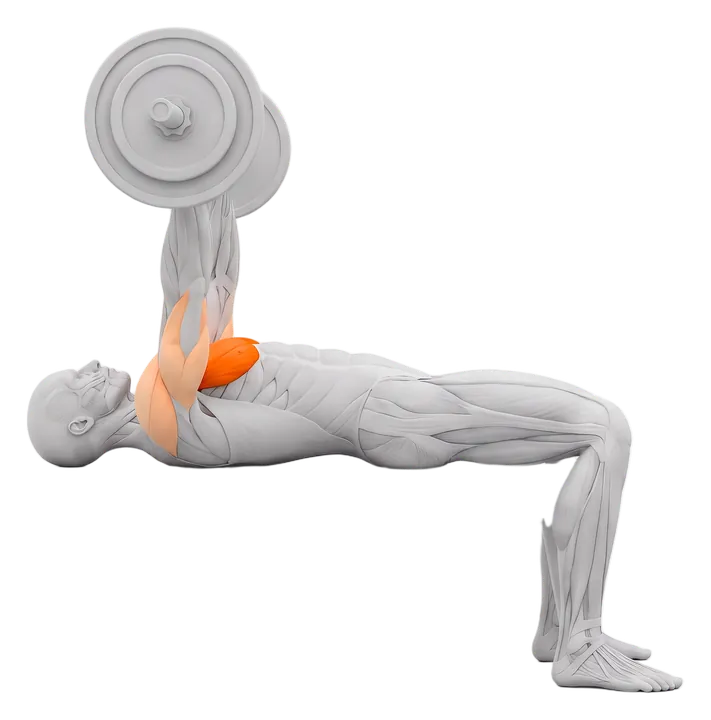
The standards assume a full rep: bar to chest, hips on the bench, elbows locked out. Compare yourself using reps like these:
- Lie with your eyes under the bar, feet flat on the floor and shoulder blades pulled back and down.
- Grip the bar a little wider than shoulder width, wrists stacked over your elbows.
- Lower the bar under control to your lower chest, elbows at roughly 45 to 70 degrees from your body.
- Touch the chest without bouncing, then press up and slightly back until your elbows lock.
- Keep your hips on the bench and your feet on the floor for the whole rep.
The bench press guide covers setup, cues and common mistakes in more detail.
How to raise your bench press
- Bench two times a weekFrequent practice builds technique and strength faster than one hard chest day. A split that benches twice a week, like an upper lower split, makes it easy.
- Work in the 3 to 8 rep range3 to 5 sets of 3 to 8 reps with 2 to 3 minutes rest builds strength, with lighter pressing and triceps work for muscle.
- Add weight in small stepsWhen you hit all your reps, add 1 to 2.5 kg (2.5 to 5 lb). That is progressive overload, and the bench responds best to small, steady jumps.
- Change the plan when you stallOnce adding weight every week stops working, a program such as 5/3/1 keeps the bench moving over months.
If the bench causes shoulder pain that does not settle, see a physiotherapist or doctor before pushing on.
The levels are Gripp's own estimates for regular gym-goers. They build on the Cooper Institute bench press norms, Falch et al. (2023) and normative data from van den Hoek et al. (2024), "Normative data for the squat, bench press and deadlift exercises in powerlifting", J Sci Med Sport 27(10):734-742, licensed under CC BY 4.0. Gripp converted the data into age and bodyweight factors. The levels are indicative and may change.