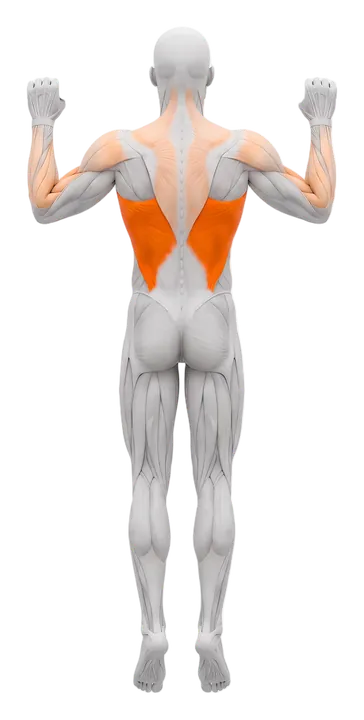
What muscles do pull-ups work?
| Muscle | Role | How much |
|---|---|---|
| Latissimus dorsi (lats) | Pull the upper arm down and back | Primary |
| Upper back (rhomboids, mid traps) | Pull the shoulder blades together and down | Secondary |
| Biceps and brachialis | Bend the elbow | Secondary |
| Rear delts | Help pull the arm back | Secondary |
| Forearms and grip | Hold you on the bar | Secondary |
| Abs | Keep the body from swinging | Stabiliser |
The pull-up is one of the best upper body pulls for lat width and upper back strength, and it sits near the top of most lists of back exercises. It also gives your biceps real work, especially with an underhand grip.
How to do a pull up
- Grip the barOverhand grip, hands a little wider than shoulder width. Wrap your thumbs around the bar.
- Dead hangHang with straight arms, legs together or crossed behind you, ribs pulled down. Squeeze your glutes to stop the swing.
- Set the shouldersPull your shoulders down away from your ears without bending your elbows. This small movement is a scapular pull-up, and it starts every good rep.
- PullDrive your elbows down towards your back pockets. Aim your chest at the bar, not your chin.
- Clear the barFinish when your chin is over the bar. Do not crane your neck to get there.
- Lower all the wayLower under control for about 2 seconds until your arms are straight again. A full hang between reps is what makes it a full pull-up.
Pull-up form cues and mistakes
- "Elbows to pockets." Thinking about the elbows, not the hands, gets the lats to do the work.
- "Hollow body." Ribs down, legs slightly in front. A big arch or kipping swing turns it into a different exercise.
- Half reps. Stopping short of a straight arm hang or of chin over bar. Count only full reps, and your progress will be real.
- Shrugging up. Shoulders up by your ears at the bottom puts strain on the shoulder. Set them first.
- Dropping down. Falling into the bottom wastes the lowering, which is valuable strength work, especially while you are still building up to more reps.
From 0 to 1: how to get your first pull-up
If you cannot do a single pull-up, train the parts of it you can do. Use three tools, in this order of priority, two to three times a week.
1. Negative pull-ups
Jump or step up so your chin is over the bar, then lower yourself as slowly as you can, aiming for 3 to 5 seconds. Do 3 to 4 sets of 3 to 5 negatives. When you can control a 5 second lowering for every rep, try a full pull-up at the start of your next session.
2. Band assisted pull-ups
Loop a resistance band over the bar and put one knee or foot in it. The band helps most at the bottom, where the pull-up is hardest. Work for 3 sets of 5 to 8, and switch to a thinner band when you can do 8 clean reps. An assisted pull-up machine with a counterweight does the same job and makes it easy to track the assistance in kilos.
3. Lat pulldown
The lat pulldown trains the same pattern with a weight you can choose. It does not replace practising on the bar, but it builds the lats and lets you train in higher rep ranges. Work for 3 sets of 8 to 12 with the same grip you use on the bar.
From 1 to 10 pull-ups
Once you have one rep, the goal is more total reps per session without grinding to failure every set. A simple approach that works for many lifters is to spread reps over many sets.
| Your max | Workout | Rest | Move on when |
|---|---|---|---|
| 1 to 2 reps | 6 to 8 sets of 1, plus 2 sets of negatives | 90 s | You can do 3 in one set |
| 3 to 5 reps | 5 sets of half your max | 2 min | All sets feel easy, then add a rep |
| 6 to 8 reps | 4 sets of 4 to 6 | 2 min | You reach 6 on every set |
| 9 to 10 reps | 3 sets of 6 to 8, one heavier day with a light weight | 2 to 3 min | You can do 10 in a set |
Keep one rep or two in reserve on most sets. Test your max every three to four weeks, not every session. If your reps stall for several weeks, add one session of band assisted reps for volume, or a few sets of lat pulldowns.
Pull-up vs chin-up
The only difference is the grip. A pull-up uses an overhand grip, palms facing away. A chin-up uses an underhand grip, palms facing you, usually a bit narrower. The chin-up puts the biceps in a stronger position, so most people can do a few more chin-ups than pull-ups.
| Pull-up | Chin-up | |
|---|---|---|
| Grip | Overhand, palms away | Underhand, palms toward you |
| Hand width | Shoulder width or wider | Shoulder width or a little narrower |
| Biceps involvement | Moderate | Higher |
| Difficulty | Harder for most | Easier for most |
| Best for | Lats and upper back | Lats plus biceps |
Both train the lats well. If you have a weaker shoulder or elbow, use the one that feels better. Chin-ups also fit well into a bicep workout as a heavy compound opener.
Pull-up grips and variations
- Wide grip pull-up: hands well outside the shoulders. Shorter range of motion and often harder; many people feel it more in the upper lats. Do not go so wide that your shoulders hurt.
- Neutral grip pull-up: palms facing each other on parallel handles. Often the most comfortable for the shoulders and elbows, and a good middle ground between pull-up and chin-up.
- Scapular pull-up: hang and pull only your shoulder blades down, without bending the elbows. A warm up and a beginner drill.
- Weighted pull-up: add a weight belt, a vest or a dumbbell between your feet once you can do about 10 to 12 clean reps.
- Door frame pull-up bar: a good home option if it is mounted securely. Test it carefully before you hang your full weight.
Pull-up sets and reps
| Goal | Sets x reps | Rest | Notes |
|---|---|---|---|
| First pull-up | 3 to 4 x 3 to 5 negatives | 90 s | 2 to 3 times a week |
| Strength | 3 to 5 x 3 to 6 | 2 to 3 min | Weighted once you pass 10 reps |
| Muscle growth | 3 to 4 x 6 to 12 | 90 s to 2 min | Band assist to reach the rep range |
| Endurance | 3 x max minus 1 or 2 | 2 min | Stop before form breaks |
On a full body workout plan, pull-ups fit as the main pull on two or three days a week. Once bodyweight reps are easy, add load and track it like any other lift; the 1RM calculator works for weighted pull-ups too if you count bodyweight plus the added weight.
Gripp counts every rep on the way to ten
Gripp is coming to iPhone. Log your pull-ups, negatives or band assisted reps, and Gripp tells you what to aim for next session. When you hit the top of your rep range, it moves you on, first more reps, then added weight, and shows your progress on a chart.
Join the waitlistPull-up alternatives
- Lat pulldown: the same movement on a cable machine with adjustable weight.
- Assisted pull-up machine: counterweight makes the bar work possible at any level.
- Inverted row: a horizontal pull under a bar or table, easier than a pull-up.
- Single arm dumbbell row: heavy upper back and lat work with one dumbbell.
- Straight arm cable pulldown: isolates the lats without the biceps.
Similar exercises
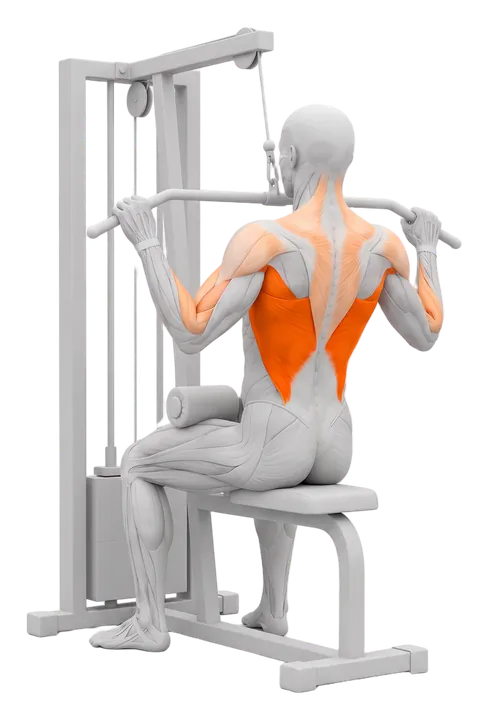 Lat pulldownLatsGuide
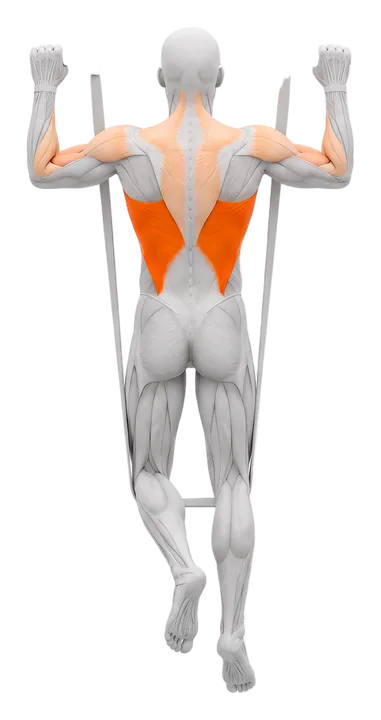 Band-assisted pull-upLats
 Chin-upLats and biceps
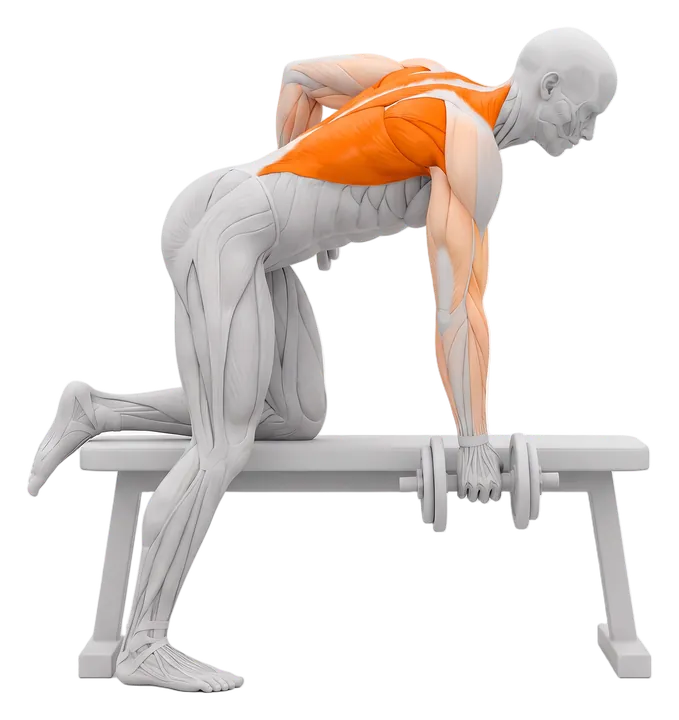 One-arm dumbbell rowLats and upper back