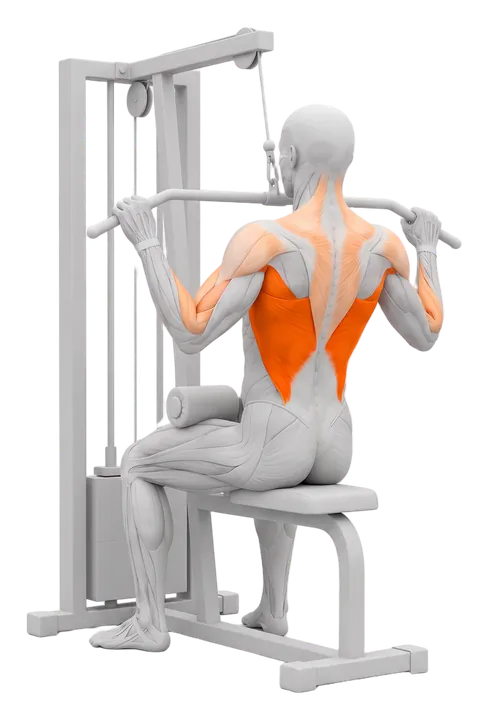
Lat pulldown muscles worked
| Muscle | Role | How much |
|---|---|---|
| Latissimus dorsi (lats) | Pull the upper arm down and back | Primary |
| Teres major | Works with the lats | Primary |
| Biceps and brachialis | Bend the elbow | Secondary, more with underhand grip |
| Rhomboids and lower traps | Pull the shoulder blades down and together | Secondary |
| Rear delts | Help pull the arm back | Secondary |
| Forearms | Grip the bar | Stabiliser |
Lat pulldowns help build a wider looking back and stronger pulling for pull-ups, rows and even the lockout of a deadlift. On a push pull legs split they are a staple of pull day.
How to do a lat pulldown
- Set the thigh padAdjust the pad so it presses firmly on your thighs with your feet flat on the floor. It stops you from being lifted off the seat on heavy sets.
- Grab the barStand up, take the bar with an overhand grip a little wider than shoulder width, then sit down and slide your knees under the pad. Your arms should be straight with a stretch in the lats.
- Set your shouldersLean back slightly, about 10 to 20 degrees, and lift your chest. Start each rep by pulling your shoulders down away from your ears.
- Pull to the upper chestDrive your elbows down towards your back pockets. Bring the bar to around your collarbone or upper chest, keeping your torso angle steady.
- Return slowlyLet the bar go back up over 2 to 3 seconds until your arms are straight and your shoulders rise a little into the stretch. Then start the next rep.
Lat pulldown form cues
- "Elbows to your pockets." Thinking about the elbows, not the hands, keeps the work in the lats instead of the biceps.
- "Hands are hooks." A relaxed but firm grip, thumbs around or alongside the bar, reduces forearm takeover.
- "Chest to the bar." Lift the chest to meet the bar instead of leaning far back to meet it.
- "Full stretch at the top." Straight arms on every rep give the lats a full range of motion.
- "Same torso angle every rep." If you have to swing back to move the weight, it is too heavy.
Common lat pulldown mistakes
- Leaning far back. A big lean turns the pulldown into a row and lets momentum do the work. Keep it to a slight lean.
- Pulling behind the neck. It puts the shoulders in an awkward position and gives no extra benefit for most people. Pull to the front.
- Shrugging up during the pull. The shoulders should go down as the bar comes down.
- Cutting the top short. Stopping with bent arms skips the stretched part of the movement.
- Letting the stack slam. Dropping the weight on the way up wastes half of every rep.
Lat pulldown grips: wide, close, neutral or underhand
All grips train the lats. The differences are smaller than gym talk suggests, so pick the grips that feel best on your shoulders and elbows and that let you pull the most weight with good form. Rotating two grips over a training block is a good approach.
| Grip | Attachment | What changes | Good for |
|---|---|---|---|
| Wide grip | Long bar, hands 1.5 times shoulder width | Shorter range, a little more upper back | The classic pulldown, builds towards wide grip pull-ups |
| Medium overhand | Long bar, just outside the shoulders | Good balance of range and load | The default for most people |
| Close grip | V bar or close handles | Longer range, more lower lats feel | Heavy loading, people with sensitive shoulders |
| Neutral grip | Palms facing each other, V bar or wide neutral bar | Shoulder friendly, strong position | Most people can pull the most weight here |
| Underhand (reverse grip) | Long bar, palms facing you, shoulder width | More biceps, arms close to the body | Builds towards chin-ups, extra arm work |
Wide grip lat pulldown
Do not go so wide that your elbows can no longer move down and in. Roughly where the bar starts to bend is wide enough for most people. Wide grip has the shortest range, so you can often use a little more weight, but control the top of every rep.
Close grip and neutral grip lat pulldown
With a V bar the hands sit close together with palms facing each other. Lean back slightly and pull the handle to your sternum, letting the elbows travel close to your sides. Many lifters find a neutral grip the most comfortable on the shoulders. A wide neutral bar, where available, combines a neutral wrist with a wider hand position.
Underhand lat pulldown
Take a shoulder width grip with palms facing you. Pull the bar to your upper chest and keep the elbows in front of your body. Because the biceps are in a stronger position, many people feel strong in this grip, but it also tires the arms faster on pull day, so do your bicep curls after it.
Straight arm and single arm lat pulldown
Straight arm lat pulldown
Stand facing a high cable with a straight bar or rope. Hinge forward slightly, keep the arms almost straight, and sweep the bar down in an arc until it reaches your thighs. Because the elbows do not bend, the biceps are taken out and the lats do nearly all the work. Use moderate weights and 10 to 15 reps; it is an isolation exercise, often done after the main pulldown or as a warm up to feel the lats.
Single arm lat pulldown
Use a single D handle on a high cable, kneeling or seated. Pull the elbow down towards your hip, with your hand ending next to your shoulder or a little lower. Working one arm at a time allows a longer range and a deeper stretch at the top, and it helps you even out a weaker side. Keep the torso still and avoid twisting to finish the rep.
Lat pulldown variations
| Variation | What changes | Good for |
|---|---|---|
| Machine pulldown (plate or stack) | Fixed handles that move in an arc | Easy setup, steady path |
| Kneeling cable pulldown | Kneel in front of a cable tower | No pulldown station needed |
| Standing lat pulldown | Standing at a high cable, slight hinge | Gyms without a seat, light work |
| Banded pulldown | Resistance band anchored overhead | Home training, higher reps |
| Partial range pulldown | Only the top half of the rep | Advanced: extra work in the stretch |
Sets and reps for the lat pulldown
| Goal | Sets x reps | Rest | Notes |
|---|---|---|---|
| Strength | 3 to 4 x 6 to 8 | 2 min | Neutral or medium grip, strict form |
| Muscle growth | 3 to 4 x 8 to 12 | 90 s | 1 to 2 reps short of failure |
| Straight arm pulldown | 2 to 3 x 12 to 15 | 60 s | Slow and controlled, feel the lats |
| Working towards pull-ups | 3 x 6 to 10 | 90 s to 2 min | Add weight until you can pull close to your bodyweight |
A typical range is 10 to 20 hard sets of back exercises per week, counting rows and pull-ups, spread over two or more sessions. The lat pulldown usually goes in after a row or pull-up on a pull or upper body day. See the upper lower split and push pull legs for complete templates.
How to progress the lat pulldown
The weight stack often jumps in big steps of 5 to 7 kg (10 to 15 lb), which can make progress hard. Work in a rep range such as 8 to 12 and only move up a plate when you hit the top of the range in every set. If your gym has small add-on weights, use them. This is progressive overload in practice.
Different machines have different cables and pulleys, so 60 kg on one pulldown is not the same as 60 kg on another. Track your numbers on the same machine to compare fairly.
Gripp remembers your last pulldown so you do not have to
Log the weight and reps and Gripp tells you what to lift next session: last time 8 reps at 55 kg, today go for 9. Hit your reps in every set and the weight goes up. Your estimated max for each exercise is shown on a progress chart, with a muscle map on every exercise page.
Join the waitlistLat pulldown alternatives
- Pull-up or chin-up: the bodyweight version. Use a band or an assisted machine if you cannot do full reps yet.
- Dumbbell pullover: a lat focused movement with dumbbells, useful at home, similar to the straight arm pulldown.
- Dumbbell or cable row: a horizontal pull that also trains the lats, with more upper back.
- Banded pulldown: a band anchored over a door or a bar, good for home training.
- Inverted row: under a bar or rings, an easy bodyweight pulling option.
Similar exercises
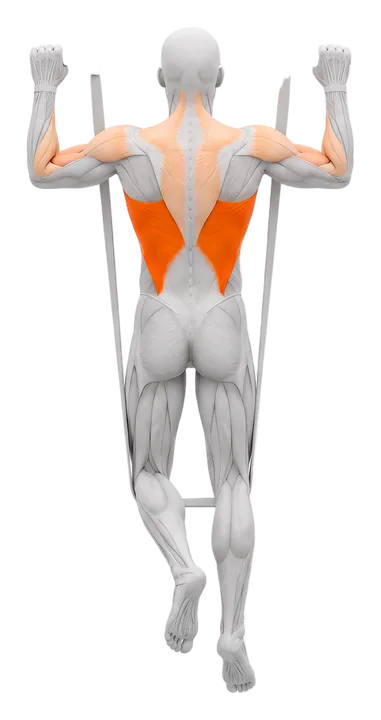 Band-assisted pull-upLats
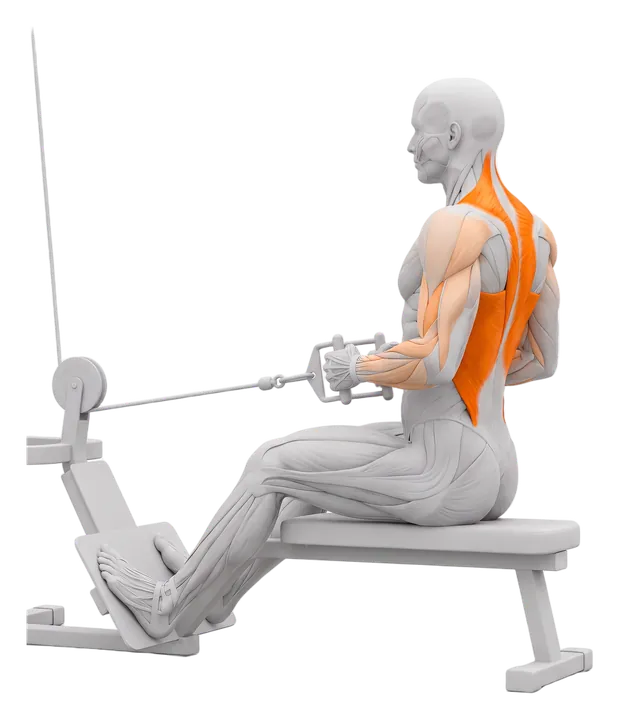 Seated cable rowUpper back and lats
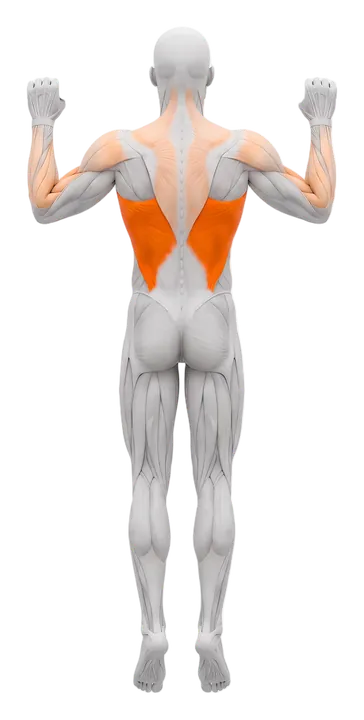 Pull-upLatsGuide
 Chin-upLats and biceps
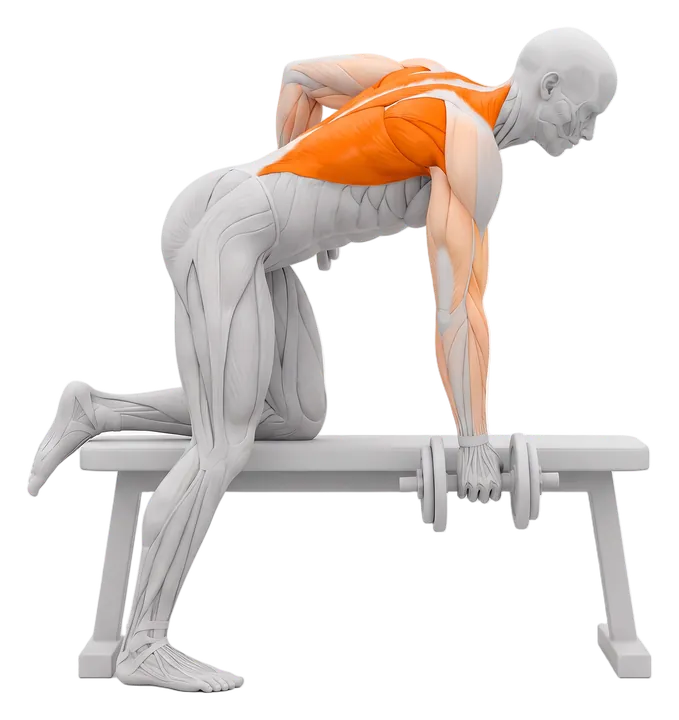 One-arm dumbbell rowLats and upper back