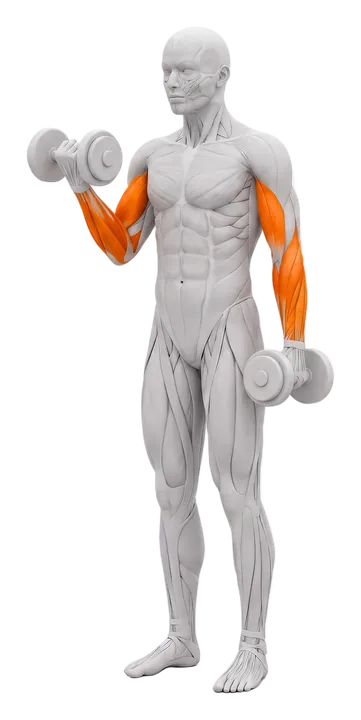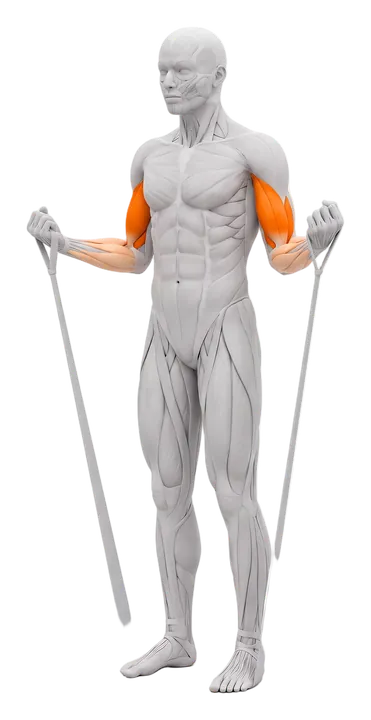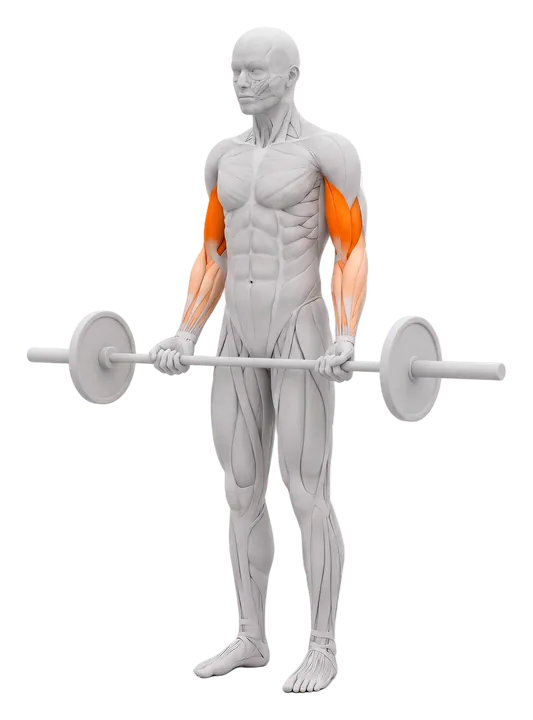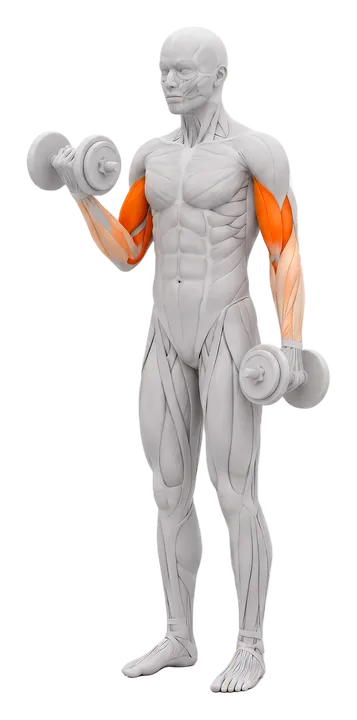
Muscles worked in the bicep curl
| Muscle | Role | How much |
|---|---|---|
| Biceps brachii | Bends the elbow and turns the palm up | Primary |
| Brachialis | Bends the elbow in every grip | Secondary |
| Brachioradialis | Helps bend the elbow, more with thumbs up | Secondary |
| Forearm flexors | Hold the weight and keep the wrist straight | Stabiliser |
| Front delts | Hold the upper arm in place | Stabiliser |
The biceps has two jobs: bending the elbow and rotating the forearm so the palm faces up. A curl that does both, like the dumbbell curl with a twist, trains the muscle through its full function. It is the main isolation exercise in nearly every bicep workout.
How to do a dumbbell bicep curl
- Start positionStand tall with a dumbbell in each hand, arms straight, palms facing your thighs or already facing forward.
- Lock the upper armElbows at your sides, shoulders down and back. Only the forearm moves from here.
- Curl and turnBend the elbow and, if you started with a neutral grip, rotate the palm up as the dumbbell passes your hip. Lead with the little finger side of the hand at the top.
- SqueezeStop when the dumbbell is near shoulder height. Squeeze the biceps for a second without letting the elbow drift forward.
- Lower in 2 to 3 secondsLower until the arm is fully straight. The slow lowering is half of the exercise.
Supination: why the twist matters
Because the biceps also rotates the forearm, it works hardest when the palm faces up. Starting with the thumbs forward and turning the palms up during the lift makes the biceps do both of its jobs. At the top, some lifters turn the little finger slightly higher than the thumb for an extra squeeze.
A supinated bicep curl (palms up the whole time) works well too. A palms down curl is the reverse bicep curl, and a thumbs up curl is the hammer curl. Both shift work away from the biceps towards the forearm and brachialis.
Bicep curl form mistakes, and when cheating is OK
- Swinging the weight up. If your hips and lower back start the movement, the weight is too heavy.
- Elbows moving forward. At the top, the front delts take over. Keep the elbows by your ribs.
- Cutting the bottom short. Full arm extension each rep, otherwise you lose a big part of the range.
- Dropping the weight. Lowering in half a second throws away the eccentric half of every rep, which is a big part of the training effect.
- Bent wrists. Keep the wrist straight, in line with the forearm.
Cheat curls: a little body English on the last one or two reps of a hard set is a known technique to push past the point where strict reps stop. The rules: only at the end of a set, only a small push from the hips, and always a slow, controlled lowering. If every rep is a cheat rep, go lighter.
Bicep curl variations
| Variation | What is different | Good for |
|---|---|---|
| Dumbbell curl | Each arm works on its own, free wrist rotation | The default; fixing a weaker arm |
| Incline bicep curl | Seated on a 45 to 60 degree incline bench, arms hang behind you | Long stretch on the biceps |
| Cable bicep curl | Constant tension from a low pulley | Tension at the bottom, easy drop sets |
| Barbell bicep curl | Both hands on a straight bar | Heaviest loads |
| EZ bar bicep curl | Angled grip on a curl bar | Heavy curls with less wrist strain |
| Zottman curl | Palms up on the way up, palms down on the way down | Biceps and forearms in one move |
| Seated curl | Sitting on a bench | Strict reps, no hip swing |
| Preacher curl | Upper arm braced on a pad | Strict reps, stretch at the bottom |
| 21s | 7 bottom half reps, 7 top half reps, 7 full reps | A finisher, light weight |
Incline bicep curl
Sit back on an incline bench set to 45 to 60 degrees and let your arms hang straight down behind your torso. The biceps start in a stretched position, so each rep is harder at the bottom. Expect to use noticeably lighter dumbbells than in a standing curl and keep the shoulders pinned to the bench.
Cable bicep curl
Use a straight bar, EZ handle, rope or single handle on a low pulley. Step back so the cable pulls slightly forward at the bottom. A single arm cable curl with the pulley behind you gives a stretch similar to the incline curl. A high cable curl, arms out to the sides at shoulder height, works the biceps in a shortened position.
Barbell and EZ bar curl
With both hands on one bar, you can lift more weight, which makes progress easy to track. A straight bar forces a full palms up grip, which some wrists dislike; the angled grip of an EZ curl bar is the usual fix. A standard straight barbell typically weighs 20 kg (45 lb), and EZ bars are often around 7 to 12 kg (15 to 25 lb), but check your gym's bars, as they vary.
Zottman curl
Curl the dumbbells up with palms facing up, turn the palms down at the top, then lower slowly with an overhand grip. The lowering trains the forearm and brachioradialis, the lifting trains the biceps. Use a weight you can lower with a palms down grip, which is lighter than your normal curl weight.
Bicep curl sets, reps and rep ranges
| Goal | Sets x reps | Rest | Notes |
|---|---|---|---|
| Muscle growth | 3 to 4 x 8 to 12 | 60 to 90 s | 1 to 2 reps short of failure |
| Muscle growth, light | 2 to 3 x 15 to 20 | 60 s | Cables or incline curls, close to failure |
| Strength | 3 x 6 to 8 | 90 s to 2 min | Barbell or EZ bar |
| Beginner | 2 to 3 x 10 to 12 | 60 to 90 s | Strict form first |
Biceps grow across a wide rep range as long as sets are taken close to failure, so pick a range you can do with good form. Higher reps are kinder to the elbows. For most people, 4 to 12 hard sets of direct biceps work a week is plenty on top of rows and pull-ups, which also train the biceps.
Progress in small steps. A 1 to 2 kg (2.5 to 5 lb) jump per dumbbell is a lot on a curl, so add reps first and only increase weight when you reach the top of your range on every set. Our guide to progressive overload covers this in detail, and you can place curls after your main lifts in a full body workout or on a pull day.
Gripp knows when you are ready for a heavier dumbbell
Gripp is coming to iPhone. Log your curls and Gripp tells you what to lift next time: hit your reps in every set and the weight goes up. It keeps an estimated 1RM for each curl variation on a progress chart and rates your arm strength against people of your age and bodyweight.
Join the waitlistBicep curl alternatives
- Hammer curl: neutral grip, more brachialis and forearm.
- Chin-up: a heavy compound pull with a lot of biceps work.
- Band curl: for home training or for elbows that dislike heavy loads.
- Spider curl: chest on an incline bench, arms hanging down, strict reps.
- Concentration curl: seated, elbow on the inside of your thigh, one arm at a time.