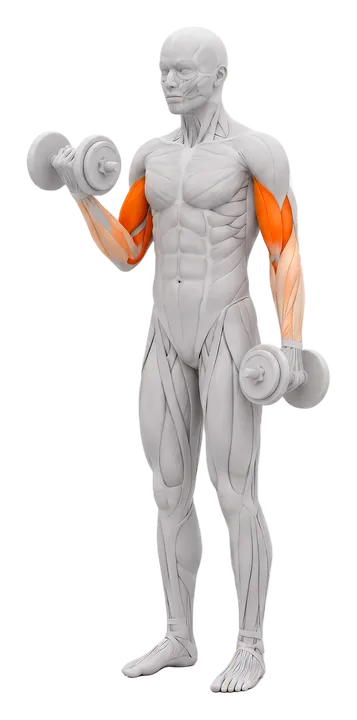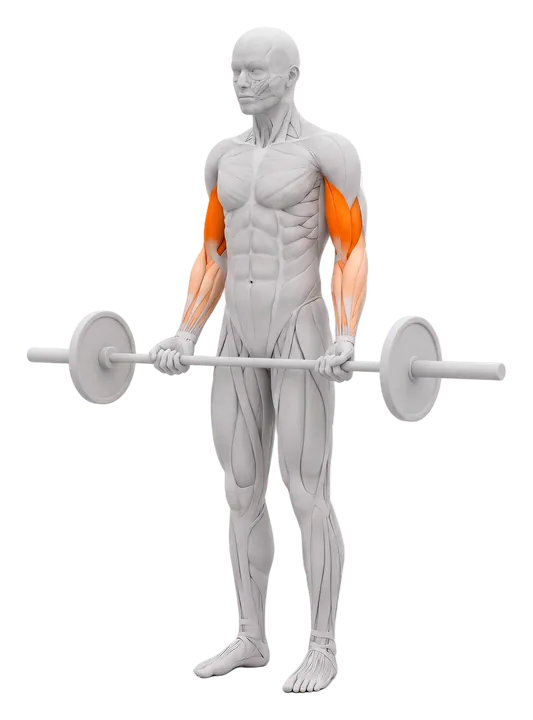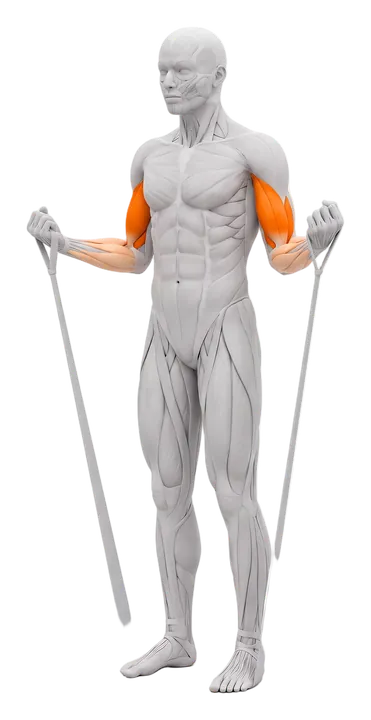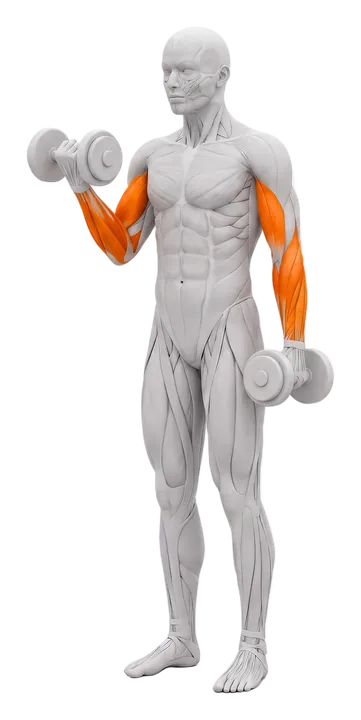
Hammer curl muscles worked
| Muscle | Where it is | Role in the hammer curl |
|---|---|---|
| Brachialis | Under the biceps, on the lower half of the upper arm | Main elbow flexor, works no matter how you turn your hand |
| Brachioradialis | Top of the forearm, near the elbow | Strongest in a neutral grip, does much more than in a regular curl |
| Biceps brachii | Front of the upper arm | Still bends the elbow, a little less than in a supinated curl |
| Wrist and finger flexors | Inside of the forearm | Hold the dumbbell |
The brachialis sits under the biceps. As it grows, it pushes the biceps up and adds width to the arm seen from the side. The brachioradialis is the muscle that makes the top of the forearm look thick. That is why many people pair hammer curls with a regular bicep curl in the same bicep workout.
How to do a hammer curl
- Stand tallFeet hip width, a dumbbell in each hand at your sides, palms facing your thighs.
- Pin the elbowsKeep your upper arms against your sides and slightly in front of the body. They stay there for the whole set.
- CurlBend the elbows and lift the dumbbells with the thumbs pointing up. Do not turn the wrists.
- Squeeze at the topStop when the dumbbells are near your shoulders and your forearms are close to vertical. Hold for a moment.
- Lower slowlyTake 2 to 3 seconds to lower until your arms are straight. Curl both arms at once or alternate.
Hammer curl form cues and mistakes
- "Thumbs to the ceiling." A neutral grip from start to finish. If the palms start turning up, it becomes a regular curl.
- "Elbows stay at your ribs." Elbows drifting forward let the front delts take over.
- Swinging the body. A small lean on the last rep is fine; using the hips to throw the weight up on every rep is not. Go lighter.
- Loose wrists. Keep the wrist straight in line with the forearm, not bent back.
- Short reps at the bottom. Straighten the arm fully each rep, so the elbow flexors work through their whole range instead of only the easy middle part.
Hammer curl vs bicep curl
The difference between a hammer curl and a bicep curl is the hand position. In a regular bicep curl the palms face up (supinated), which puts the biceps in its strongest position. In the hammer curl the palms face each other (neutral), which takes some work off the biceps and gives it to the brachialis and brachioradialis. Most people can lift a little more in a hammer curl.
| Bicep curl | Hammer curl | |
|---|---|---|
| Grip | Palms up (supinated) | Palms facing in (neutral) |
| Biceps work | Higher | Moderate |
| Brachialis and brachioradialis | Moderate | Higher |
| Forearm and grip training | Some | More |
| Load | Usually a bit lighter | Usually a bit heavier |
| Wrist and elbow comfort | Can bother some people | Often more comfortable |
Which is better? Neither, they complement each other. If your goal is bigger arms, do both: a supinated curl for the biceps peak and a hammer curl for thickness and forearms. If supinated curls bother your wrists or elbows, the hammer curl is a good main curl on its own.
Hammer curl variations
Cross body hammer curl
Curl one dumbbell up and across your body towards the opposite shoulder, thumb up. The angle is comfortable for many people and is often said to bias the brachialis a little more. Do one arm at a time and keep the upper arm still.
Rope cable hammer curl
Attach a rope to a low cable pulley and curl it with a neutral grip, pulling the rope ends slightly apart at the top. The cable keeps tension on the muscle at the bottom of the rep, where a dumbbell is easiest. It is also easy to do drop sets by moving the pin.
Other versions
- Seated hammer curl: sitting on a bench stops you from using your hips.
- Preacher hammer curl: arm braced on a pad, strict reps with a stretch at the bottom.
- Incline hammer curl: lying back on an incline bench, arms hang behind the body for a longer stretch.
- Hammer curl with a neutral grip bar: both hands on a swiss bar or football bar, heavier loading.
Hammer curl sets and reps
| Goal | Sets x reps | Rest | Notes |
|---|---|---|---|
| Arm size | 3 to 4 x 8 to 12 | 60 to 90 s | 1 to 2 reps short of failure |
| Forearms and grip | 2 to 3 x 12 to 15 | 60 s | Slow lowering, full stretch |
| Strength | 3 x 6 to 10 | 90 s | Strict, no swing |
| Beginner | 2 to 3 x 10 to 12 | 60 to 90 s | Learn to keep the elbows still |
How many sets of hammer curls should you do? For most people, 2 to 4 sets once or twice a week is enough, on top of rows and pull-ups that already train the arms. Do them after your main pulling exercises, such as the pull-up or lat pulldown, so your grip is not tired before the big lifts.
Progress by adding reps first, then going up one dumbbell size when you reach the top of the range in every set. Dumbbell jumps are big in relative terms for arm exercises, so expect to stay at a weight for a few weeks. See progressive overload for more ways to progress small exercises.
Gripp tracks small jumps on small lifts
Gripp is coming to iPhone. Log your hammer curls and Gripp tells you when to add reps and when to go up a dumbbell. Every exercise page shows a muscle map, and Gripp rates your arm strength against people of your age and bodyweight.
Join the waitlistHammer curl alternatives
- Reverse curl: palms down, an even stronger focus on the brachioradialis.
- Neutral grip pull-up or chin-up: a heavy compound that also trains the elbow flexors.
- Zottman curl: curl up with palms up, lower with palms down.
- Rope cable curl: the cable version of the hammer curl.
- Farmer's carry: walking with heavy dumbbells, for grip and forearms.