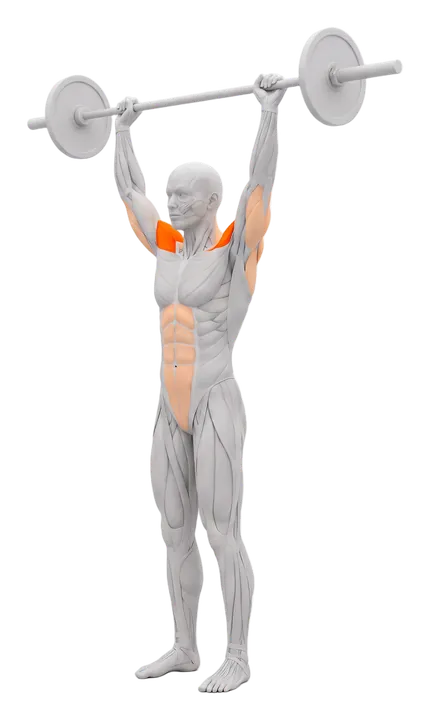
What muscles does the overhead press work?
| Muscle | Role | How much |
|---|---|---|
| Front delts | Lift the arms overhead, hardest off the shoulders | Primary |
| Triceps | Lock out the elbows, hardest near the top | Secondary |
| Side delts | Help raise the arms | Secondary |
| Upper traps and serratus anterior | Rotate the shoulder blades up and support the lockout | Secondary |
| Abs, obliques and lower back | Keep the torso upright and stop you leaning back | Stabiliser |
| Glutes and legs | Lock the base so force goes into the bar | Stabiliser |
What does the overhead press work that a shoulder machine does not? Standing up with a barbell, your trunk has to resist being bent backwards by the load. That makes the standing press a core exercise as much as a shoulder exercise, and it is why the number you can press is usually well below what you can lift on a seated machine.
How to do the overhead press
- Set the bar in the rackSet the hooks at about collarbone height, so you can unrack with a small dip of the knees. An empty Olympic bar weighs 20 kg (45 lb).
- Grip just outside the shouldersHands a thumb width or two outside the shoulders, bar low in the palm over the wrist bones, wrists close to straight. From the side, your forearms should be vertical.
- Unrack and set your stanceStep back one or two steps. Feet about hip width, knees straight, glutes and stomach tight. The bar rests on the front of the shoulders or just above, elbows slightly in front of the bar.
- Press and move your headTake a breath and brace. Press the bar straight up, pulling your chin back so the bar passes your face. As soon as it clears your forehead, push your head forward under the bar.
- Lock out over mid footFinish with straight arms, the bar over your shoulders and the middle of your feet, and your ears in line with or slightly in front of your arms. Shrug up a little at the top.
- Lower to the startPull your head back again and lower the bar to your collarbones under control. Reset your breath at the bottom if you need to.
Overhead press bar path
The bar should travel in a vertical line over the middle of your feet. Your face is in the way, so your head moves instead of the bar: back at the start, forward once the bar passes the forehead. A bar that swings out in front of your face moves away from your shoulders, which makes it much harder to press and often makes you lean back.
- Start position: bar on or just above the collarbones, elbows slightly in front.
- Middle: chin tucked back, bar passing close to your nose and forehead.
- Top: head through, bar over the back of the skull and mid foot, arms straight.
Filming one set from the side is the fastest way to check your bar path.
Overhead press form cues
- "Squeeze the glutes." Tight glutes keep the hips under you and stop the lower back from arching.
- "Ribs down." A small lean back is normal; turning the press into a standing incline press is not.
- "Bar close to the face." Move your head, not the bar.
- "Head through the window." At the top, your head comes forward between your arms.
- "Elbows slightly forward at the start." Elbows behind the bar make the first part of the press weak.
Common overhead press mistakes
- Leaning far back. The most common fault. It moves the work to the upper chest and puts the lower back under strain. Lower the weight and squeeze the glutes.
- Bar drifting forward. Usually the head did not move back at the start. Tuck the chin and keep the bar close.
- Wrists bent far back. Holding the bar high in the fingers makes the wrists bend. Set it lower in the palm.
- Grip too wide. A wide grip shortens the range but makes the forearms lean. Hands just outside the shoulders work for most people.
- Soft lockout. Not finishing with straight arms and the head through. A full lockout is what counts as a rep.
Military press vs overhead press vs push press
| Lift | How it is done | Good for |
|---|---|---|
| Overhead press (strict press) | Standing, no leg drive | The standard strength lift |
| Military press | Strict press, traditionally with heels together | Same lift with a stricter stance and less balance |
| Push press | A short dip and drive with the legs starts the bar moving | Heavier loads, power, getting past sticking points |
| Seated overhead press | Seated, often with a backrest | Shoulder focus, less core and lower back demand |
| Shoulder press | General name, usually seated or with dumbbells or a machine | Shoulder size, beginners, joint comfort |
Military press vs overhead press: today the names are mostly used for the same thing. Strictly, a military press is done with the heels together, which makes it harder to balance. Push press vs overhead press: the push press uses the legs to start the bar, so you can handle more weight and train power, but your shoulders do less of the work. Most lifters build their base with the strict press and use the push press as a variation.
Overhead press vs shoulder press: "shoulder press" often means a seated press with dumbbells or a machine. The standing barbell press trains more of the body and is the one used to measure pressing strength. See the dumbbell shoulder press guide for the seated version.
Overhead press workout: sets and reps
| Goal | Sets x reps | Rest | Notes |
|---|---|---|---|
| Strength | 3 to 5 x 3 to 5 | 3 min | Strict, full lockout |
| Strength and size | 3 to 4 x 6 to 10 | 2 to 3 min | 1 to 2 reps short of failure |
| Beginner linear progression | 3 x 5 | 3 min | Add a little weight each session |
| Technique practice | 3 to 5 x 3 to 5 | 2 min | Light, film your bar path |
Most people press once or twice a week. On an upper lower split, it fits as the main lift on one upper day, with the bench press as the main lift on the other. On a push pull legs routine, rotate it with the bench as the first lift on push days. Programs like 5/3/1 make the press one of four main lifts.
The press leaves the side and rear delts with work to do. Two or three sets of lateral raises and face pulls after the last heavy set take care of both in under ten minutes.
Overhead press strength progression
The press is the slowest of the big lifts to progress, because the muscles are smaller. Expect steps of 2.5 kg (5 lb) to stall earlier than on the squat or bench. Common ways to keep moving:
- Use smaller plates. Fractional plates of 0.5 or 1.25 kg (1 to 2.5 lb) per side let you keep adding weight for longer.
- Add reps before weight. Work from 3 x 5 to 3 x 8 at the same weight, then increase the load and go back to 5.
- Use the push press as a second lift to get used to heavier weights overhead.
- Train your triceps and upper back, which often limit the lockout.
To find your training weights, test a hard set of 3 to 5 and put it into the 1RM calculator. For the principles behind adding weight over time, see progressive overload. As a rough rule of thumb, many lifters press about 60 to 70 percent of what they bench, but the ratio varies a lot.
Gripp tells you when to add the next 2.5 kg
Gripp is coming to iPhone. Log your press sets and Gripp sets your next session: "last time 4 reps at 50 kg, today go for 5". When you hit your reps in every set, the weight goes up. Your estimated 1RM is plotted over time, and Gripp rates your shoulder strength against people of your age and bodyweight.
Join the waitlistOverhead press alternatives
- Dumbbell shoulder press: seated or standing, each arm on its own path.
- Landmine press: an angled press that is often easier on the shoulders.
- Kettlebell overhead press: one arm at a time, demanding on the core and the shoulder stabilisers.
- Smith machine overhead press: fixed bar path, less balance needed.
- Machine or cable shoulder press: easy to go close to failure safely.
- Push press: a heavier, leg assisted version of the same lift.
Similar exercises
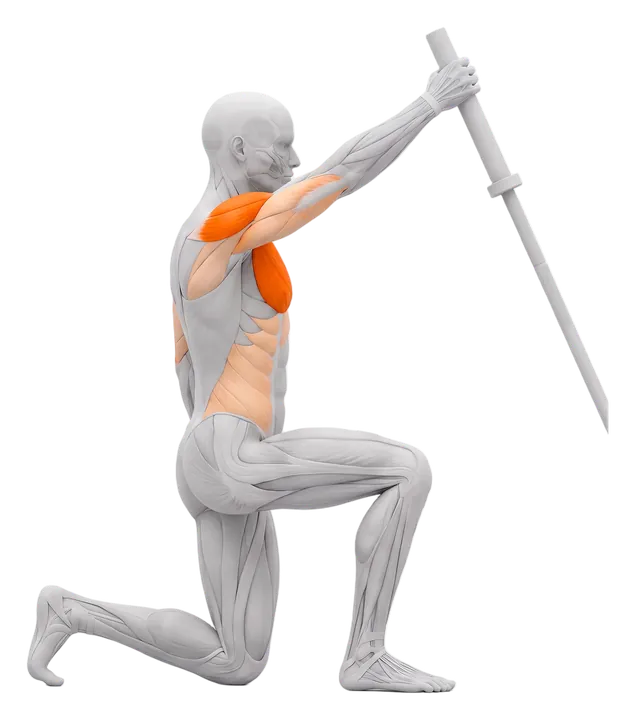 Half-kneeling landmine pressFront delts and chest
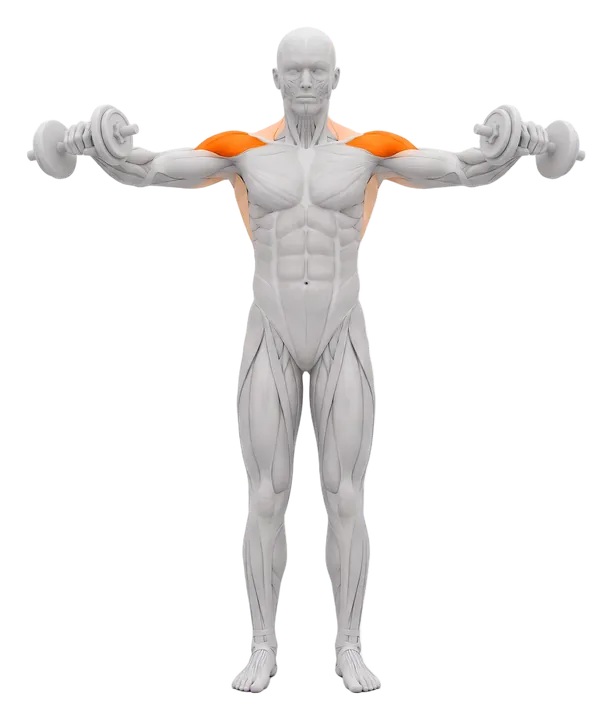 Dumbbell lateral raiseSide deltsGuide
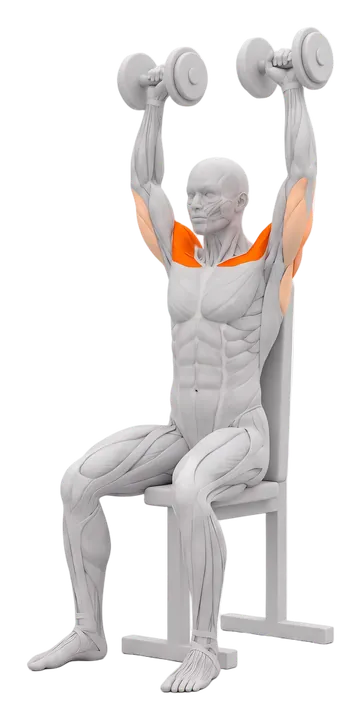 Seated dumbbell shoulder pressFront deltsGuide
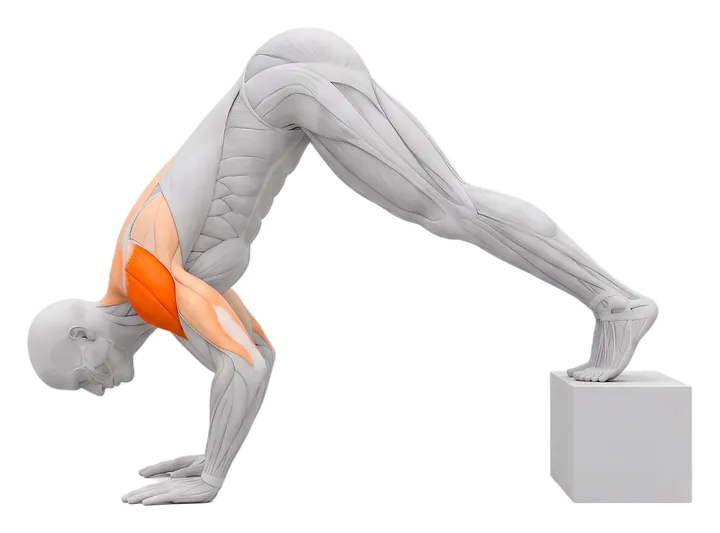 Pike push-upFront delts