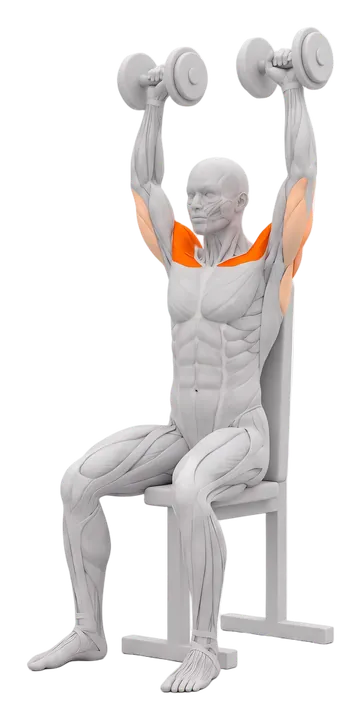
Dumbbell shoulder press muscles worked
| Muscle | Role | How much |
|---|---|---|
| Front delts | Raise the arms overhead | Primary |
| Side delts | Help, more with the elbows out to the side | Secondary |
| Triceps | Straighten the elbows at the top | Secondary |
| Upper traps and serratus anterior | Rotate the shoulder blades up so the arms can go overhead | Secondary |
| Rotator cuff | Keeps each dumbbell steady | Stabiliser |
| Core | Holds the torso still, much more when standing | Stabiliser |
Because each hand holds its own weight, the dumbbell overhead press asks more of the small stabilising muscles than a barbell does. A weaker side cannot hide behind the stronger one, which makes it a good way to even out left and right.
How to do a seated dumbbell shoulder press
- Set the benchSet an adjustable bench to its most upright position, or one notch below. Sit with your back against the pad and feet flat on the floor.
- Get the dumbbells upRest the dumbbells on your thighs, then kick them up one knee at a time as you sit back. You end with the dumbbells beside your shoulders, palms forward or facing in.
- Set the start positionElbows slightly in front of your body, forearms vertical, dumbbells around ear to chin height. Brace your stomach and keep your ribs down.
- Press up and slightly inPush the dumbbells up until your arms are straight. They move slightly towards each other but do not need to touch at the top.
- Lower to the startLower under control until the dumbbells are back at shoulder height, upper arms around parallel to the floor or a little lower, then press again.
Dumbbell overhead press form cues
- "Forearms vertical." Wrists stacked over the elbows from the side and the front. Leaning forearms waste force.
- "Elbows a little forward." Point them roughly 20 to 30 degrees forward rather than straight out to the sides. It lines the upper arm up with the shoulder blade and usually pinches less.
- "Ribs down, glutes tight." Do not turn the press into an incline press by arching the lower back.
- "Reach to the ceiling." At the top, let the shoulder blades rotate up and finish with the arms by your ears.
- "Same speed, both arms." If one arm lags, the set ends when that arm cannot complete a clean rep.
Seated vs standing dumbbell overhead press
| Seated | Standing | |
|---|---|---|
| Back support | Bench backrest | None |
| Load | Usually heavier | Usually a little lighter |
| Core and legs | Little involvement | Core works hard to stay upright |
| Getting into position | Kick the dumbbells up from the knees | Clean or curl them to the shoulders |
| Good for | Shoulder size, heavy sets, lower back issues | Full body stability, sports, home training |
The standing dumbbell overhead press is the more athletic version: your whole body has to hold still while you press. The seated press lets you focus on the shoulders and go heavier. Pick seated if your goal is shoulder size or your lower back complains; pick standing if you want carryover to everyday strength or have no bench.
Bench angle for the dumbbell shoulder press
A fully upright bench (90 degrees) or one notch back (around 75 to 85 degrees) both work. The lower you set the bench, the more the exercise turns into an incline press and the more the upper chest takes over. Below about 60 degrees you are effectively doing an incline dumbbell press. Many lifters prefer one notch back from vertical because it lets the head and shoulders settle into the pad.
Neutral grip dumbbell overhead press
With a neutral grip, your palms face each other and the elbows point forward instead of out. This reduces how far the upper arm has to rotate, and many people with cranky shoulders find it more comfortable. It also brings the triceps and front delts in a bit more. A rotating version, where you start neutral at the bottom and turn the palms forward as you press, sits between the two and is similar to the Arnold press.
There is no need to choose one forever. Use the grip that feels best on your shoulders, and switch between them every few months if you like variety.
Common dumbbell shoulder press mistakes
- Arching the lower back. The chest points up and the press turns into an incline press. Tighten the stomach and lower the weight.
- Short reps. Stopping with the dumbbells at the top of your head skips the hardest part. Lower to shoulder height.
- Banging the dumbbells together. Clashing them at the top takes tension off the shoulders. Stop just before they touch.
- Flared elbows straight out. Pressing with the elbows directly to the sides can bother the shoulders. Bring them slightly forward.
- Dropping the dumbbells at the end. Bring them back to your thighs or the floor with control, especially when they are heavy.
Dumbbell shoulder press vs barbell overhead press
| Dumbbell shoulder press | Barbell overhead press | |
|---|---|---|
| Path of the hands | Free, each arm on its own | Fixed by the bar |
| Load | Lower total weight | Heavier, small weight steps |
| Stability demand | Higher per arm | Higher for the whole body when standing |
| Weight steps | Often 2 to 2.5 kg (5 lb) per dumbbell | As small as 1 kg (2.5 lb) total |
| Good for | Shoulder size, uneven sides, joint comfort | Strength, testing a max, strength programs |
Dumbbell shoulder press vs overhead press: the barbell overhead press is easier to load heavy and to progress in small steps, which is why strength programs such as 5/3/1 build around it. Dumbbells give your joints more freedom and train each side on its own. Most people press a bit less in total with two dumbbells than with a barbell, but the gap varies a lot between lifters.
Sets and reps for the dumbbell shoulder press
| Goal | Sets x reps | Rest | Notes |
|---|---|---|---|
| Strength | 3 to 5 x 5 to 8 | 2 to 3 min | Seated, heavy but strict |
| Shoulder growth | 3 to 4 x 8 to 12 | 90 s to 2 min | 1 to 2 reps short of failure |
| General fitness | 3 x 10 to 12 | 90 s | Standing or seated |
| Beginner | 2 to 3 x 10 to 12 | 90 s | Light, full range |
Use it as the main press on a shoulder day, or as the second press after the bench on a push day. Because it is mostly a front delt exercise, follow it with lateral raises and the face pull so the side and rear of the shoulder get direct work too.
How to progress the dumbbell shoulder press
The jump from one pair of dumbbells to the next is often 2 kg (5 lb) per hand, a big step on a shoulder exercise. Use double progression: stay at the same weight and add reps until you hit the top of your range on every set, then move up and drop back to the bottom of the range. Check progressive overload for more ways to keep moving when the dumbbell steps feel too big.
Know which dumbbells to grab
Gripp is coming to iPhone. Gripp logs every set and tells you what to lift next session: "last time 9 reps with 20 kg, today go for 10". When all sets hit the target, the weight goes up. Your estimated max for the dumbbell shoulder press is tracked on a progress chart.
Join the waitlistDumbbell shoulder press alternatives
- Barbell overhead press: heavier, better for strength progress.
- Landmine press: the arm presses up and forward at an angle, a good choice when straight overhead pressing hurts.
- Machine shoulder press: fixed path, easy to train hard safely.
- Arnold press: a rotating dumbbell press with a longer range for the front delts.
- Pike push-up: a bodyweight press for home training.
- Lateral raise: not a press, but the go to option for the side delts if pressing is off limits for a while.
Similar exercises
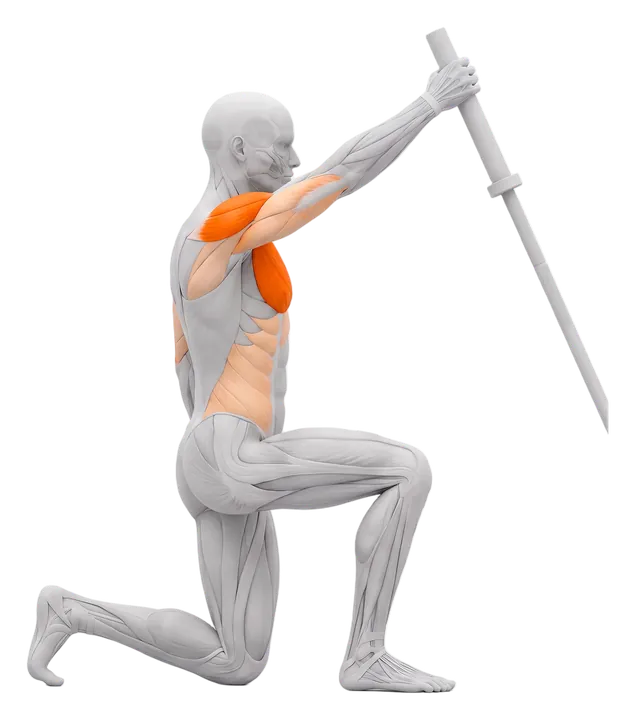 Half-kneeling landmine pressFront delts and chest
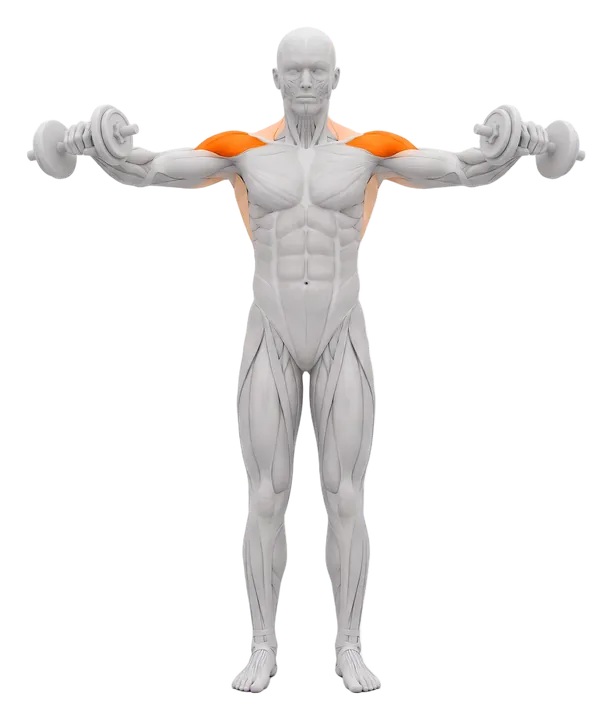 Dumbbell lateral raiseSide deltsGuide
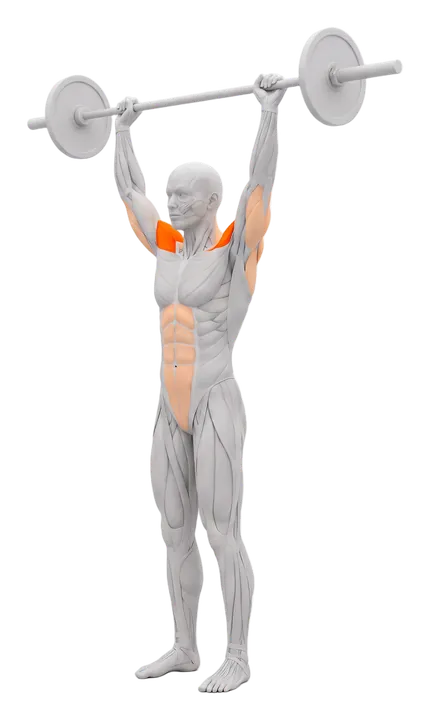 Barbell overhead pressFront deltsGuide
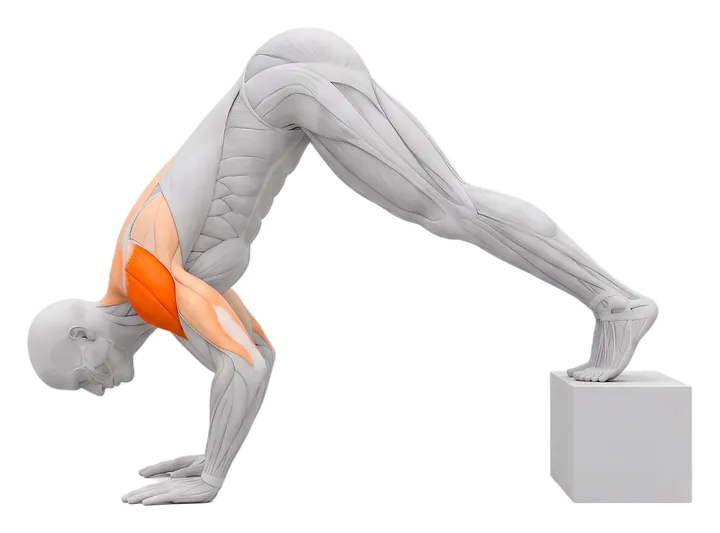 Pike push-upFront delts