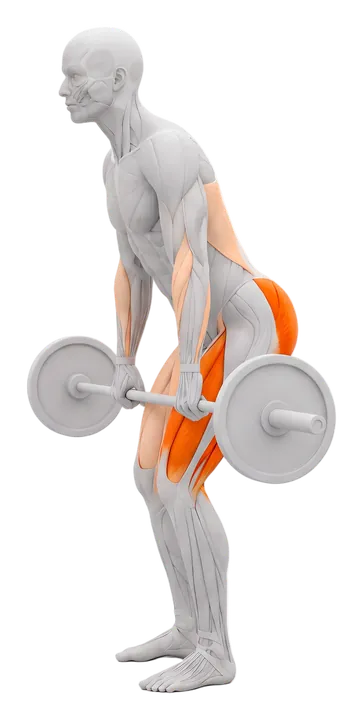
What is a Romanian deadlift?
The RDL starts at the top, standing tall with the weight in your hands, instead of on the floor like a regular deadlift. You push your hips back while your knees stay slightly bent and almost fixed, and the bar travels down along your thighs until you feel a strong stretch in your hamstrings. Then you reverse it.
Because the knees barely move, the hamstrings and glutes do most of the work. The lower back works hard too, but as a stabiliser that holds your spine still, not as the muscle that lifts the weight.
RDL muscles worked
| Muscle | Role | How much |
|---|---|---|
| Hamstrings | Lengthen on the way down, extend the hip on the way up | Primary |
| Gluteus maximus | Extends the hip, finishes the lockout | Primary |
| Spinal erectors (lower back) | Hold the back flat under load | Secondary |
| Adductor magnus | Helps extend the hip from the stretched position | Secondary |
| Forearms and upper back | Grip the bar, keep the shoulders set | Stabilisers |
Romanian deadlift for glutes: the RDL loads the glutes hardest in the bottom half, where they are stretched. If glutes are your main goal, pair it with an exercise that loads them in the shortened position at the top, like the hip thrust, or another of the glute exercises that peak at lockout. A slightly deeper knee bend and pushing the hips further back also shifts a little more work to the glutes.
How to do a Romanian deadlift
- Set up standingDeadlift the bar from the floor or take it from a rack at mid thigh height. Feet hip width apart, hands just outside your thighs, double overhand grip.
- Brace and set your backTake a breath into your belly, squeeze your shoulder blades slightly down, and unlock your knees a little. That knee angle stays about the same for the whole rep.
- Push your hips backStart the movement by moving your hips backwards, as if closing a car door with your backside. Your torso tilts forward as a result. Keep the bar in contact with, or very close to, your thighs.
- Lower to your hamstring rangeStop when your hamstrings are fully stretched and your back is still flat. For most people that is somewhere between just below the knee and mid shin. Depth comes from hip flexibility, not from rounding.
- Drive the hips forwardPush your feet into the floor and bring your hips forward until you stand tall. Squeeze your glutes at the top, but do not lean back past vertical.
Romanian deadlift form cues
- "Hips back, not down." If your hips drop and your knees bend more, you are squatting the weight.
- "Shave your legs with the bar." A bar that drifts forward puts the load on your lower back.
- "Proud chest, long neck." Look at the floor a couple of metres ahead so your neck stays in line with your spine.
- "Slow down, fast up." Take 2 to 3 seconds on the way down. The stretch under control is where the RDL does its job.
- "Stop when the hips stop." When your hips cannot move further back, you are at the bottom, even if the bar is still above your knees.
Common RDL mistakes
- Rounding the lower back to reach the floor. The RDL is not a touch-the-floor exercise. Reduce the depth until you can keep the back flat.
- Bending the knees more and more. That turns it into a conventional deadlift and takes tension off the hamstrings.
- Locking the knees completely. Fully straight legs turn it into a stiff leg deadlift and make it harder to hinge with a flat back. Keep a soft bend.
- Hyperextending at the top. Leaning back to "finish" the rep loads the lower back, not the glutes. Stand tall and stop.
- Going too heavy too soon. Grip and back fatigue usually give out before the hamstrings. Lifting straps are fine for heavy sets.
RDL vs deadlift: what is the difference?
The conventional deadlift starts every rep from the floor and uses a lot of knee bend, so quads, glutes, hamstrings and back all contribute and you can lift the most weight. The Romanian deadlift starts from the top, keeps the knees nearly fixed and only goes as low as your hamstrings allow, so it is a lighter, more targeted hamstring and glute exercise.
| Romanian deadlift | Conventional deadlift | Stiff leg deadlift | |
|---|---|---|---|
| Starts from | Standing | Floor | Floor or standing |
| Knee bend | Slight, fixed | Large, changes during the rep | Almost none |
| Range | To hamstring stretch | Floor to lockout | Usually to the floor |
| Main muscles | Hamstrings, glutes | Glutes, quads, back, hamstrings | Hamstrings, lower back |
| Typical load | Moderate | Heaviest | Lightest |
Most programs use both: the deadlift as a heavy strength lift, and the RDL as an accessory for more hamstring volume. A good morning is a similar hinge with the bar on your back instead of in your hands, which loads the lower back a bit more.
Romanian deadlift variations
| Variation | What changes | Good for |
|---|---|---|
| Barbell RDL | Heaviest loading, fixed bar path | Strength and hamstring size |
| Dumbbell RDL | Dumbbells move freely beside the thighs | Home gyms, learning the hinge, lighter loads |
| Single leg RDL | One leg works, the other floats back | Balance, glute work, fixing left-right gaps |
| Kettlebell RDL | One bell between the legs or one in each hand | Home training, higher reps |
| Cable RDL | Constant tension from a low cable | Higher reps and a lighter back load |
| Deficit RDL | Stand on a plate for more range | Advanced lifters with good hamstring mobility |
Dumbbell Romanian deadlift
Hold a dumbbell in each hand in front of your thighs, palms facing you. The form is the same as with a barbell: soft knees, hips back, dumbbells close to the legs. Dumbbells let you turn the hands slightly towards each other, which many people find easier on the shoulders, and you will hit grip limits later than you think because the load is usually lighter.
Single leg Romanian deadlift
Stand on one leg with a dumbbell or kettlebell in the opposite hand. Hinge forward while the free leg moves straight back, so that your body and back leg form one line, like a seesaw. Keep the hips square to the floor: if the hip of the free leg rotates up, you have gone too far. Start with light weight or none, and hold onto a rack with your free hand if balance stops you from feeling the hamstring. Single leg RDL form tip: a slight bend in the standing knee and a slow lowering matter more than depth.
Sets and reps for the RDL
The RDL responds best to moderate weights and controlled reps. Very low reps rarely make sense, because form and grip break down before the hamstrings are challenged.
| Goal | Sets x reps | Rest | Effort |
|---|---|---|---|
| Strength | 3 to 4 x 5 to 6 | 2 to 3 min | 1 to 2 reps left in the tank |
| Muscle growth | 3 to 4 x 8 to 12 | 90 s to 2 min | 1 to 3 reps left |
| Single leg RDL | 2 to 3 x 8 to 12 per leg | 60 to 90 s | Stop when balance breaks |
| Beginner, learning the hinge | 2 to 3 x 10 | 90 s | Easy, focus on position |
Put RDLs in a leg workout or on pull day, once or twice a week. In an upper lower split they fit well on the second lower day after squats, and in push pull legs they work on leg day or as the hinge on pull day. Expect sore hamstrings the first few weeks; the guide to DOMS explains why.
How to progress the Romanian deadlift
Use a double progression: pick a rep range like 8 to 10, and when you hit the top of the range in every set, add 2.5 to 5 kg (5 to 10 lb) next time. That steady progressive overload works for months on the RDL, because the movement is stable and easy to repeat.
As a rule of thumb, many lifters end up using somewhere around 50 to 70 % of their conventional deadlift for RDL sets of 8. The deadlift standards show where that deadlift stands. If you want a number to plan from, enter a recent set in the 1RM calculator.
Gripp tells you what to lift on your next RDL set
Log your reps and weight and Gripp suggests the next step: last time 9 reps at 80 kg, today go for 10. Hit your reps in every set and the weight goes up. Your estimated max is tracked on a progress chart, and the exercise page shows a muscle map of what the RDL trains.
Join the waitlistRomanian deadlift alternatives
- Hip thrust: trains the glutes at the top instead of the bottom. See the hip thrust guide.
- Good morning: the same hinge with the bar on your back. Lighter loads, more lower back.
- Seated or lying leg curl: hamstrings without loading the back, useful if your back is tired or sore.
- 45 degree back extension: a hinge with your hips on a pad, good for glutes and hamstrings at higher reps.
- Cable pull-through: a hip hinge with the cable between your legs, easy to learn and light on the back.
- Bulgarian split squat: not a hinge, but trains the glutes hard one leg at a time. See the Bulgarian split squat guide.
Similar exercises
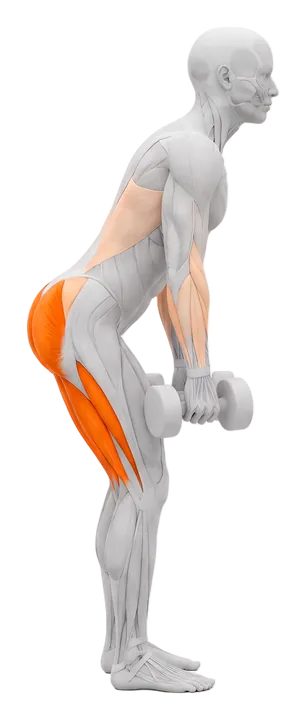 Dumbbell Romanian deadliftHamstrings and glutes
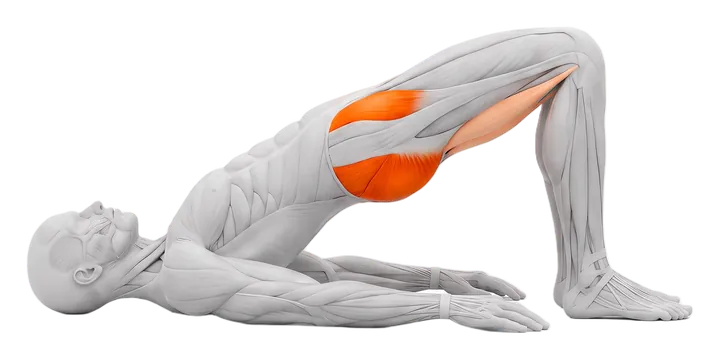 Glute bridgeGlutes
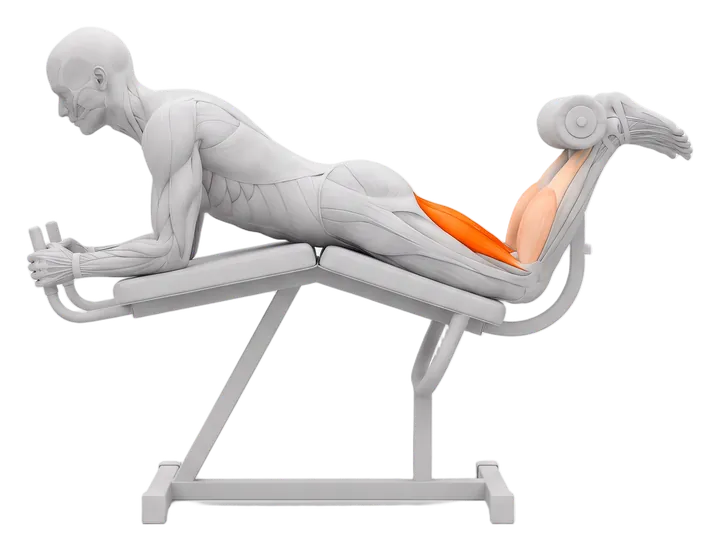 Lying leg curlHamstrings
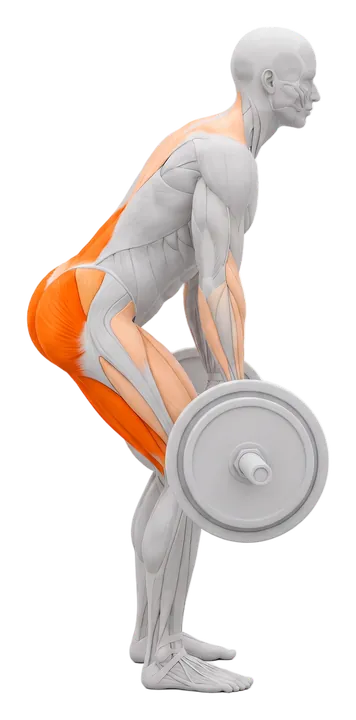 Barbell deadliftGlutes and hamstringsGuide
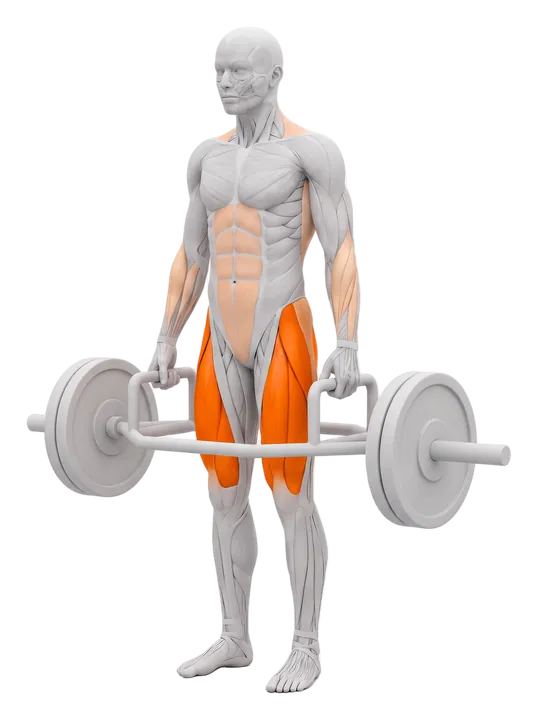 Trap bar deadliftGlutes and quads
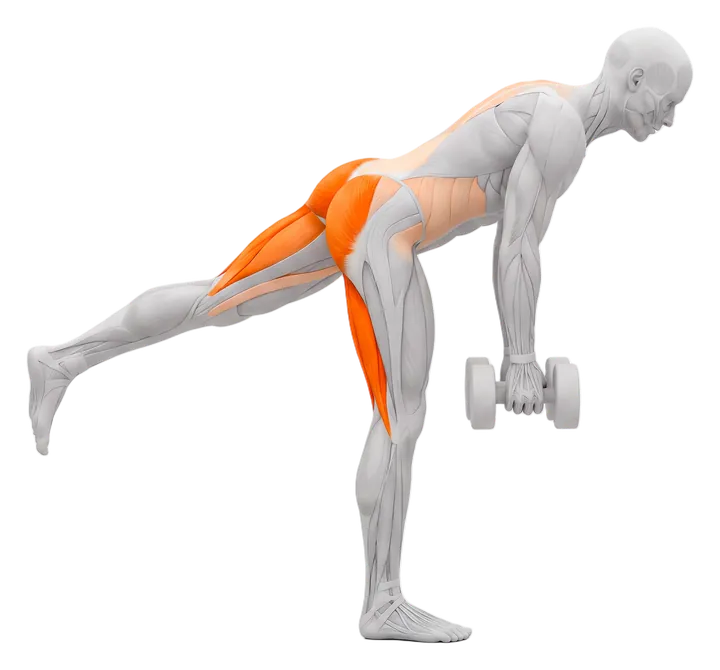 Single-leg Romanian deadliftHamstrings and glutes