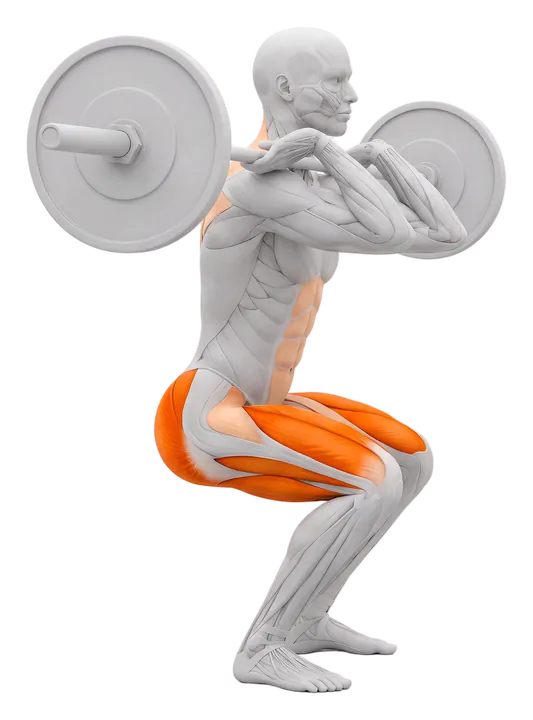
Front squat muscles worked
| Muscle | What it does here | Role |
|---|---|---|
| Quadriceps | Straighten the knee from a deep, knees forward bottom position | Primary |
| Glutes | Drive the hips up out of the hole | Primary |
| Adductors | Help extend the hip at depth and keep the knees tracking | Secondary |
| Upper back | Holds the elbows high so the bar does not roll forward | Secondary |
| Abs and obliques | Resist the forward pull of the bar and keep the torso stiff | Secondary |
| Lower back | Holds a neutral spine, with less load than in the back squat | Stabiliser |
Compared with the back squat, the front squat puts the knees further forward and keeps the torso closer to vertical. That makes it a quad builder first. The glutes still work hard, but if your goal is a bigger posterior chain you will want a hinge like the Romanian deadlift next to it.
The front rack position
Get the rack right and the rest of the lift gets much easier. The bar should sit on the meat of your front delts, close to your throat, not in your hands. Your hands only keep it from sliding off.
Clean grip
Hands just outside shoulder width, palms up, bar resting on the fingers with the elbows pointing forward and high. Two or three fingers under the bar is enough. This is the most stable grip, but it asks for mobile wrists, lats and triceps.
Cross-arm grip
Cross your arms in front of you and place each hand on the opposite shoulder, pinning the bar. It needs no wrist mobility, so many lifters who never do Olympic lifts use it. The downside is that it feels less secure as the weight climbs, and the bar can drift if your elbows drop.
Straps
Loop a lifting strap around the bar on each side and hold the straps with your elbows up. It is a good middle step while your wrists get used to the clean grip.
How to do a barbell front squat
- Set the bar at upper chest heightSet the J-hooks about level with your collarbone, so you unrack with a small knee bend, not on your toes.
- Step under and make the shelfWalk in until the bar touches your throat, take your grip and lift the elbows until your upper arms are close to parallel with the floor. The bar should press into your shoulders.
- Unrack and take two steps backStand up with the bar, take two short steps back and set your feet about shoulder width, toes turned out slightly.
- Breathe and braceTake a big breath into your belly, brace as if someone is about to poke you in the stomach and keep the elbows high.
- Sit straight downLet the knees travel forward over the toes and sit down between your heels. Keep the chest tall. Go as deep as you can with a neutral back; most people can reach below parallel here more easily than in the back squat.
- Stand up elbows firstDrive up by pushing the elbows up and the floor away at the same time. Exhale near the top and take a new breath before the next rep.
Front squat form cues
- "Elbows up out of the hole." The moment your elbows drop, your upper back rounds and the bar rolls forward. Lead with the elbows on the way up.
- "Sit between your heels." Think of an elevator going down, not a chair behind you. A vertical torso is the goal.
- "Knees forward is fine." The front squat needs the knees to travel past the toes. Fighting that makes you lean.
- "Whole foot." Keep the big toe, little toe and heel on the floor. If your heels lift, try squat shoes or small plates under the heels.
- "Tall through the crown." Look straight ahead and keep the neck long; looking up hard tends to tip the torso back.
Common front squat mistakes
- Holding the bar with the palms. A full grip pulls the elbows down. Open the hands and let the shoulders carry the bar.
- Bar too far from the throat. A gap between bar and neck means the bar rests on your arms, not your shoulders.
- Elbows dropping in the bottom. The rep usually fails here: the bar slides forward and you dump it. Lighter weight and paused reps fix it.
- Hips shooting up first. This turns the lift into a good morning with a bar in front of you. Keep the chest and hips rising together.
- Forcing depth with a rounded back. Go as deep as you can with a neutral spine, then build mobility over time.
Front squat vs back squat
Both are full squats with a barbell. The difference is where the bar sits, and that changes everything about how the lift feels.
| Front squat | Back squat | |
|---|---|---|
| Bar position | On the front delts | On the upper back |
| Torso | Close to upright | More forward lean |
| Main muscles | Quads, upper back, abs | Quads, glutes, adductors, lower back |
| Typical load | Around 80 % of the back squat (rule of thumb) | Heavier |
| Lower back load | Lower | Higher |
| Limiting factor | Front rack, upper back strength | Leg and hip strength |
| Bailing a missed rep | Drop the bar forward | Needs safeties or spotters |
Which should you do? If you compete in powerlifting, the back squat is the lift you are tested on, and front squats work as a quad and posture builder on a second day. If you just want strong legs, either can be your main squat. People whose lower back gets cranky under heavy back squats often do better on the front squat, as long as the wrists cooperate. If you want a number to compare against, the squat strength standards are based on the back squat, so add roughly a quarter to your front squat for a rough comparison.
Dumbbell front squat and other variations
| Variation | How | Good for |
|---|---|---|
| Dumbbell front squat | One dumbbell on each shoulder, ends resting on the delts | Home gyms, no rack needed |
| Goblet squat | One dumbbell or kettlebell held at the chest | Learning the upright squat pattern |
| Paused front squat | 2 to 3 s pause at the bottom | Fixing elbows dropping and staying tight |
| Heels elevated front squat | Heels on a small wedge or plates | Limited ankle mobility, extra quad work |
| Safety bar or Zercher squat | Bar held in other positions in front of the body | Upper back strength without the front rack |
| Front box squat | Sit to a box at a fixed height | Controlled depth |
Dumbbell front squat
Clean two dumbbells to your shoulders and rest one end of each on your front delts, elbows forward. It trains the same upright pattern without a rack, but you run out of load quickly because you have to get the bells onto your shoulders. Once it gets easy, slow the lowering or switch to a single leg exercise. If you only have one dumbbell, the goblet squat is the natural step before a barbell front squat.
Sets, reps and rest for the front squat
| Goal | Sets x reps | Rest | Notes |
|---|---|---|---|
| Strength | 3 to 5 x 3 to 5 | 2 to 4 min | Low reps keep the rack position solid |
| Muscle growth | 3 to 4 x 6 to 10 | 2 to 3 min | Upper back often tires before the legs |
| Technique | 4 to 6 x 2 to 3 | 90 s to 2 min | Light, paused reps |
| Next to back squats | 2 to 3 x 4 to 6 | 2 to 3 min | Second squat day, about 70 to 80 % of your back squat working weight |
High rep front squats are hard to hold together because the upper back gives out and breathing under the bar is uncomfortable. That is why most programs keep them at 10 reps or fewer. You can put them on the lower day of an upper lower split or as the squat in a full leg workout, followed by a hinge and a hamstring curl. How long to wait between heavy sets is covered in rest between sets.
How to progress your front squat
Add 2.5 kg (5 lb) when you hit all your planned reps with the elbows up the whole way. If you keep failing in the same spot with the bar rolling forward, the legs are not the problem: drop 10 % and add a pause at the bottom for a few weeks. To estimate a front squat max from a set of 3 to 5, use the 1RM calculator; the same formula works for any squat.
Track your front squat next to your back squat
Gripp logs every set and tells you the weight and reps to aim for next session. It keeps an estimated 1RM for each lift on its own chart, so you can see whether your front squat keeps pace with your back squat, and it rates your leg strength against people of your age and bodyweight.
Join the waitlistFor the long game, the rules in progressive overload apply: small steps, repeated for months.
Front squat alternatives
- Goblet squat: the same upright pattern with one dumbbell, easier on the wrists.
- Leg press: heavy quad work with no balance or rack position. See the leg press guide.
- Hack squat machine: knees forward, torso supported, very quad heavy.
- Bulgarian split squat: one leg at a time with an upright torso, good when a barbell is not an option.
- Heels elevated goblet squat: a light, high rep quad finisher.
Similar exercises
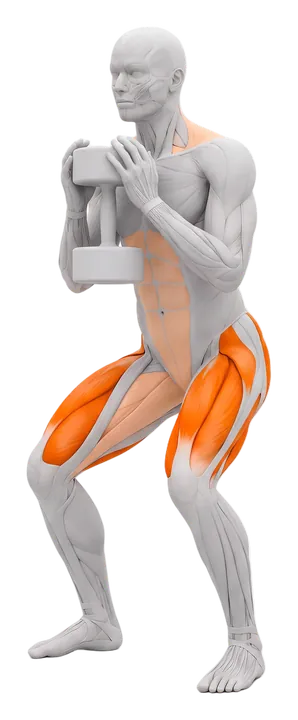 Goblet squatQuads and glutesGuide
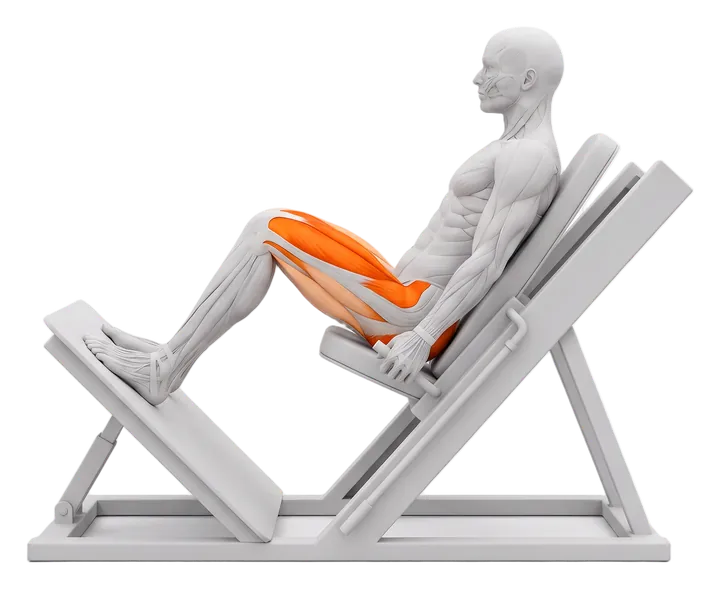 Leg pressQuads and glutesGuide
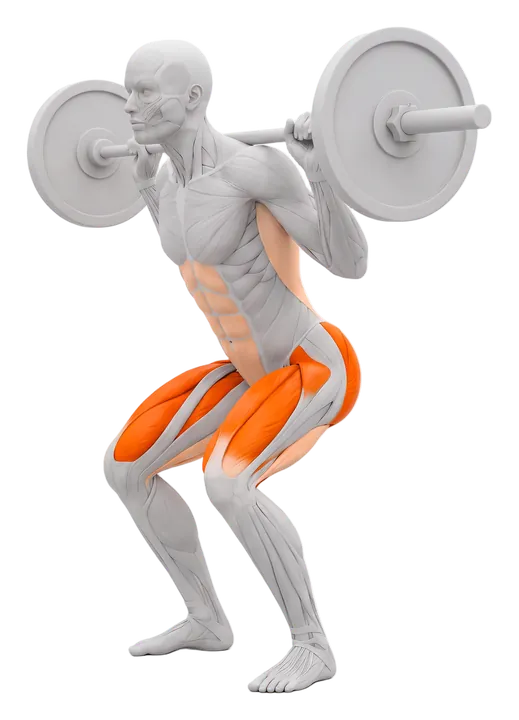 Barbell back squatQuads and glutesGuide
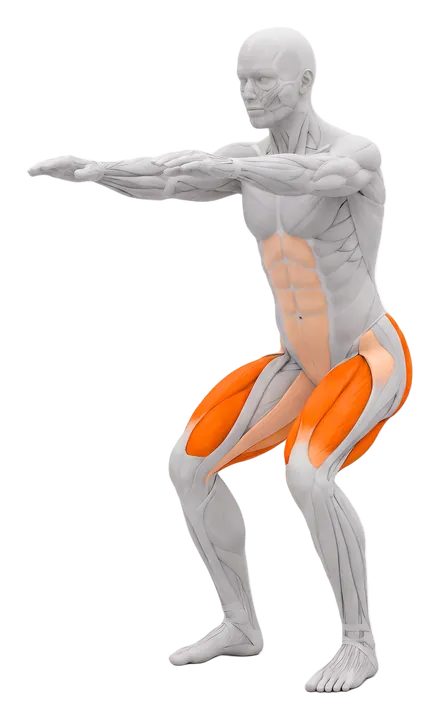 Bodyweight squatQuads and glutes
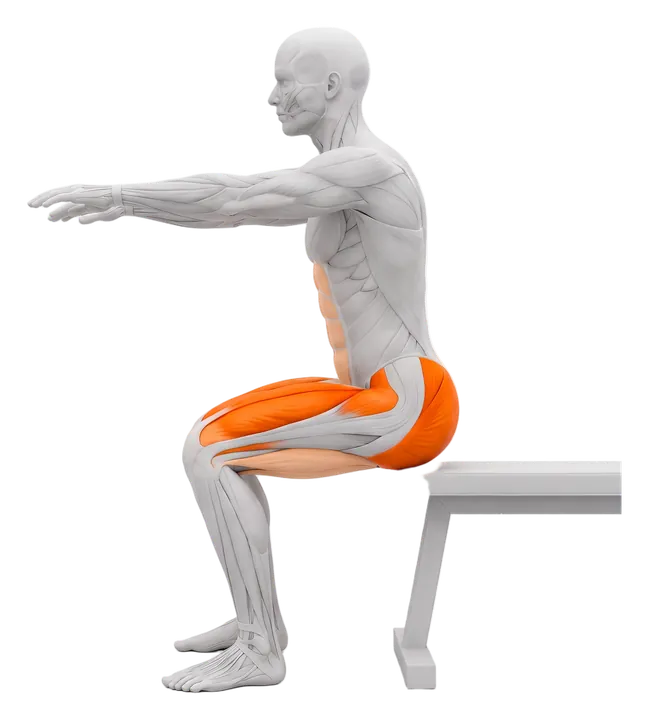 Box squat to benchQuads and glutesGuide
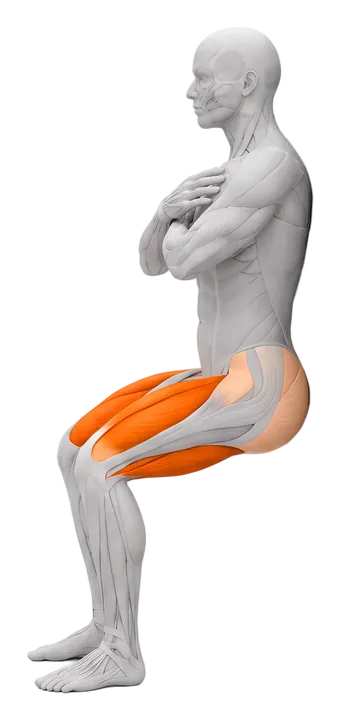 Wall sitQuads