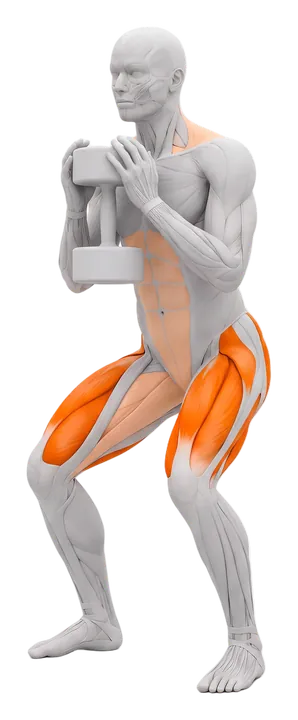
What is a goblet squat?
The name comes from the way you hold the weight: cupped in both hands at chest height, like a large cup or goblet. Because the load sits in front of your body, your centre of mass stays over your midfoot even when you sit low. That forces an upright chest and makes it hard to fold forward, which is the most common fault new lifters have when they first try a barbell squat.
It is also practical. One dumbbell, no rack, no spotter, and you can switch weights in seconds. That makes it a regular on leg workout days in commercial gyms, home gyms and hotel gyms alike.
Goblet squat muscles worked
| Muscle | Role | How much |
|---|---|---|
| Quadriceps | Straighten the knee on the way up | Primary |
| Gluteus maximus | Extends the hip, most out of the bottom | Primary |
| Adductors | Help extend the hip in a deep squat | Secondary |
| Abs and obliques | Hold the torso upright against the load in front | Secondary |
| Upper back | Keeps the chest up and the weight close | Secondary |
| Calves | Balance over the midfoot | Stabiliser |
The upright torso means the knees travel further forward than in a low bar back squat, so the goblet squat leans towards the quads. Sitting deep brings in more glutes and adductors. If glutes are your main goal, pair it with a hip dominant lift from our glute exercises list.
How to do a goblet squat
- Pick up the weightHold a dumbbell vertically by the top head, palms pressed under the plate, or hold a kettlebell by the horns. Pull it in so it touches your chest, elbows pointing down.
- Set your stanceFeet a little wider than hip width, toes turned out 15 to 30 degrees. Spread your weight across the whole foot: heel, big toe and little toe.
- BraceTake a breath into your belly and tighten your midsection as if someone is about to poke you in the stomach.
- Sit down between your heelsBend the knees and hips at the same time. Let the knees travel forward and out over the toes. Keep the chest tall and the weight glued to your sternum.
- Reach your depthGo as low as you can while your heels stay down and your lower back stays neutral. For most people that is hip crease below the knee, with the elbows brushing the inside of the knees.
- Stand upDrive through the whole foot, push the knees out and stand tall. Breathe out at the top, then take a new breath before the next rep.
Goblet squat form cues
- "Weight on your chest, not in your hands." If the dumbbell drifts away from your body, your back rounds and your arms tire before your legs.
- "Elbows inside the knees." At the bottom, the elbows can gently push the knees out. It is a built in check that you are low enough.
- "Tripod foot." Heel, big toe and little toe stay in contact the whole rep.
- "Chest proud on the way up." Hips and chest rise together. If the hips shoot up first, the weight is too heavy or you are out of position.
- "Slow down, stand up fast." Two to three seconds down, then a strong push up.
Common goblet squat mistakes
- Heels lifting. Usually tight ankles or a stance that is too narrow. Widen the feet, turn the toes out more, or raise the heels (see below).
- Knees caving in. Think about spreading the floor apart with your feet. A lighter weight often fixes it.
- Rounding at the bottom. A small tuck of the pelvis at full depth is normal for many people; a clearly rounding lower back under load is not. Stop a few centimetres higher.
- Holding the breath for the whole set. Breathe and brace for each rep.
- Arms giving up first. Once holding the weight is harder than squatting it, it is time for a different variation.
Dumbbell vs kettlebell goblet squat
Both work. The choice comes down to grip comfort and what your gym has. Heavy dumbbells are easier to find than heavy kettlebells, which is why the dumbbell goblet squat is the more common version.
| Dumbbell | Kettlebell | |
|---|---|---|
| How to hold it | Vertically, hands under the top head | By the horns, or the bell resting in your palms |
| Weight steps | Usually 2 kg (5 lb) jumps | Often 4 kg (8 to 10 lb) jumps |
| Heaviest available | Often 40 kg (90 lb) or more | Often 24 to 32 kg (53 to 70 lb) |
| Feel | Stable, a little wide against the chest | Compact, sits closer to the body |
What size dumbbell for goblet squats?
Choose a weight you can squat for 10 reps at full depth with about two reps left. Most beginners land somewhere between 8 and 16 kg (18 and 35 lb); trained lifters often use 24 to 40 kg (53 to 88 lb). If the weight pulls your chest down or you cannot hold it for the whole set, it is too heavy for now.
Heel elevated goblet squat
Put your heels on a slant board, a pair of small plates or a wedge about 2 to 5 cm (1 to 2 in) high. Raising the heels lets the knees travel further forward without the ankles running out of range. You stay more upright, sit deeper and the quads do more of the work.
Use it if your heels lift in a normal goblet squat, or as a quad focused variation even if your ankles are fine. A narrower stance with heels together on the wedge turns it into a very knee dominant exercise; start light, because it is harder than it looks.
Goblet squat sets and reps
| Goal | Sets x reps | Rest | Notes |
|---|---|---|---|
| Learning to squat | 3 x 8 to 10 | 90 s | Pause 1 to 2 s at the bottom |
| Muscle growth | 3 to 4 x 10 to 15 | 60 to 90 s | Heel elevated version works well |
| Strength (beginner) | 3 to 5 x 6 to 8 | 2 min | Heaviest weight you can still hold well |
| Warm up before barbell squats | 2 x 8 | Short | Light, focus on depth |
A goblet squat fits as the first lift in a beginner full body workout, two to three times a week. Later, it moves to second or third spot after a barbell squat, or alongside single leg work like the Bulgarian split squat.
How to progress, and when to move to the barbell
Add reps first, then weight. When you hit the top of your rep range on every set with good depth, go up one dumbbell size next session. This is progressive overload in its simplest form.
Sooner or later you hit a limit that has nothing to do with your legs: your arms and upper back cannot hold a heavier dumbbell, or the gym runs out of weights. As a rule of thumb, once you can do clean sets of 8 to 10 with a dumbbell around a third to a half of your bodyweight, you have earned a barbell. A program like Starting Strength picks up from there. Keep the goblet squat as a warm up and as a lighter quad exercise on other days.
If barbells are not for you, the leg press and split squats let you keep loading the legs heavily without holding the weight in your arms.
Gripp tells you when to grab the next dumbbell
Gripp is coming to iPhone. Log your sets and Gripp suggests what to lift next time: hit your reps in every set and the weight goes up. It keeps an estimated 1RM per exercise on a progress chart, so you can see your squat climbing even when you switch from dumbbell to barbell.
Join the waitlistGoblet squat alternatives
- Box squat: squat to a bench or box. Good for controlling depth or for sore knees.
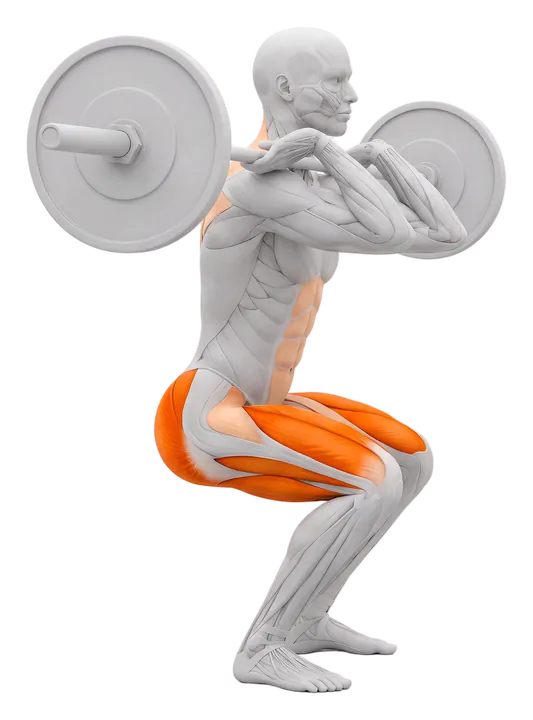
- Front squat: the barbell version of an upright squat, the natural next step after the goblet squat.
- Leg press: heavy quad and glute work with your back supported.
- Bulgarian split squat: one leg at a time, hold dumbbells at your sides.
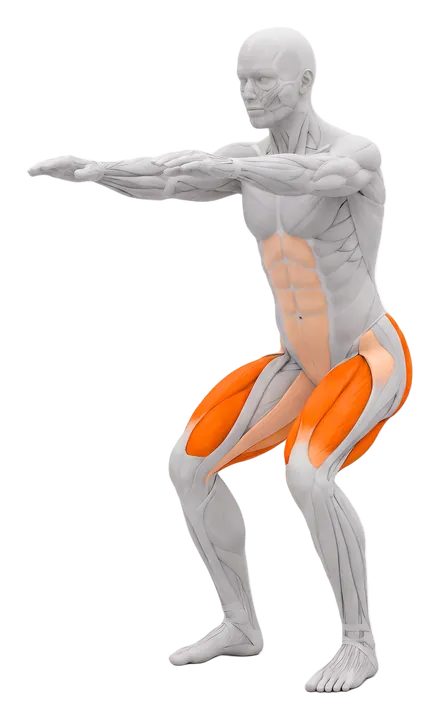
- Bodyweight squat: the version to master before adding any weight.
Similar exercises
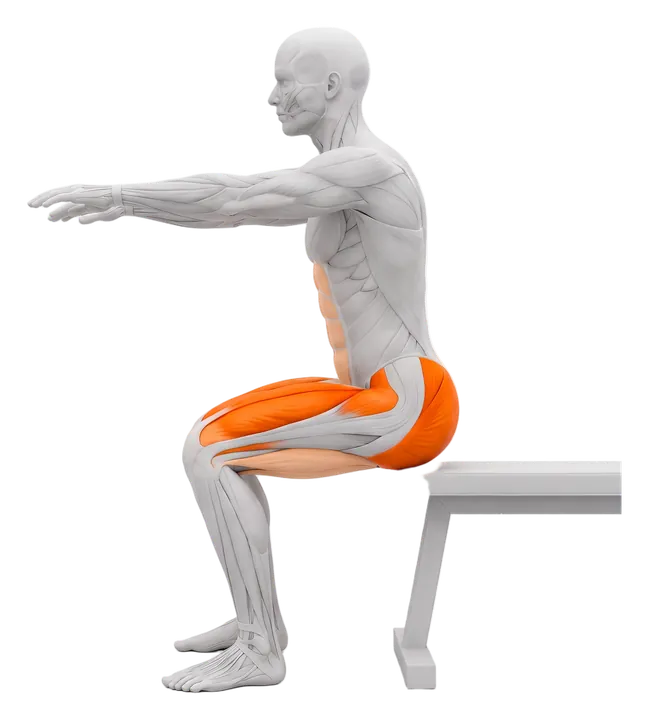 Box squat to benchQuads and glutes
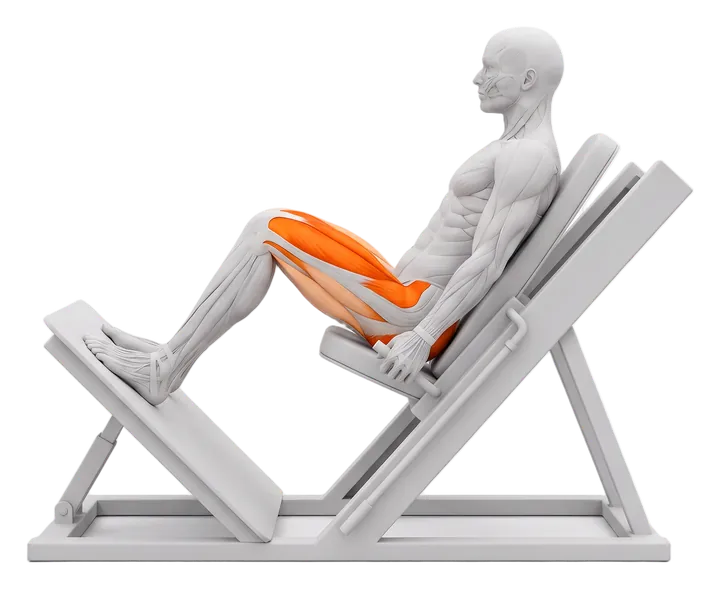 Leg pressQuads and glutesGuide
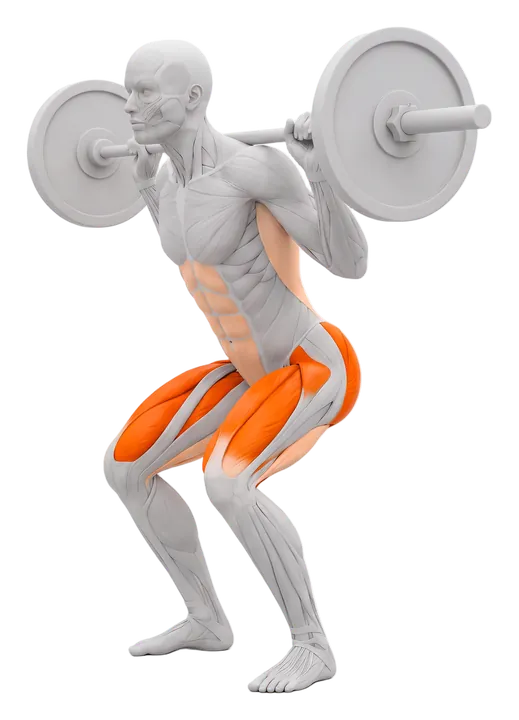 Barbell back squatQuads and glutes
 Barbell front squatQuads and glutes
 Bodyweight squatQuads and glutes
 Wall sitQuads