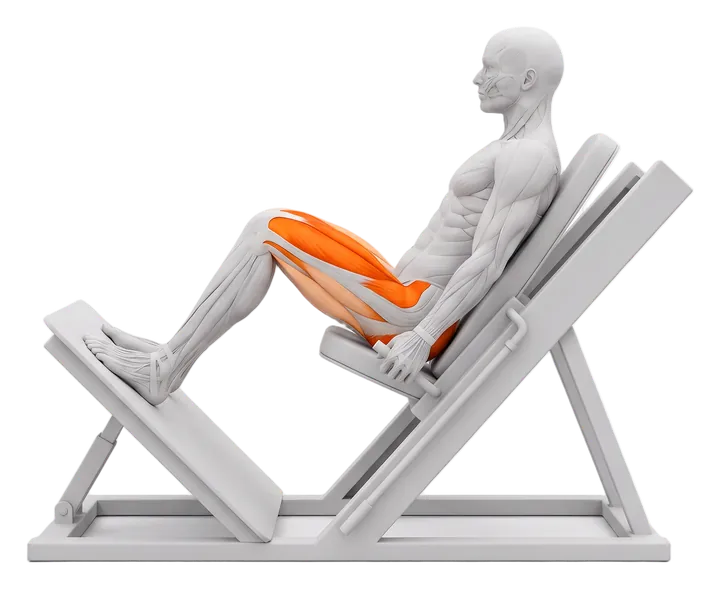
Leg press muscles worked
| Muscle | Role | How much |
|---|---|---|
| Quadriceps | Straighten the knee | Primary |
| Gluteus maximus | Extend the hip, most in the deep part | Primary |
| Adductors | Help extend the hip, more with a wide stance | Secondary |
| Hamstrings | Help at the hip, more with the feet high | Secondary |
| Calves | Stabilise the ankle | Stabiliser |
Because the seat supports your back and the machine guides the path, the leg press lets you load the legs heavily without having to balance or hold the weight. That makes it a staple of almost every leg workout, either as the main lift or after squats.
Leg press foot placement guide
Foot position is the leg press question people ask most, and for good reason. Moving the feet changes how much the knees and hips bend, which changes which muscles do most of the work. These are tendencies, not switches: every position still trains the quads and glutes.
| Foot position | What changes | Targets more | Watch out for |
|---|---|---|---|
| Middle, shoulder width | Balanced knee and hip bend | Quads and glutes evenly | The default; start here |
| High on the platform | Less knee bend, more hip bend | Glutes and hamstrings | Lower back rounding at the bottom |
| Low on the platform | More knee bend, knees travel forward | Quads | Heels lifting, knee discomfort |
| Wide, toes out | Hips open more | Adductors and glutes | Knees caving in |
| Narrow, feet close | Hips stay narrow, knees and hips feel cramped | Quads (not specifically the outer quads) | Limited depth |
Leg press foot placement for glutes
Place your feet high and a little wider than shoulder width, toes turned slightly out. Lower deep, push through the heels, and pause briefly at the bottom. The deep hip bend is what brings in the glutes. For more glute options, see our glute exercises.
Leg press foot placement for quads
Place your feet low and about hip width apart. Your knees travel further forward, so the quads take more of the load. Only go as low as you can with your heels still flat; if they lift, move your feet up a few centimetres.
How to do the leg press
- Adjust the seatSet the backrest so you can bring your knees towards your chest without your lower back leaving the pad. A more upright seat reduces how deep you can go.
- Place your feetStart in the middle of the platform, shoulder width apart, toes slightly out. Whole foot in contact.
- Unlock the sledPress the platform up a little, release the safety handles and hold the side grips. Keep a slight bend in the knees.
- Lower under controlBend the knees and let the platform come towards you for 2 to 3 seconds. Knees track in line with your toes.
- Stop before the back roundsFind the point where your hips start to curl up off the seat, and stop just before it. That is your depth.
- PressDrive through the whole foot until the legs are almost straight. Do not slam into a locked knee at the top.
Leg press depth and your lower back
The most important rule on the leg press: your lower back and hips stay against the pad. If you go too deep, the pelvis rolls up and the lower back rounds while under a heavy load. That is the classic way people hurt themselves on this machine, often with weights they would never squat.
To find your depth, do a set with an empty sled and have someone watch your hips, or put a hand under your lower back. The moment it lifts, you have gone far enough. Mobility and seat setting change this point, so check again if you change machines.
Common leg press mistakes
- Loading the machine for an ego set. Short, bouncing reps with a huge stack do less for your legs than deep, controlled reps with less weight.
- Hands on the knees. Pushing on your knees takes work away from the legs. Hold the handles.
- Heels lifting. Feet too low on the platform. Move them up.
- Knees caving in. Push the knees out in line with your toes, especially in a wide stance.
- Holding the breath for the whole set. Breathe at the top between reps.
Leg press variations
- 45 degree leg press: the plate loaded sled you see in most gyms. Allows the heaviest loads.
- Horizontal (seated) leg press: a cable stack machine where you sit upright and press forward. Easier to set up, usually lighter.
- Vertical leg press: you lie on your back and press straight up. Rare, and harder on the lower back at depth.
- Single leg press: one foot in the middle of the platform. Good for fixing a weaker side and for heavy work without huge loads; start with about 40 to 50 percent of your two leg weight.
- Pause leg press: one to two seconds at the bottom, no bounce.
Leg press vs hack squat vs squat
| Leg press | Hack squat | Barbell squat | |
|---|---|---|---|
| Body position | Seated, back on pad | Standing on a sled, back on pad | Free standing, bar on back |
| Balance needed | None | Little | A lot |
| Main focus | Quads and glutes, set by foot position | Quads | Quads, glutes, core, back |
| Spinal load | Low, if depth is controlled | Moderate | High |
| Learning curve | Easy | Easy | Takes practice |
| Good for | Heavy leg volume, beginners, after squats | Quad growth | Overall strength, carryover to sport |
The barbell squat trains more muscles at once and builds strength you can use outside the gym. The leg press lets you train the legs hard when your back, balance or technique is the limit, or after squats when you are tired. A hack squat sits in between and is a favourite for quad growth. For most people, the best answer is to use a squat pattern, such as a goblet squat or barbell squat, plus the leg press, rather than choosing one.
Do not compare numbers between them. Leg press weights are much higher than squat weights because of the sled angle, the sled's own weight and the shorter range of motion, and they differ between machines.
Leg press sets and reps
| Goal | Sets x reps | Rest | Notes |
|---|---|---|---|
| Strength | 3 to 4 x 6 to 8 | 2 to 3 min | Controlled depth, no bounce |
| Muscle growth | 3 to 4 x 10 to 15 | 90 s to 2 min | 1 to 2 reps short of failure |
| Beginner | 2 to 3 x 10 to 12 | 90 s | Learn your depth first |
| Finisher | 1 to 2 x 20 | 2 min | After squats, moderate weight |
On a leg day, put the leg press first if it is your main lift, or after squats as a second exercise, then finish with a hamstring exercise like the Romanian deadlift. Add weight when you hit the top of your rep range on every set; steps of 5 to 10 kg (10 to 20 lb) are normal on this machine. Read more in progressive overload.
Gripp remembers your machine weights
Gripp is coming to iPhone. Log the weight and reps for every set and Gripp tells you what to press next session. It keeps an estimated max per exercise on a progress chart, so your leg press numbers stay comparable from week to week.
Join the waitlistLeg press alternatives and home substitutes
- Hack squat: the closest machine alternative, more quad focused.
- Goblet squat: the best substitute with just a dumbbell.
- Bulgarian split squat: heavy single leg work at home or in the gym. See the Bulgarian split squat guide.
- Step-up: a box and a pair of dumbbells.
- Belt squat: loads the legs through the hips with no weight on the spine.
- Wall sit or banded squat: simple home options for higher reps.
Similar exercises
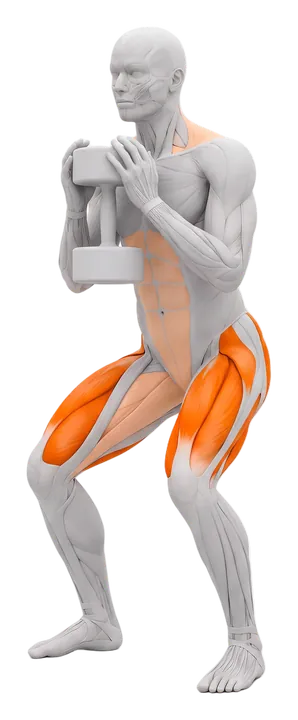 Goblet squatQuads and glutesGuide
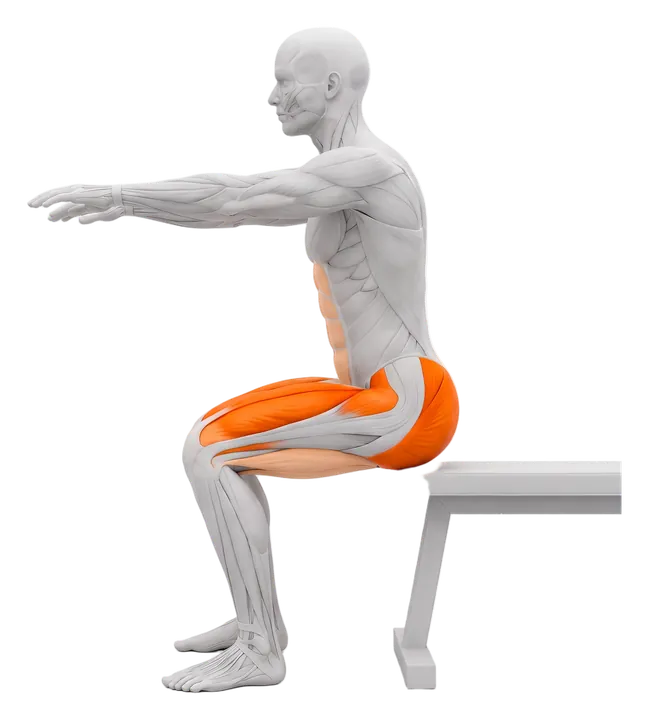 Box squat to benchQuads and glutes
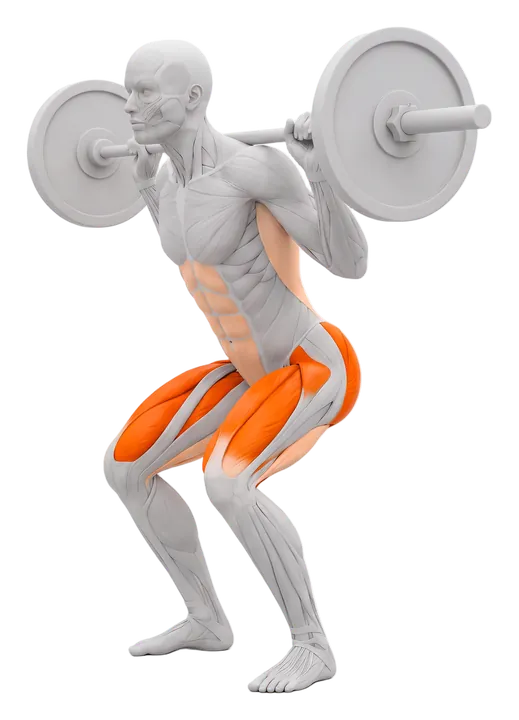 Barbell back squatQuads and glutes
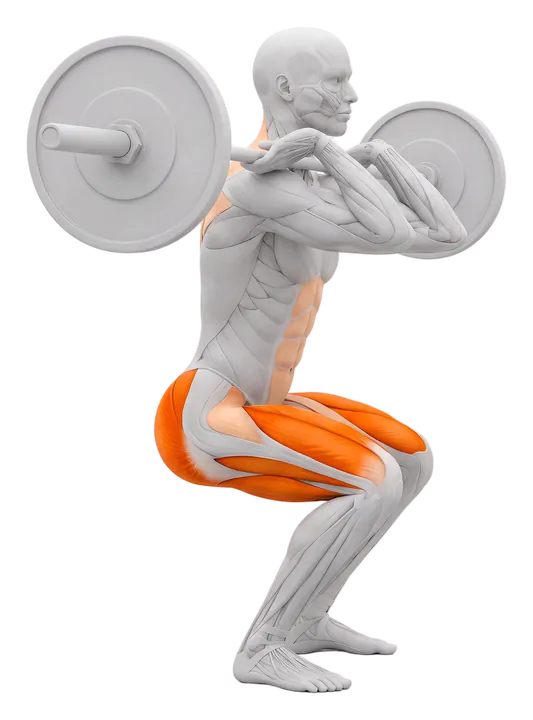 Barbell front squatQuads and glutes
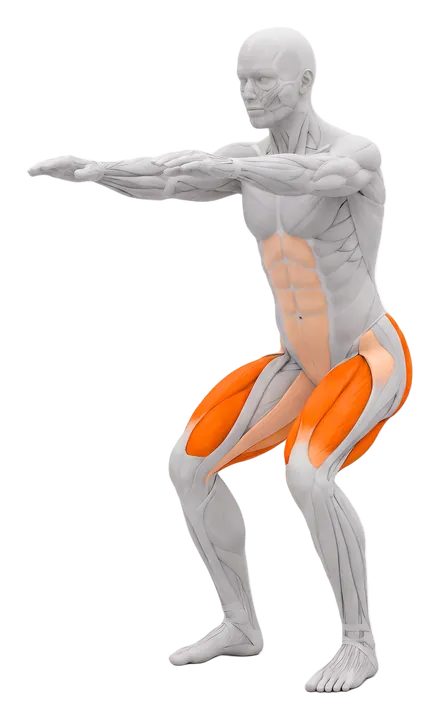 Bodyweight squatQuads and glutes
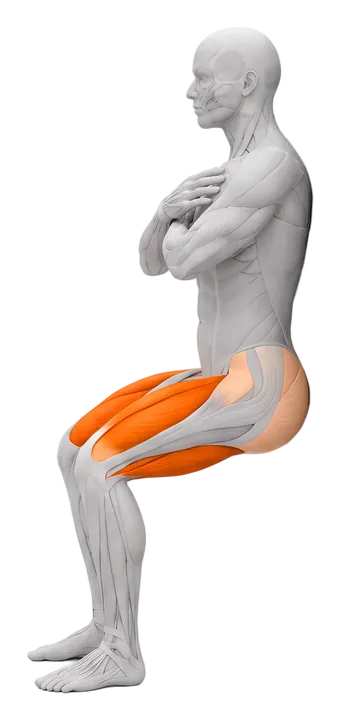 Wall sitQuads