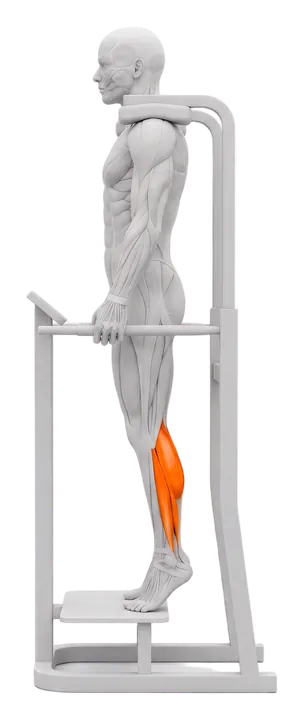
Calf raise muscles worked
Your calf is two main muscles that share the Achilles tendon. The difference that matters for training is which joints they cross.
| Muscle | Crosses | Works hardest in |
|---|---|---|
| Gastrocnemius | Knee and ankle | Standing calf raise, leg press calf raise (straight knees) |
| Soleus | Ankle only | Seated calf raise (bent knees), also active standing |
| Tibialis posterior and peroneals | Ankle and foot | Both, they keep the ankle from rolling in or out |
When the knee is bent to about 90 degrees, the gastrocnemius is slack and cannot pull hard, so the soleus takes over. That is the whole reason seated and standing machines both exist. For a full list of options for the lower leg, see the calf exercises hub.
How to do a standing calf raise
- Set up on an edgeStand on the platform of a calf machine, a step or a plate with the balls of your feet on the edge and your heels free. Shoulder pads snug, or hold dumbbells at your sides.
- Lower into the stretchKnees straight but not locked hard. Let your heels sink as low as they go, slowly, over about 2 seconds.
- Pause at the bottomHold the deepest point for 1 to 2 seconds. This takes out the spring of the Achilles tendon, so the muscle has to start the rep.
- Rise as high as you canPush through the big toe and the ball of the foot until you are on your toes. Squeeze for a second at the top, then lower again.
- "Big toe down." Keeps the ankle from rolling out onto the little toe.
- "Same speed both ways." If the lowering is faster than the lifting, you are bouncing.
- "Knees stay still." A small knee bend that comes and goes turns it into a jump.
Full range and the pause: why they matter
The Achilles tendon is long and springy. Quick reps from the middle of the range let it store and return energy, so you can move a lot of weight with little work from the muscle. Gym calves that never grow are very often trained this way: heavy stack, short fast reps.
A rule that works for most people: drop the load until you can hold a full second at the bottom and a full second at the top on every rep. Expect to use a lot less weight than before. Then build back up from there, and only count reps that reach both ends.
Standing vs seated calf raise
| Standing calf raise | Seated calf raise | |
|---|---|---|
| Knee | Straight | Bent to about 90 degrees |
| Main muscle | Gastrocnemius, plus soleus | Soleus |
| Load | Usually heavier | Usually lighter, the pad rests on the thighs |
| Equipment | Calf machine, Smith machine, step and dumbbells | Seated calf machine, or a bench with a weight on the knees |
| Good for | Overall calf size and the visible upper calf | The deeper, lower part of the calf and running |
If you only have time for one, do the standing version, because the soleus also works there. If you train calves twice a week, do one day of each.
Leg press calf raise
The leg press is a common place to train calves when the calf machine is busy. Sit in the machine, place only the balls of your feet on the lower edge of the platform, and straighten your knees without locking them hard. Push the platform away with your toes, then let it come back until your ankles are fully bent.
- Keep the safety catches engaged on machines that have them. If your feet slip off the edge, the sled moves towards you.
- Use a lighter load than for a standing calf raise at first, the stretch at the bottom is often deeper.
- A leg press calf raise counts as the straight knee version, so it trains the gastrocnemius like a standing raise.
Calf raise variations
| Variation | How | When to use it |
|---|---|---|
| Bodyweight calf raise | Two feet on a step, no load | Beginners, warm up, home |
| Single leg calf raise | One foot on a step, hold a wall, dumbbell in the same side hand | Home training and fixing a weaker side |
| Smith machine calf raise | Bar on the back, toes on a plate or step | Heavy standing work without a calf machine |
| Donkey calf raise | Bent at the hips, machine pad or partner on the hips | Straight knee work without a standing machine |
| Seated calf raise | Machine pad on the lower thighs | Soleus focus |
A single leg calf raise on a stair with a dumbbell is a strong choice for training at home, because one leg against your whole bodyweight is already heavy. Add the dumbbell when you pass about 20 slow reps.
How many sets and reps for calf raises?
| Goal | Sets x reps | Rest | Tempo |
|---|---|---|---|
| Calf size | 3 to 4 x 10 to 15 | 60 to 90 s | 2 s down, 1 to 2 s pause, 1 s up |
| Strength | 3 to 4 x 8 to 12 | 90 s to 2 min | Heavier, still a full pause |
| Endurance and running | 2 to 3 x 15 to 25 | 45 to 60 s | Steady, full range |
| Beginner | 2 x 12 to 15 | 60 s | Bodyweight or light machine |
As a rule of thumb, 6 to 12 hard sets per week split over two sessions is plenty for most people. Calves recover fast, so they fit at the end of almost any day. On a push pull legs split, add them to both leg days; in a full body plan, put a few sets at the end of two sessions. The leg machine workout and the leg workout at home both finish with them.
How to progress calf raises
Use the same double progression as for any other lift: pick a rep range like 10 to 15, add reps each session, and add weight when every set reaches 15 with a full pause. The steps can be bigger than on the upper body, often 5 kg (10 lb) on a calf machine, but only if form stays the same.
Gripp keeps the calf weight honest
Log every set of standing and seated calf raises, and Gripp tells you what to aim for next time: the same weight for more reps, or a step up when you hit the top of the range in every set. Each exercise gets its own estimated max and progress chart.
Join the waitlistSimilar exercises
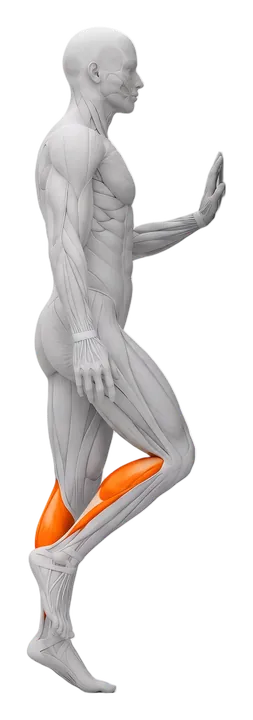 Single-leg calf raiseCalves
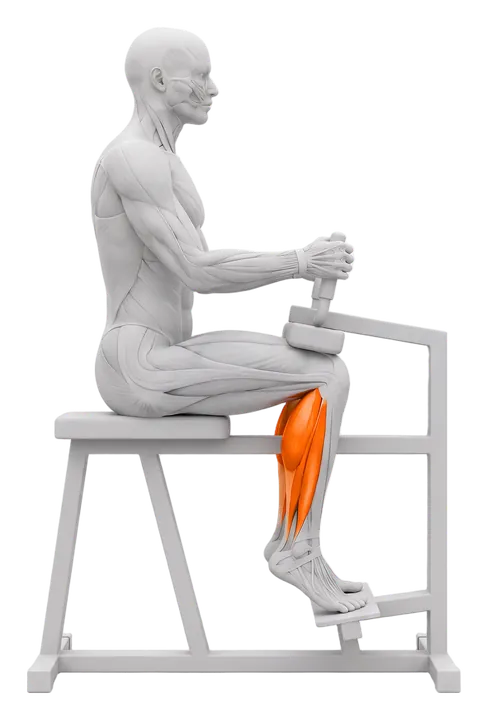 Seated calf raiseCalves