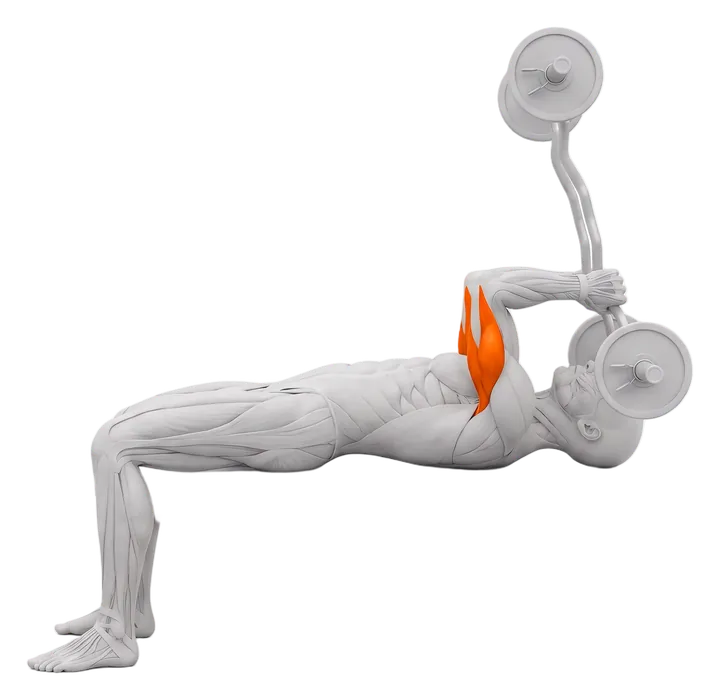
What do skull crushers work?
| Muscle | Role | How much |
|---|---|---|
| Triceps, long head | Straightens the elbow; stretched when the arms angle back | Primary |
| Triceps, lateral head | Straightens the elbow | Primary |
| Triceps, medial head | Straightens the elbow | Primary |
| Lats and rear shoulder | Hold the upper arms in place | Stabiliser |
| Forearms | Grip and wrist position | Stabiliser |
The long head is the biggest of the three heads and the only one that crosses the shoulder. It is lengthened when your upper arm is raised towards or past your head. A skull crusher with the arms tilted slightly back puts it in that position, which a tricep pushdown does not. That is why the two make a good pair in any tricep workout.
How to do skull crushers
- Lie on a flat benchFeet flat on the floor, head on the bench. Hold an EZ bar with a narrow grip on the angled part, about shoulder width or a bit closer.
- Set the start positionPress the bar up over your chest, then let your arms tilt back slightly so the bar sits over your eyes or forehead. Your upper arms should be angled a little towards your head, not straight up.
- Lower by bending the elbowsKeep your upper arms still and bend only at the elbows. Lower the bar over two to three seconds to just above your forehead, or past it towards the top of your head for more stretch.
- Extend back upStraighten your elbows to bring the bar back to the start. Stop just short of a hard lockout to keep tension on the triceps.
- Keep the elbows inElbows point roughly towards your feet the whole set, not out to the sides.
Lowering behind the head for the long head
The classic version lowers the bar to the forehead with the upper arms vertical. Many coaches now prefer a slightly different path: upper arms angled back 15 to 30 degrees and the bar lowered behind the top of the head. Two things change:
- More stretch on the long head, because the arm is closer to overhead.
- Constant tension, because with arms angled back the triceps are still working at the top. With vertical arms, the weight rests on locked joints at the top and the triceps get a break.
The trade off: going behind the head takes more shoulder mobility and makes it easier for the elbows to drift. If you try it, let the upper arms move back a little at the bottom and return them at the top, but keep it small. The movement should still be mostly at the elbow.
EZ bar vs dumbbell skull crushers
| EZ bar | Dumbbells | |
|---|---|---|
| Grip | Semi supinated, angled | Neutral, palms facing each other |
| Load | Heavier, small jumps with plates | Lighter, limited by dumbbell steps |
| Elbow comfort | Good for most | Often the most comfortable |
| Balance | Stable, both arms linked | Each arm on its own |
| Range | Bar stops at the head | Dumbbells go beside the head, deeper stretch |
EZ bar skull crushers
The angled grip of an EZ bar is easier on the wrists and elbows than a straight barbell. It is the standard choice and the easiest to load in small steps. Get a partner to hand you the bar, or start with it on your thighs and press it up as you lie back.
Dumbbell skull crushers
Hold a dumbbell in each hand with palms facing each other and lower them to beside your head. The neutral grip is often kinder to the elbows, the dumbbells can travel past your ears for a longer stretch, and each arm has to do its own work. A single dumbbell held with both hands is a simple option at home.
Incline and other versions
On an incline bench, the arms are further overhead, which adds long head stretch. Cable skull crushers with a low pulley behind the bench keep tension even through the rep. A straight barbell works but puts the wrists in a more fixed position.
Skull crushers and elbow comfort
Skull crushers have a reputation for sore elbows. Most of it comes down to load and warm up.
- Warm up first. One or two light sets of pushdowns get blood into the elbows.
- Use moderate to high reps, 8 to 15. Heavy sets of 5 are where elbows usually complain.
- Switch to dumbbells or a neutral grip if the EZ bar bothers you.
- Shorten the range a little at the bottom.
- Put them later in the session after the elbows are warm from pressing.
Common skull crusher mistakes
- Elbows flaring out. Keeps the load off the triceps and strains the elbow. Squeeze them in.
- Turning it into a press. If your upper arms swing a lot, you are doing a close grip bench. Lower the weight.
- Dropping fast. The bar is moving towards your face. Lower it slowly, always.
- Too heavy, too soon. Small jumps. This is not a lift to test your max on.
- No spotter at heavy weights. Fail on the way up, not the way down, and stop a rep or two short of failure.
Sets and reps for skull crushers
| Goal | Sets x reps | Rest | Notes |
|---|---|---|---|
| Triceps growth | 3 x 8 to 12 | 90 s | EZ bar, arms angled back |
| Long head focus | 3 x 10 to 15 | 90 s | Dumbbells or incline, behind the head |
| Sensitive elbows | 2 to 3 x 12 to 15 | 60 to 90 s | Dumbbells, neutral grip, light |
| Beginner | 2 x 10 to 12 | 90 s | Light EZ bar, to the forehead |
Do skull crushers once a week, maybe twice, after pressing such as the bench press or dips. On the Arnold split shoulders and arms share a day, which is a natural home for them. On a push day, put them before pushdowns so the heavier exercise comes first.
How to progress skull crushers
Use small steps: 2.5 kg (5 lb) total on an EZ bar, or the next dumbbell when you can. Work up through a rep range such as 8 to 12, and add weight only when every set reaches 12 with the elbows in and control at the bottom. More on the method in progressive overload.
Gripp knows when you are ready for more
Log your skull crushers and Gripp tells you what to aim for next session, from last time's weight and reps. When every set hits the top of your range, it suggests more weight. Your estimated max goes on a chart, and Gripp rates your arms against people of your age and bodyweight.
Join the waitlistSkull crusher alternatives
- Overhead tricep extension: cable or dumbbell, the most long head stretch.
- Cable tricep pushdown: elbow friendly and easy to learn.
- Close grip push-up: bodyweight triceps work at home.
- Dips: heavy compound triceps work.
- Cable skull crusher: the same movement with steadier tension.
Similar exercises
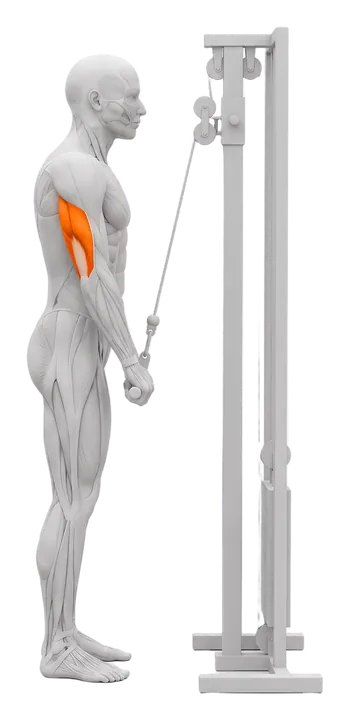 Cable triceps pushdownTricepsGuide
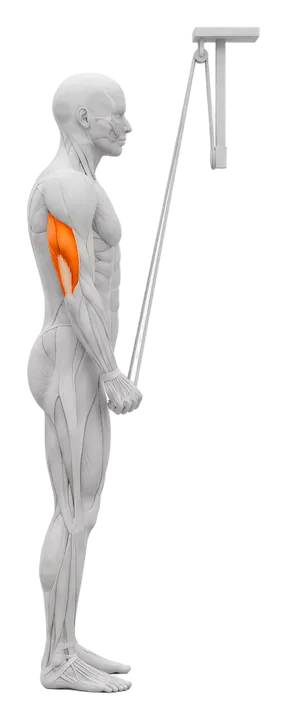 Band triceps pushdownTriceps
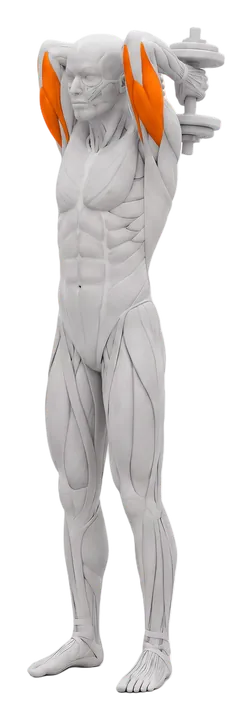 Overhead dumbbell triceps extensionTricepsGuide
 Close-grip push-upTriceps and chest