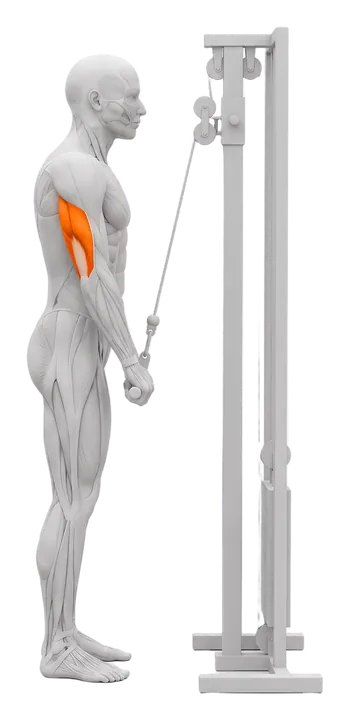
Tricep pushdown muscles worked
| Muscle | Role | How much |
|---|---|---|
| Triceps, lateral head | Straightens the elbow, outer back of the arm | Primary |
| Triceps, medial head | Straightens the elbow, works in every press | Primary |
| Triceps, long head | Straightens the elbow; also crosses the shoulder | Primary, less stretched here |
| Forearms | Hold the grip and keep the wrists straight | Stabiliser |
| Core and lats | Keep the torso and upper arms still | Stabiliser |
All three heads straighten the elbow, so all three work in a pushdown. The long head also runs over the shoulder, and it is stretched most when the arm is overhead. With the arms at your sides, as here, the long head works but is not lengthened. That is why a complete tricep workout pairs the pushdown with an overhead or lying extension such as skull crushers.
How to do a tricep pushdown
- Set the pulley highPut the pulley at the top position and clip on your attachment. Stand close enough that the cable runs straight down in front of you, feet about hip width, knees soft.
- Pin the elbowsGrab the handle and pull it down until your elbows are bent to roughly 90 degrees, then tuck your elbows against your sides, slightly in front of the ribs. This is the start position.
- Push downStraighten your elbows until your arms are fully locked out at your thighs. Only the forearms move; the upper arms stay where they are.
- Squeeze at the bottomHold the lockout for a moment and squeeze the back of your arms.
- Return with controlLet the handle rise until your forearms are about parallel to the floor or slightly higher, then push again. Do not let the elbows drift up and forward.
How to keep your elbows pinned
Elbows that swing forward and back are the most common pushdown fault. When the upper arm moves, the lats and shoulders join in and the set turns into a half press, half pulldown. These fixes help:
- Lean slightly forward from the hips, about 10 to 20 degrees, so the cable pulls along your arms instead of away from you.
- Squeeze a towel between each elbow and your side for a few sets. If it drops, the elbow moved.
- Shoulders down and back. Shrugging lets the upper arm swing.
- Stop the return at about 90 degrees. Going higher is usually where the elbows start to float.
- Lower the weight. If you have to rock your body to start the rep, the stack is too heavy.
Rope vs straight bar vs V bar vs single arm
| Attachment | Grip | How it feels | Good for |
|---|---|---|---|
| Rope | Neutral, palms facing each other | Spread the ends apart at the bottom for a strong squeeze | Full lockout, comfortable on wrists |
| Straight bar | Overhand, palms down | Most stable, usually the heaviest | Loading heavier, simple progression |
| V bar | Angled, between neutral and overhand | Very stable, easy on the wrists | A middle ground between rope and bar |
| Single handle | Neutral or palms down, one arm | Lets you check each arm on its own | Fixing a weaker side, elbow comfort |
| Reverse grip bar | Underhand, palms up | Lighter, more forearm work | Variety, wrist friendly for some |
Rope tricep pushdown
The rope lets your hands rotate and move apart at the bottom. Push the ends towards the outside of your thighs as you lock out. You will use a little less weight than with a bar, but many lifters feel the triceps work more. It is a good default.
Straight bar and V bar pushdown
A fixed bar keeps both hands locked together, so it is the most stable version and usually the one you can load the most. Some people get wrist strain with a straight bar; the angled V bar or an EZ attachment often fixes that.
Single arm tricep pushdown
Use a single D handle, overhand or neutral. Stand side on to the stack and push down beside your hip. It takes longer but it shows quickly if one arm is weaker, and it is often the most comfortable option for sore elbows.
Tricep pushdown form mistakes
- Elbows flaring out. Keep them close to your sides and pointing back.
- Leaning over the bar and pushing with body weight. A big lean turns it into a press. Small lean, arms do the work.
- Bent wrists. Keep the wrists straight, in line with the forearm.
- Partial reps. Lock out fully every rep. That is where the triceps are working hardest.
- Letting the stack yank you up. Control the return over about two seconds.
Tricep pushdown sets and rep ranges
| Goal | Sets x reps | Rest | Notes |
|---|---|---|---|
| Muscle growth | 3 x 10 to 15 | 60 to 90 s | 1 to 2 reps short of failure |
| Heavier work | 3 x 8 to 10 | 90 s | Straight bar or V bar, strict form |
| Finisher | 2 x 15 to 25 | 45 to 60 s | Rope, pause at lockout |
| Beginner | 2 to 3 x 12 to 15 | 60 s | Learn to keep the elbows still |
The pushdown suits moderate to high reps. Very heavy sets of 5 rarely work well because the body starts to help. Do it after compound pressing such as the bench press or tricep dips, once or twice a week. On the push day of a push pull legs split it often closes the session.
How to progress the tricep pushdown
Choose a range such as 10 to 15 and add reps until every set reaches 15 with locked elbows. Then add one plate on the stack and start near 10 again. If the next plate is too big a jump, keep the weight and add a one second pause at lockout. The idea behind this is explained in progressive overload.
Gripp keeps your pushdown numbers moving
Log each set and Gripp shows what you lifted last time and what to aim for today. Hit the top of the rep range in every set and it moves the weight up. Your estimated max for the exercise goes on a chart, and Gripp rates your arms against people of your age and bodyweight.
Join the waitlistTricep pushdown alternatives
- Band tricep pushdown: a resistance band over a door or bar, the home version.
- Close grip push-up: a bodyweight press with a lot of triceps work.
- Overhead tricep extension: with a cable or dumbbell, it stretches the long head.
- Skull crushers: a lying extension with an EZ bar or dumbbells.
- Dips: a heavy compound option for the triceps and chest.
- Dumbbell kickback: light and strict, if you have no cable.
Similar exercises
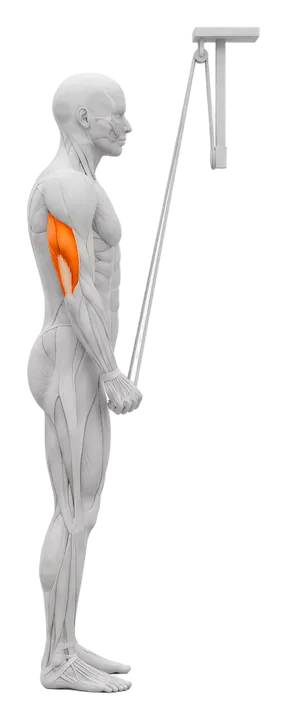 Band triceps pushdownTriceps
 Close-grip push-upTriceps and chest
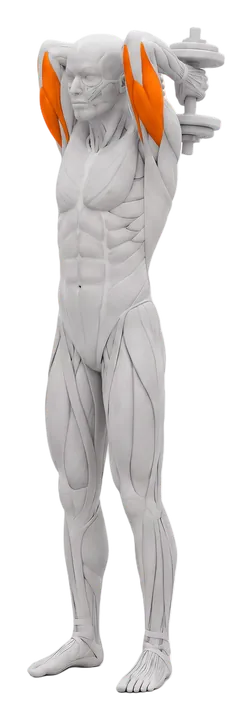 Overhead dumbbell triceps extensionTricepsGuide
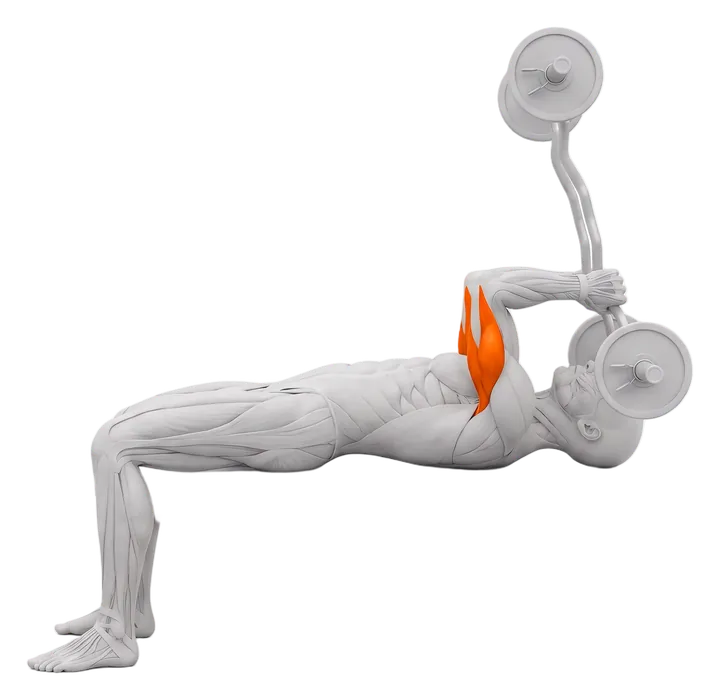 Lying triceps extension (skull crusher)TricepsGuide