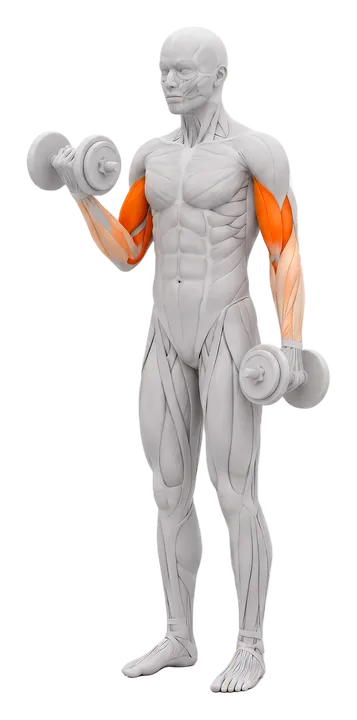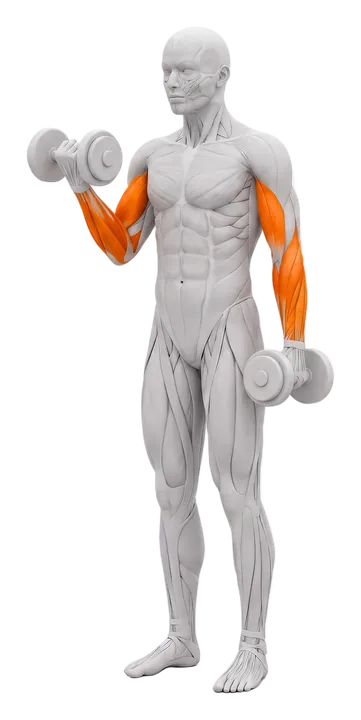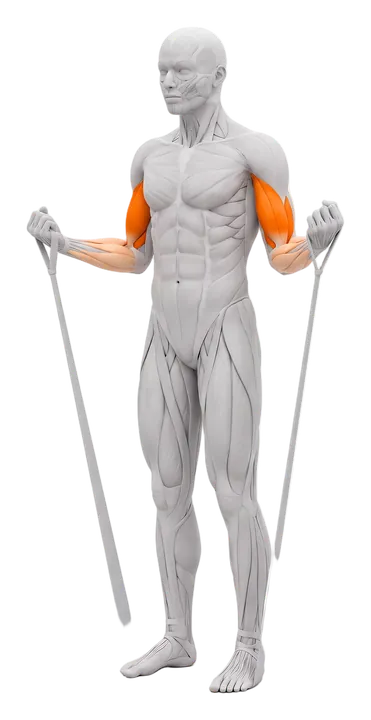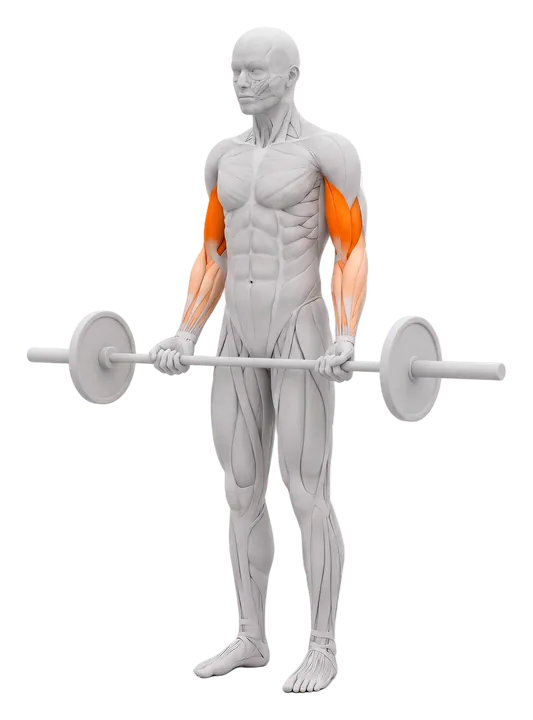
Barbell bicep curl muscles worked
| Muscle | Role in the barbell curl | How much |
|---|---|---|
| Biceps brachii | Bends the elbow; the fixed palms up grip keeps it fully engaged | Primary |
| Brachialis | Bends the elbow under the biceps | Secondary |
| Brachioradialis | Assists, a little more on an EZ bar | Secondary |
| Forearm flexors | Grip the bar and hold the wrists neutral | Stabiliser |
| Front delts | Hold the upper arm still | Stabiliser |
| Core and lower back | Keep the torso upright, more with heavy loads | Stabiliser |
With dumbbells, your hands can rotate freely. A straight barbell locks both hands palms up for the whole rep, which is the position where the biceps is at its strongest. That is the main reason the barbell curl is a staple of every bicep workout built for size, and why many lifters treat it as their heavy curl and do lighter dumbbell bicep curls later in the session.
How to do a standing barbell curl
- Grip the barTake the bar from a rack at hip height, or deadlift it up from the floor. Underhand grip, hands about shoulder width, thumbs wrapped around the bar.
- Stand tallFeet hip width, knees soft, glutes tight. The bar hangs against your thighs with straight arms.
- CurlKeep your elbows by your ribs and bend them to bring the bar up in an arc. Stop when your forearms are near vertical and the bar is in front of your upper chest. Do not let the elbows travel forward to finish higher.
- SqueezeHold the top briefly and tense the biceps hard. This is also where you check that your wrists are straight, not curled back.
- Lower slowlyTake two to three seconds to lower the bar until your arms are fully straight. Touch the thighs lightly, then start the next rep without bouncing.
Straight bar vs EZ bar bicep curl
This is the biggest choice with the barbell curl. Both build the biceps; they differ in comfort and in how much the forearm helps.
| Straight barbell | EZ bar | |
|---|---|---|
| Hand position | Fully palms up (supinated) | Angled, partly turned in |
| Biceps involvement | Highest | Slightly lower |
| Brachioradialis | Less | A bit more |
| Wrist and elbow comfort | Some people feel strain | Kinder for most people |
| Bar weight | Olympic bar usually 20 kg (45 lb) | Varies, often roughly 7 to 12 kg (15 to 25 lb) |
| Good for | Maximum biceps load | Joint friendly heavy curling |
When to choose the straight bar
If your wrists handle it, the straight barbell gives the biceps the most direct load. Shorter fixed weight barbells, found on racks in many gyms, are convenient because a full Olympic bar is already a working weight for many beginners.
When to choose the EZ bar bicep curl
If your forearms or the inside of your elbows ache on a straight bar, the EZ bar is the fix. Its bends let your hands turn in slightly, which many people find much more comfortable. Grip the inner bends for a closer curl or the outer bends for a wider one. Weigh your gym's EZ bar once or check the label, because they are not standard, and log that weight so your numbers mean something.
Grip width
- Shoulder width: the default. Forearms run straight down, wrists stay neutral.
- Close grip barbell bicep curl: hands a little inside shoulder width. Many lifters feel it more on the outer part of the arm. It can strain the wrists on a straight bar, so the EZ bar inner bends are an easier way to try it.
- Wide grip: hands outside shoulder width. Often felt more on the inner part of the biceps. Keep the elbows tucked even if the hands are wide.
Differences between grips are small. Pick the one that feels best on your joints and keep it the same, so you can compare sessions.
Cheat curls: when swinging is a tool and when it is a habit
The barbell curl is the classic exercise for cheating, because a heavy bar is easy to swing up with the hips. Done on purpose, a cheat curl lets you lift a weight you could not curl strictly and then fight it on the way down. Done by accident, it just means the bar is too heavy.
| Strict curl | Planned cheat curl | |
|---|---|---|
| Body | Still, glutes tight | Small hip drive to start the bar |
| Load | Your normal working weight | Heavier than you can curl strictly |
| Lowering | Controlled | Very slow, 3 to 4 s, this is the point |
| When | Every working set | Last reps of a set, or one extra set |
| Risk | Low | Higher for the lower back if the lean grows |
A simple rule: if you cannot lower the bar slowly, the cheat was too big. Keep the lean small, keep the elbows near the body, and never round the lower back to get the bar moving. For beginners, strict reps are enough for a long time. Lean back against a wall if you want to make cheating impossible.
Common barbell curl mistakes
- Elbows swinging forward. The front delts lift the bar the last part. Finish lower and keep the elbows at your sides.
- Wrists bending back. Common with heavy straight bar curls. Keep the knuckles in line with the forearm, or switch to an EZ bar.
- Leaning back on every rep. Turns the curl into a standing back bend. Lighten the load.
- Stopping short at the bottom. Straighten the arms fully each rep to train the biceps through its whole range.
Sets and reps for barbell curls
| Goal | Sets x reps | Rest | Notes |
|---|---|---|---|
| Biceps growth | 3 to 4 x 8 to 12 | 60 to 90 s | Strict, 1 to 2 reps from failure |
| Strength | 3 x 6 to 8 | 2 min | Straight bar, lean kept small |
| Overload | 1 to 2 x 5 to 6 cheat reps | 2 min | After strict sets, slow lowering |
| Joint friendly | 3 x 12 to 15 | 60 s | EZ bar, moderate weight |
Put barbell curls first in your arm block, while you are fresh. Follow them with a neutral grip curl like the hammer curl for the brachialis and forearms. On a push pull legs split, they fit at the end of the pull day, or you can superset them with skull crushers on an arm day. An overhead tricep extension is another good partner.
How to add weight to the barbell curl
This is where the barbell beats dumbbells. With fractional or 1.25 kg (2.5 lb) plates, you can add 2.5 kg (5 lb) to the bar, or even less, instead of jumping a whole dumbbell size on each arm. Work in a range such as 8 to 12, add a rep when you can, and add the smallest plate pair once every set reaches 12 with strict form. The progressive overload guide explains why small steps add up.
Gripp spots when the bar can go up
Log your barbell curls with weight and reps, and Gripp tells you what to hit next time: one more rep, or a heavier bar when every set reached the top of your range. Your estimated 1RM for the curl goes on a chart, and your arm strength is rated against people of your age and bodyweight.
Join the waitlistBarbell curl alternatives
- Dumbbell curl: free wrist rotation, each arm works alone.
- Cable curl with a straight bar: the same grip with tension at the bottom of the rep. More in the cable bicep workout.
- Preacher curl: upper arms braced on a pad, so cheating is impossible.
- Chin-up: a heavy compound pull with a lot of biceps work.
- Band curl: for home or for sore elbows.