Why curl on a cable
A dumbbell curl is hard in the middle and easy at both ends, because gravity pulls straight down and your forearm is only working against it when it is close to horizontal. A cable changes that. Stand back from a low pulley, lean slightly, or turn your body, and you can move the hardest part of the curl to the start, the middle or the top.
That makes the cable machine the most flexible bicep tool in the gym. The same station gives you a curl that is heavy in the stretch (Bayesian), one that is heavy when the elbow is fully bent (high cable curl) and one that stays hard from bottom to top (a straight bar curl stepped back from the pulley). None of these moves are in our exercise library with their own card yet, so each is described below. For dumbbell and barbell options, see the bicep workout hub.
Other cable exercises that train your arms
The cable bicep workout
| Exercise | Attachment and pulley | Sets x reps | Rest |
|---|---|---|---|
| Cable curl | Straight or EZ bar, low pulley | 3 x 8 to 12 | 90 s |
| Bayesian curl, facing away | Single D handle, low pulley | 3 x 10 to 12 per arm | 60 s |
| High cable curl, both arms | Two D handles, pulleys at shoulder height or higher | 3 x 12 to 15 | 60 s |
| Rope hammer curl | Rope, low pulley | 2 x 12 to 15 | 60 s |
Order matters. The straight bar curl comes first because it lets you use the most weight. The Bayesian curl follows while you are still fresh enough to control the stretch. The high curl and rope curl are lighter, so they work well when the biceps are already tired.
How to do each cable curl
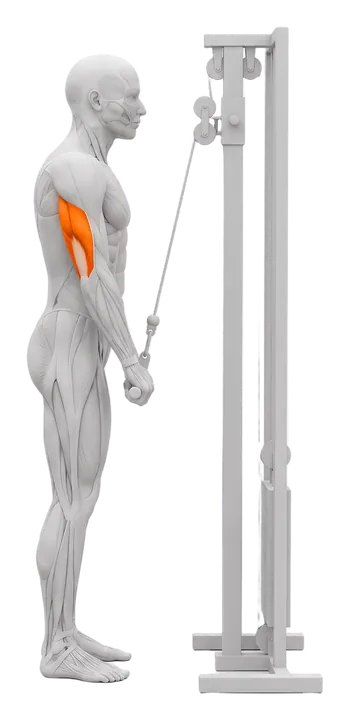
- Cable curl with a barClip a straight or EZ bar to the low pulley, take one step back and stand tall. Curl with the elbows pinned to your sides and lower for about two seconds. Stepping back a little keeps tension on the biceps at the bottom, where a dumbbell goes slack. The EZ bar is easier on the wrists for many people.
- Bayesian curlFace away from a low pulley with a single handle, step forward until your arm is pulled slightly behind your body, and curl from there without letting the elbow drift forward. The biceps work hardest when they are long, which a dumbbell curl cannot do.
- High cable curlSet two pulleys at shoulder height or higher, stand in the middle and curl both handles towards your ears, like a front double biceps pose. The load peaks when the elbow is fully bent, so squeeze for a second there.
- Rope hammer curlUse the rope on a low pulley with palms facing each other. This grip shifts more work to the brachialis and brachioradialis, the muscles that add thickness to the side of the upper arm and forearm. Pull the rope ends apart slightly at the top.
The cable rope hammer curl does the same job as a hammer curl with dumbbells, with constant tension instead of a heavy middle. Pick the one you can progress on.
More cable curl variations
- Single arm cable bicep curl: stand side-on to the low pulley. Each arm works on its own, which helps if one bicep is visibly smaller. Do the weaker arm first and match its reps with the other.
- Reverse cable curl: overhand grip on a straight bar. Much lighter, and it trains the brachioradialis and wrist extensors more than the biceps. Useful for forearms and for elbow balance.
- Lying cable curl: lie on your back on the floor or a bench with your feet towards the low pulley and curl to your forehead. It removes all body swing, so it is a strict choice for the last set.
- Seated cable curl: sit on the low row bench and curl with your elbows on your knees, close to a preacher curl. Good for people who cheat on standing curls.
- Overhead cable curl: like the high cable curl but with one arm at a time and the elbow slightly higher, for a peak contraction.
Beginner version
If you are new to curls, two exercises are plenty. Your biceps also work on every row and pulldown, so a beginner does not need a long arm session.
| Exercise | Sets x reps | Rest |
|---|---|---|
| Cable curl, EZ bar | 3 x 10 to 12 | 90 s |
| Rope hammer curl | 2 x 12 to 15 | 60 s |
Put it at the end of a pull day once or twice a week. After six to eight weeks, add the Bayesian curl and work up to the full session.
Advanced version with a drop set
| Exercise | Sets x reps | Rest | Technique |
|---|---|---|---|
| Cable curl, straight bar | 4 x 6 to 10 | 2 min | Heavy, strict, 2 second lowering |
| Bayesian curl | 3 x 8 to 12 per arm | 60 s | Pause 1 second in the stretch |
| High cable curl | 3 x 12 to 15 | 60 s | 1 second squeeze at the top |
| Rope hammer curl | 3 x 10 to 12 | 60 s | Last set: drop set, see below |
| Reverse cable curl | 2 x 12 to 15 | 60 s | Forearms |
A cable curl drop set is quick because you only move a pin. Do your last set to about 1 rep short of failure, move the pin up two plates, do as many clean reps as you can, then drop once more. Use it on the final set of one exercise, not every set, or recovery for your next pull day will suffer. The drop sets guide covers when they are worth it.
Arm cable workout: biceps and triceps together
If you want a full arm workout with cables, pair each curl with a triceps move and alternate them as supersets. A cable overhead tricep extension is a good choice next to the pushdown. You save time, and the opposing muscle rests while the other works.
| Pair | Exercise A | Exercise B | Sets x reps |
|---|---|---|---|
| 1 | Cable curl, straight bar | Tricep pushdown, straight bar | 3 x 8 to 12 each |
| 2 | Bayesian curl | Overhead cable triceps extension, rope | 3 x 10 to 12 each |
| 3 | Rope hammer curl | Rope pushdown | 2 x 12 to 15 each |
Rest 60 to 90 seconds after each pair. Technique for the pushdowns is in the tricep pushdown guide, and more ways to combine muscles are in the supersets guide.
How to progress your cable curls
Biceps are a small muscle, and a single pin on a cable stack can be a 10 to 20 percent jump on a curl. That is why reps should go up before weight does. Pick a range, for example 10 to 12, stay at one weight until every set reaches 12 with no swing, then move up one pin.
- Pin too heavy? Many stacks have a small add-on weight that slides on top. Use it as a half step.
- No add-on? Slow the lowering to 3 seconds or add a set for a week or two, then try the next pin again.
- Compare like with like. The numbers on two cable stations rarely match, so track each curl on the same machine.
The full rule set is in the progressive overload guide.
Gripp tracks every pin you curl
Gripp is coming to iPhone. It logs reps and weight for every set and tells you what to aim for next session: last time 11 reps at 20 kg (45 lb) on the cable curl, today go for 12. Your estimated 1RM per exercise goes on a chart over time, and Gripp rates your arm strength against people of your age and bodyweight.
Join the waitlist