Why train your back on cables
With a dumbbell or barbell, gravity only pulls straight down, so a row gets easy at the bottom and a pulldown move is impossible. A cable pulls along its own line, set by the pulley. That gives your back muscles tension from the full stretch to the full squeeze, on angles free weights cannot reach.
- Constant tension: there is no point in the rep where the weight rests on a joint. The lats and upper back work from start to finish.
- Stretch under load: at the top of a pulldown or the front of a cable row your lats are long and still loaded, a position that tends to be good for muscle growth.
- Low spinal load: you sit or stand braced instead of holding a heavy bar in a hinge. Useful on days when your lower back is tired from squats or deadlifts.
- Fast weight changes: moving a pin takes a second, which makes drop sets and finding the right load easy.
- Attachments: the same station gives you wide, close, neutral, rope and single-arm versions of every pull.
Cable back exercises
The cable back workout
All of this happens on one cable station, a lat pulldown seat and a low row seat, which most gyms put side by side. Plan about 50 minutes.
| Exercise | Attachment | Sets x reps | Rest |
|---|---|---|---|
| Lat pulldown | Wide bar | 4 x 6 to 10 | 2 min |
| Seated cable row | Close neutral handle (V-bar) | 4 x 8 to 12 | 2 min |
| Single-arm cable row, standing or kneeling | Single D handle | 3 x 10 to 12 per side | 90 s |
| Straight-arm pulldown | Straight bar or rope | 3 x 12 to 15 | 60 s |
| Cable face pull | Rope | 3 x 12 to 20 | 60 s |
Want to make it a back and bicep cable workout? Add 3 sets of cable curls with the straight bar at the end. Your biceps already worked on every pull, so 2 to 3 sets is enough. More arm options are in the bicep workout.
Why each exercise is in it
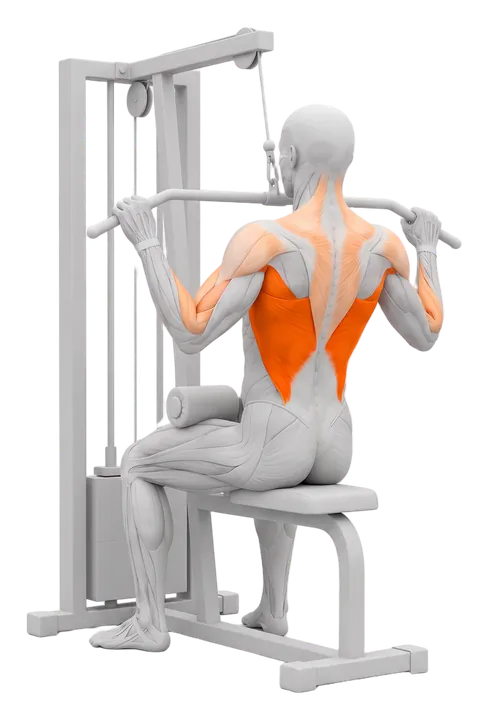
- Lat pulldown: the vertical pull and the heaviest lift of the session. It trains the lats through a big range and is the cable version of the pull-up. Grip width and how far to lean back are in the lat pulldown guide.
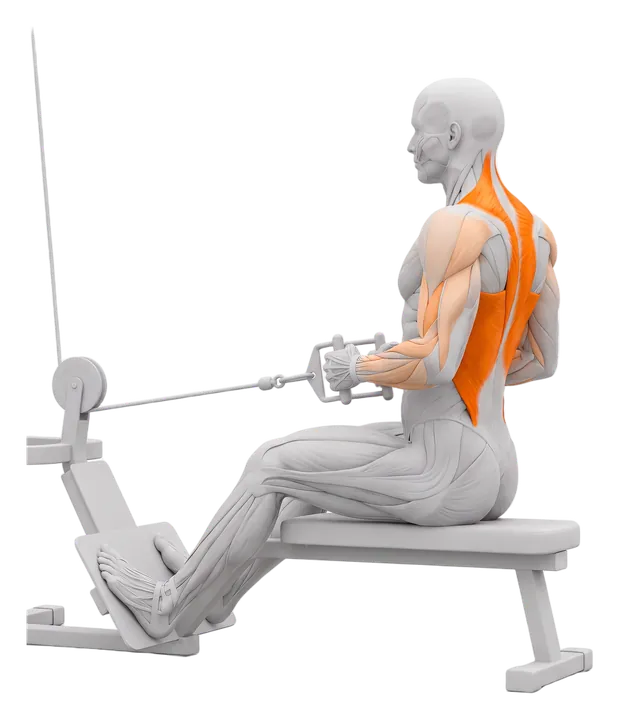
- Seated cable row: the horizontal pull for the mid back, rhomboids and lats. Let the shoulder blades travel forward at the front, then pull them back. The seated cable row guide covers grips and posture.
- Single-arm cable row: each side works on its own, which shows and fixes left to right differences. Pull the elbow back towards the hip to bias the lats.
- Straight-arm pulldown: stand facing a high pulley, arms almost straight, hinge slightly forward and sweep the bar or rope down to your thighs. The biceps barely help, so this isolates the lats. It is not in our exercise library yet, but it is easy to learn: keep the elbows soft and fixed, and stop when the hands reach the hips.
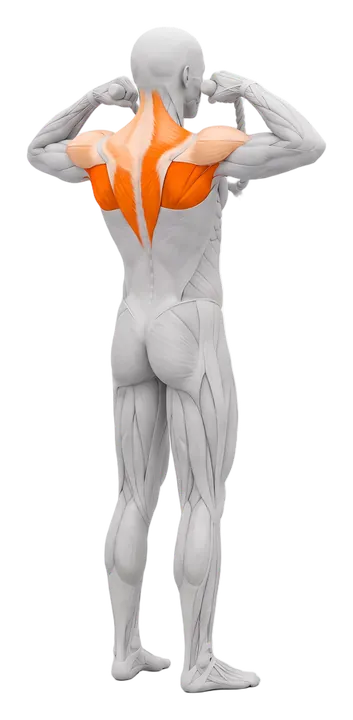
- Face pull: rear delts and upper back, the muscles that balance a lot of pressing. Rope at eye height or a little higher. See the face pull guide for hand position.
Which attachment to use
The handle changes your grip width and hand angle, which changes which muscles do most of the work. There is no single best attachment. Pick one per exercise and keep it for several weeks so your numbers are comparable.
| Attachment | Grip | Best for | Feels like |
|---|---|---|---|
| Wide straight bar | Overhand, wider than shoulders | Lat pulldown, wide rows for upper back | Classic pulldown, more upper back and rear delt |
| Close neutral handle (V-bar) | Palms facing, hands close | Seated cable row, close-grip pulldown | Strong position, easy to load heavy |
| Wide neutral or parallel grip bar | Palms facing, shoulder width | Pulldown and row | Comfortable for many shoulders |
| Rope | Palms facing, free to rotate | Face pull, straight-arm pulldown | Lets the wrists move naturally |
| Single D handle | Any | Single-arm rows and pulldowns | Full range for each side |
Beginner version
If you are new to back training, start with three exercises and learn to feel the shoulder blades move.
| Exercise | Sets x reps | Rest |
|---|---|---|
| Lat pulldown, neutral or wide grip | 3 x 8 to 12 | 90 s |
| Seated cable row, V-bar | 3 x 10 to 12 | 90 s |
| Cable face pull | 2 x 12 to 15 | 60 s |
Do it once or twice a week. When you can do 12 strict pulldowns with a weight close to your bodyweight, you are ready to start working on pull-ups.
Advanced version
| Exercise | Sets x reps | Rest | Technique |
|---|---|---|---|
| Lat pulldown, wide bar | 4 x 5 to 8 | 2 to 3 min | Heavy, 1 to 2 reps left |
| Single-arm kneeling lat pulldown | 3 x 10 to 12 per side | 90 s | Full stretch at the top |
| Seated cable row, V-bar | 4 x 8 to 10 | 2 min | Last set: drop the weight 20 to 30 percent and keep going |
| Straight-arm pulldown, rope | 3 x 12 to 15 | 60 s | One second squeeze at the hips |
| Wide-grip seated row to the upper chest | 3 x 10 to 12 | 90 s | Elbows high, upper back |
| Cable face pull | 3 x 15 to 20 | 60 s | Slow lowering |
If your gym is free, pull-ups or a dumbbell row can replace one cable move for variety, but this session is complete as it stands.
Upper back and lower back on cables
Most upper back cable exercises are rows with the elbows out: wide-grip seated rows, face pulls and high rows with a rope. Use them for the rhomboids, middle traps and rear delts. Lat-focused moves keep the elbows closer to the body and pull towards the hips.
The lower back is a different story. The erector muscles mainly keep your spine still, and a cable machine is not the best tool for that. A cable pull-through, facing away from a low pulley and hinging at the hips, trains glutes and hamstrings with some lower back work. For direct lower back training, back extensions and Romanian deadlifts from the back exercises guide are the better choice. If your lower back hurts during or after training, reduce the load and see a physiotherapist if it does not settle.
How to progress on the cable stack
Cables make progressive overload simple, with one catch: the jumps between pins can be large. Many stacks go up in 5 to 7 kg (10 to 15 lb) steps, and some machines have a small add-on weight for half steps.
- Pick a rep range for each exercise, for example 8 to 12 on rows.
- Use the same weight until every set reaches the top of the range with clean form.
- Move up one pin. Your reps will drop, often to the bottom of the range, and that is fine.
- Build the reps back up over the next sessions, then move up again.
- If a jump is too big, use the add-on weight, hold the last rep for two seconds, or add a set before moving up.
Stack numbers are not the same from machine to machine because pulleys change the real resistance, so compare yourself only on the same machine. The progressive overload guide explains double progression in detail.
Gripp remembers every pin
Gripp is coming to iPhone. It logs each set's reps and weight and tells you what to lift next session: last time 10 reps at 59 kg (130 lb) on the seated cable row, today go for 11. Your estimated 1RM per exercise goes on a chart, and Gripp rates your back strength against people of your age and bodyweight.
Join the waitlistWhere the cable back workout fits in your week
This is a natural pull day on push pull legs. On an upper and lower split, take the pulldown, the row and the face pull and pair them with presses. If you train at home with dumbbells only, the dumbbell back exercises page has a session built for that equipment.