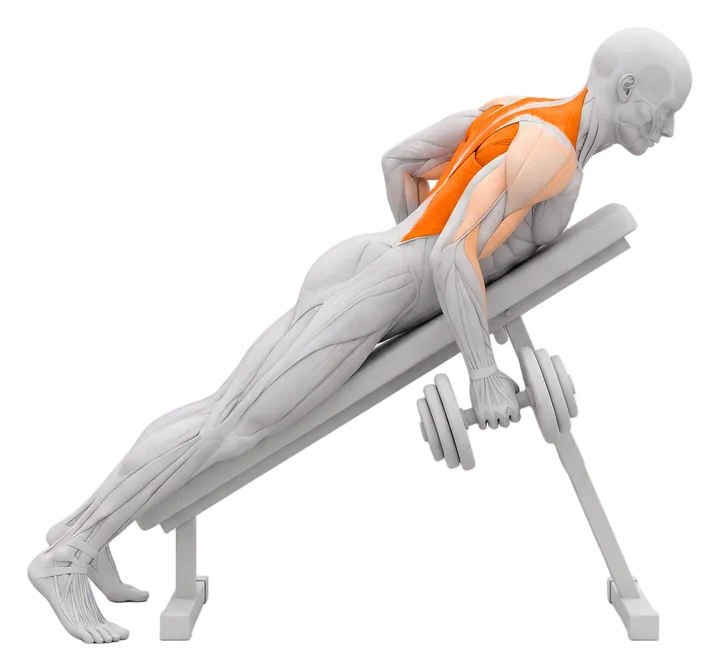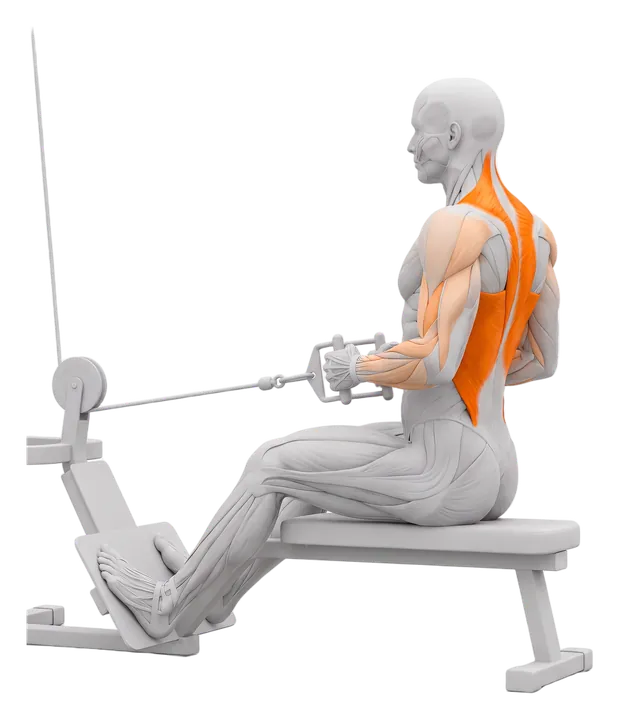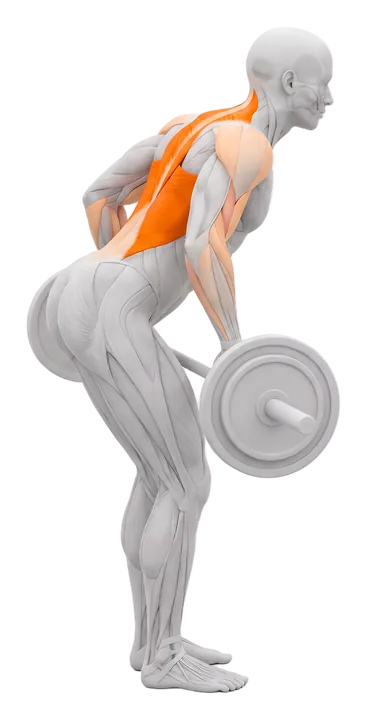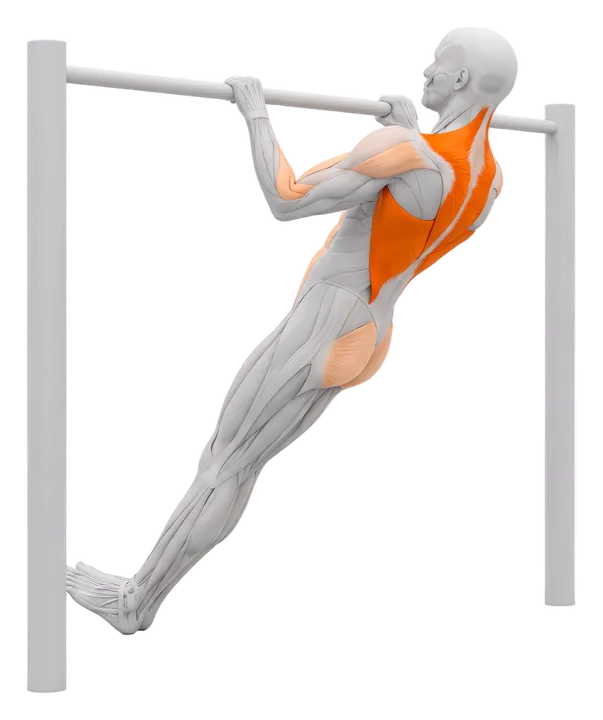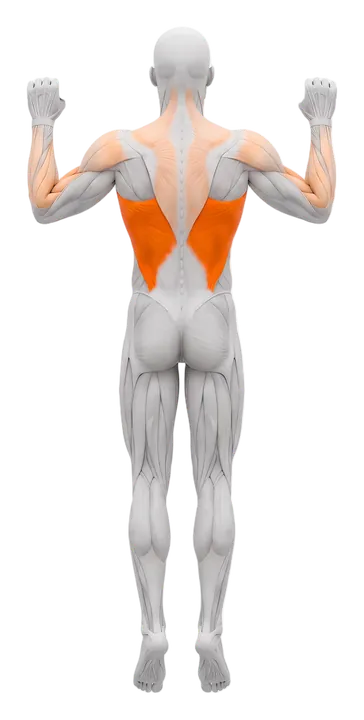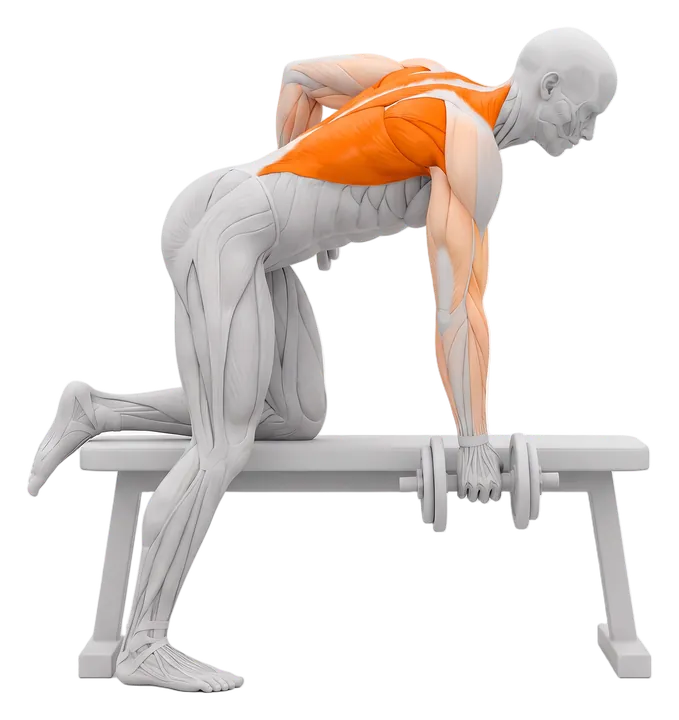
Dumbbell row muscles worked
| Muscle | Role | How much |
|---|---|---|
| Lats | Pull the upper arm back towards the hip | Primary |
| Upper back (rhomboids, middle traps) | Pull the shoulder blade back towards the spine | Primary |
| Rear delts | Help pull the upper arm back, more with the elbow out | Secondary |
| Biceps and forearms | Bend the elbow and hold the dumbbell | Secondary |
| Abs and obliques | Stop the torso from rotating | Secondary |
Because each side works alone, the one-arm dumbbell row shows you quickly if one side is weaker, and it lets the shoulder blade move further than a barbell row. It belongs in almost any back exercises plan, and it is often the main row in dumbbell back exercises at home. For a full session without gym machines, see the back workout at home.
How to do a single arm dumbbell row
- Set up on the benchPut your left knee and left hand on a flat bench, hand under the shoulder. Your right foot stands on the floor, a little out to the side for balance. Your back is flat and roughly parallel to the floor.
- Take the dumbbellHold the dumbbell in your right hand with the arm hanging straight below the shoulder, palm facing the bench. Let the shoulder drop slightly to feel a stretch in the lat.
- PullDrive the elbow up and back until the dumbbell reaches the side of your lower ribs or hip. Keep your chest square to the bench.
- LowerLower the dumbbell under control until the arm is straight and the shoulder blade has moved forward again. Do all reps on one side, then switch.
Lats vs upper back: the elbow path decides
The same dumbbell row can bias two different areas of the back, depending on where your elbow goes. Choose one path per set and keep it the same so the numbers you log mean something.
| Lat focused row | Upper back focused row | |
|---|---|---|
| Elbow | Close to the body, travelling towards the hip | Out at about 45 to 60 degrees from the body |
| Dumbbell finishes | At the hip | At the lower chest |
| Grip | Neutral, palm facing in | Neutral or slightly turned, knuckles out |
| Feel it | Side of the back, below the armpit | Between and around the shoulder blades, rear delts |
| Pair with | Pull ups, lat pulldown | Face pulls, rear delt flyes |
A useful cue for the dumbbell row for lats is to pull in an arc, as if you were drawing the dumbbell back into your pocket, not straight up. For the upper back version, think about pulling your shoulder blade towards your spine before the elbow bends.
Going heavy without twisting
The dumbbell row is one of the few back exercises where many people can handle a heavy dumbbell for a long set. The catch: as the weight goes up, the torso starts rotating open at the top, the hips lift and the rep turns into a heave. That moves the work from the back to momentum and the lower back.
- Keep your shoulders square to the floor. If your chest opens towards the ceiling at the top, the weight is too heavy for the full range.
- Brace before every rep. Breathe in, tense the abs, then pull.
- Use straps on heavy sets. If grip gives out before the back, straps let the back keep working.
- Stop the rep where the back stops. A rep that ends a little lower but without rotation is better than a full height rep thrown up with the hips.
- Try the three point stance. For very heavy dumbbells, stand with both feet on the floor and one hand on the bench or a rack. It is easier to brace than with a knee on the bench.
Dumbbell row form mistakes
- Rounded lower back. Keep the back flat. If you cannot, lower your torso or use a higher bench to support it.
- Shrugging the dumbbell up. The shoulder rises to the ear and the traps take over. Keep the shoulder down and pull with the elbow.
- Short range at the bottom. Let the arm straighten fully and the shoulder blade move forward.
- Curling the weight. Too much elbow bend early turns the row into a biceps curl. Think of your hand as a hook.
Dumbbell row variations
| Variation | Setup | Good for |
|---|---|---|
| Single arm dumbbell row | One hand and knee on a bench | Heavy loads, fixing side to side differences |
| Dumbbell bent over row | Standing, hinged at the hips, a dumbbell in each hand | Both sides at once, trains the hinge position |
| Dumbbell chest-supported row | Lying face down on an incline bench | Strict reps, no lower back strain |
| Three point row | Both feet on the floor, one hand on a bench | The heaviest single arm sets |
| Dumbbell rear delt row | Elbows wide, light weight | Rear delts and upper back |
Dumbbell bent over row
Hinge at the hips until your torso is around 30 to 45 degrees above parallel, knees soft, a dumbbell in each hand. Row both at once to your hips. The two arm dumbbell row saves time but uses lighter weights, because your lower back has to hold the hinge.
Chest-supported and incline dumbbell row
Set an incline bench at 30 to 45 degrees and lie face down with your chest on the pad. With nothing to cheat with, this incline dumbbell row is the strictest version and an easy pick on days your lower back is tired, for example after deadlifts.
Dumbbell row sets and reps
| Goal | Sets x reps per arm | Rest | Notes |
|---|---|---|---|
| Strength | 3 to 4 x 5 to 8 | 2 min | Three point stance, straps if needed |
| Muscle growth | 3 to 4 x 8 to 12 | 60 to 90 s between sides | Full stretch at the bottom |
| General fitness | 2 to 3 x 8 to 12 | 60 s | Bench supported |
| Rehab or light days | 2 to 3 x 10 to 15 | 60 s | Chest-supported |
Row once or twice a week. It fits as the second exercise on a pull day of push pull legs, after pull ups or the lat pulldown, or as the horizontal pull on an upper day. Rowing roughly as many sets as you press keeps the shoulders balanced.
How to progress the dumbbell row
Dumbbells jump in fixed steps, often 2 to 2.5 kg (5 lb) per dumbbell, so reps matter more than weight. Work in a range such as 8 to 12 per arm. When every set reaches 12 with a still torso, move up one dumbbell and start again near 8. The progressive overload guide explains this double progression in detail.
Gripp knows when to grab the next dumbbell
Log reps and weight for each set and Gripp tells you what to aim for next time: more reps, or the next dumbbell when you have hit the top of your range in every set. Your estimated 1RM for the row is charted over time, and your back strength is rated against people of your age and bodyweight.
Join the waitlistDumbbell row alternatives
- Seated cable row: constant tension and many grip options. It pairs with the lat pulldown in a cable back workout.
- Chest-supported row machine: heavy rowing with no lower back load.
- Barbell row: both arms, heavier total load, more lower back.
- Inverted row: a bodyweight row under a bar or rings.