The problem with back training at home
Chest and legs are easy at home because you can push against the floor. Your back pulls, and pulling needs something to pull on: a bar above you, a weight below you, or a band fixed somewhere. With none of those you are left with floor exercises like reverse snow angels, which train posture but will not build much muscle.
So pick your setup first. Each of these gives you a real back workout, and the more you have, the more options you get.
| Equipment | Vertical pull (lats) | Horizontal pull (upper back) |
|---|---|---|
| Nothing | None that loads the lats well | Inverted row under a sturdy table, towel row on a post |
| Door frame pull-up bar | Pull-ups, chin-ups, negatives | Inverted row with the bar mounted low, if your model allows it |
| Resistance band | Band lat pulldown, band straight-arm pulldown | Band row, band pull-apart |
| Pair of dumbbells | Dumbbell pullover (partly) | One-arm dumbbell row, rear delt fly |
Back exercises you can do at home
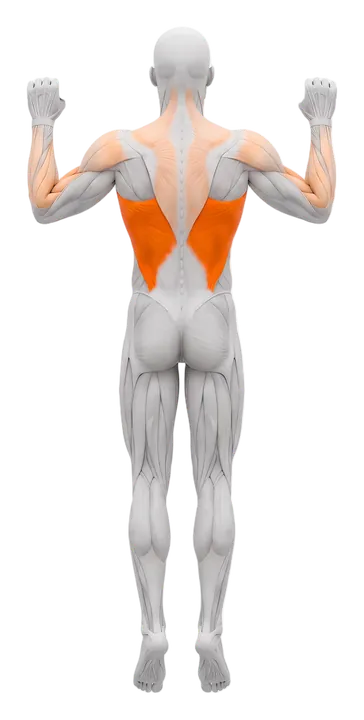 Pull-upLatsGuide
 Chin-upLats and bicepsGuide
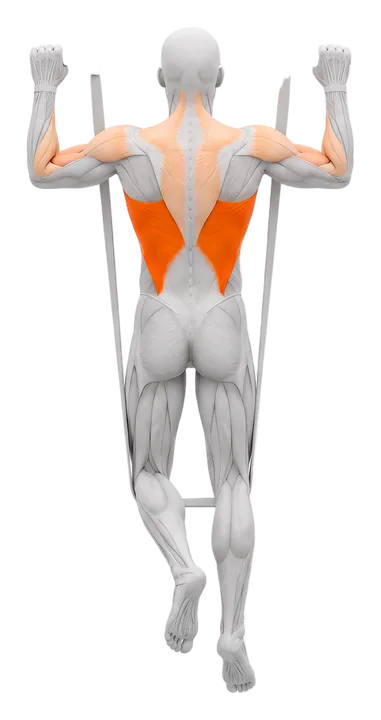 Band-assisted pull-upLats
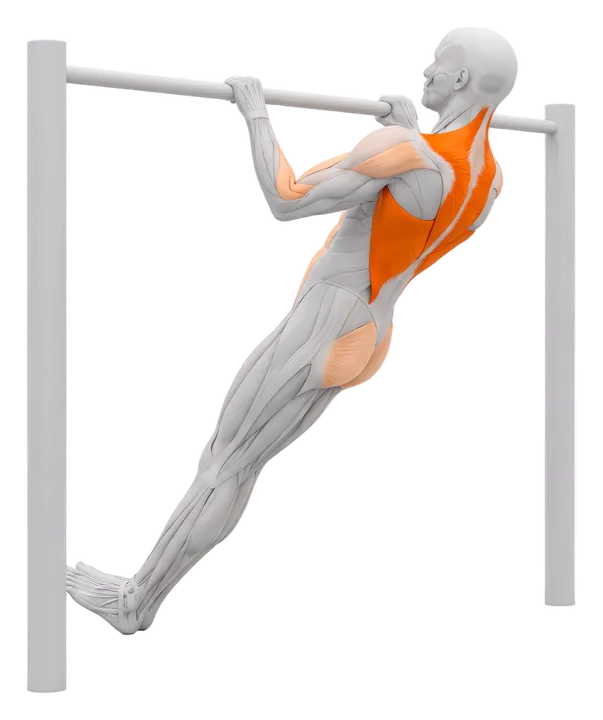 Inverted rowUpper back and latsGuide
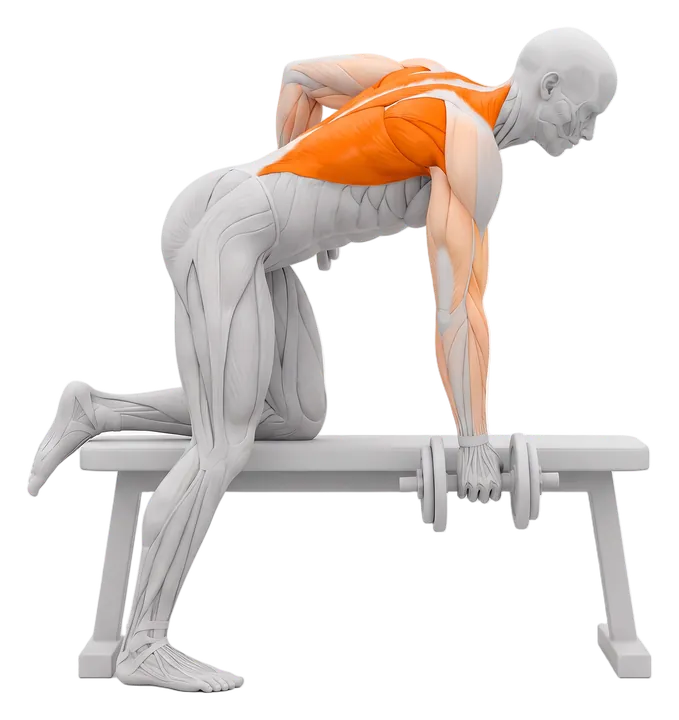 One-arm dumbbell rowLats and upper backGuide
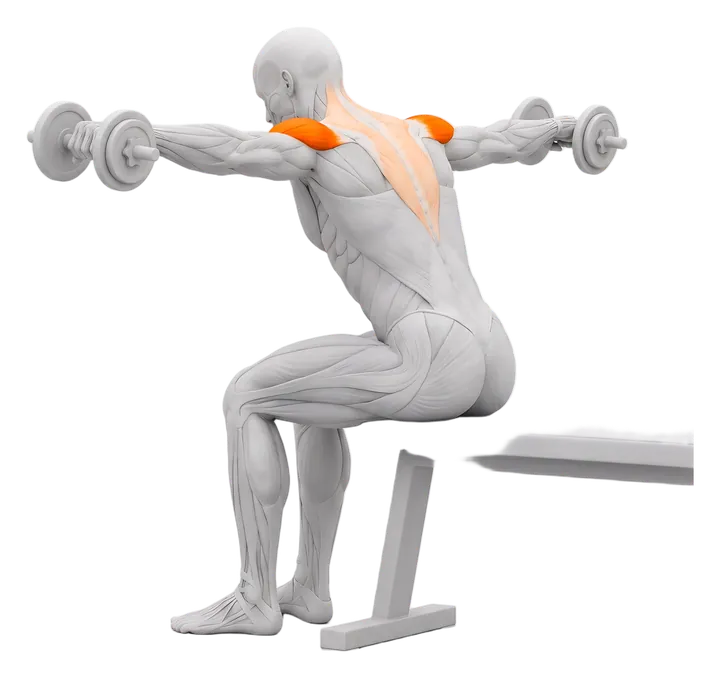 Bent-over rear delt flyRear deltsGuide
 Band pull-apartRear delts and upper back
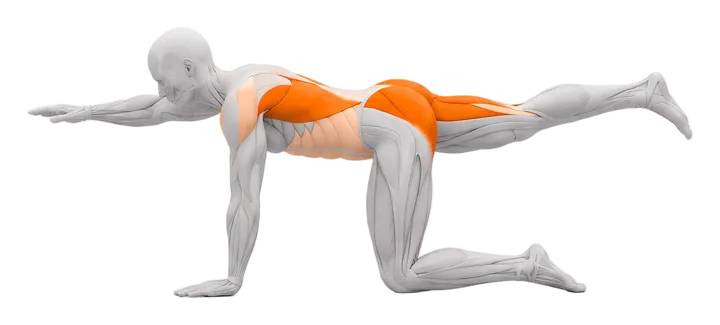 Bird dogLower back and glutes
The back workout at home
This version uses a door frame pull-up bar, a band and a pair of dumbbells. Swap rows from the table above if you are missing one. Around 35 minutes.
| Exercise | Sets x reps | Rest | Main target |
|---|---|---|---|
| Pull-up or chin-up (band-assisted if needed) | 4 x 4 to 10 | 2 min | Lats |
| One-arm dumbbell row, hand on a chair | 3 x 10 to 15 per side | 60 to 90 s | Lats and mid back |
| Inverted row under a table or low bar | 3 x 8 to 15 | 90 s | Upper back |
| Band straight-arm pulldown | 2 x 15 to 20 | 60 s | Lats, without the biceps |
| Rear delt fly or band pull-apart | 3 x 15 to 20 | 60 s | Rear delts, upper back |
For a back and bicep home workout, finish with 2 to 3 sets of dumbbell or band curls. Chin-ups as your first exercise already hit the biceps hard, so keep the curl volume low. To see how your pull-up reps compare, check the pull-up standards.
Why each exercise is in it
- Pull-up or chin-up: the best lat builder you can do at home and the hardest. Chin-ups, palms facing you, are usually easier for beginners because the biceps help more. The chin-up guide explains the difference.
- One-arm dumbbell row: even light dumbbells work well here, because one arm at a time pulls a weight a pair of hands would find easy. Brace a hand and knee on a sturdy chair or the sofa and pull the elbow back to your hip. The dumbbell row guide has the setup.
- Inverted row: lie under a solid table, hold the edge with both hands and pull your chest up to it, heels on the floor. The more upright your body, the easier it gets. Test the table with your full weight first, and use a heavy dining table, not a light or folding one.
- Band straight-arm pulldown: anchor the band high in a door, arms almost straight, and sweep your hands down to your thighs. It trains the lats without your arms tiring first.
- Rear delt fly or band pull-apart: both work the rear delts and the muscles between your shoulder blades, which help balance push-up heavy home routines.
Lat pulldown at home: alternatives that work
Many people searching for a lat pulldown at home do not have room for a machine. The movement itself is easy to replace.
- Band lat pulldownAnchor a long loop band at the top of a closed door, kneel facing it and pull the band down to your upper chest with your elbows driving towards your ribs. Use two bands or step further back to make it harder. It is the closest match to the cable machine.
- Band-assisted pull-upLoop a band over the pull-up bar and put a foot or knee in it. You lift your own bodyweight minus the band's help, and you can use thinner bands as you get stronger.
- Pull-up negativesJump or step to the top position, then lower yourself for 3 to 5 seconds. You are stronger lowering than lifting, so negatives work before you can do a full rep.
- Dumbbell pulloverLying on the floor or across the sofa, lower one dumbbell behind your head with slightly bent arms and pull it back over your chest. It loads the lats in a stretch, but much less than a real pulldown.
If you can buy one item for back training at home, a pull-up bar or a set of bands gives far more than a home lat pulldown machine for the space and cost. In a gym, the lat pulldown guide and the cable back workout take over.
At home dumbbell back exercises
With only dumbbells and no bar, rows become the core of your back day, done from three positions so each part of the back gets a turn.
| Exercise | Sets x reps | Rest |
|---|---|---|
| One-arm dumbbell row, elbow close | 4 x 10 to 15 per side | 60 to 90 s |
| Bent-over two-arm row, elbows wide | 3 x 10 to 15 | 90 s |
| Dumbbell pullover on the floor | 3 x 12 to 15 | 60 s |
| Bent-over rear delt fly | 3 x 15 to 20 | 60 s |
| Dumbbell Romanian deadlift (lower back, glutes, hamstrings) | 3 x 10 to 12 | 90 s |
If you have a bench and a full set of dumbbells, the dumbbell back exercises page goes further with chest-supported and seal-style rows.
Beginner and advanced versions
Beginner: no pull-up yet
| Exercise | Sets x reps | Rest |
|---|---|---|
| Pull-up negative or band-assisted pull-up | 3 x 3 to 6 | 2 min |
| Inverted row, body fairly upright | 3 x 8 to 12 | 90 s |
| Band pull-apart | 2 x 15 to 20 | 60 s |
| Bird dog | 2 x 8 per side, slow | 45 s |
The bird dog is not a muscle builder, but it teaches you to keep the lower back steady while your arms and legs move, which carries over to every row.
Advanced: when 10 strict pull-ups are easy
| Exercise | Sets x reps | Rest | Technique |
|---|---|---|---|
| Backpack-loaded pull-up | 4 x 5 to 8 | 2 to 3 min | Add books or bottles in 2 kg steps |
| Chin-up, 3 second lowering | 3 x 6 to 10 | 2 min | Full hang at the bottom |
| One-arm dumbbell row, pause at the top | 3 x 12 to 15 per side | 60 s | 1 second hold |
| Feet-elevated inverted row | 3 x 8 to 12 | 90 s | Feet on a chair |
| Band pull-apart | 2 x 20 to 30 | 45 s | Finisher |
How to progress your back without heavy weights
With a fixed pair of dumbbells and your bodyweight, you cannot just add plates. You make the work harder in other ways.
- Reps first. Work up to the top of a range like 10 to 15 on rows before changing anything else.
- Leverage on inverted rows. Walk your feet forward so your body is more horizontal, then raise your feet onto a chair.
- Less help on pull-ups. Move to a thinner band, then to negatives plus singles, then to full sets.
- Slow down and pause. A 3 second lowering and a 1 second hold at the top make a 12 kg row feel much heavier.
- Add load where you can. A backpack on pull-ups and inverted rows, a second band on pulldowns.
Keep every set close to failure, 1 to 3 reps short. That is what makes light home training build muscle. The progressive overload guide has the full method, and the home workout plan puts this session into a full week.
Your home pulls, logged
Gripp is coming to iPhone. It logs reps and weight for every set and tells you what to aim for next time: last time 6 pull-ups, today go for 7, and when every set hits the top of your range it moves you on. If your bar breaks or you travel, ask the AI coach in the app to swap an exercise; the change only happens when you approve it.
Join the waitlist