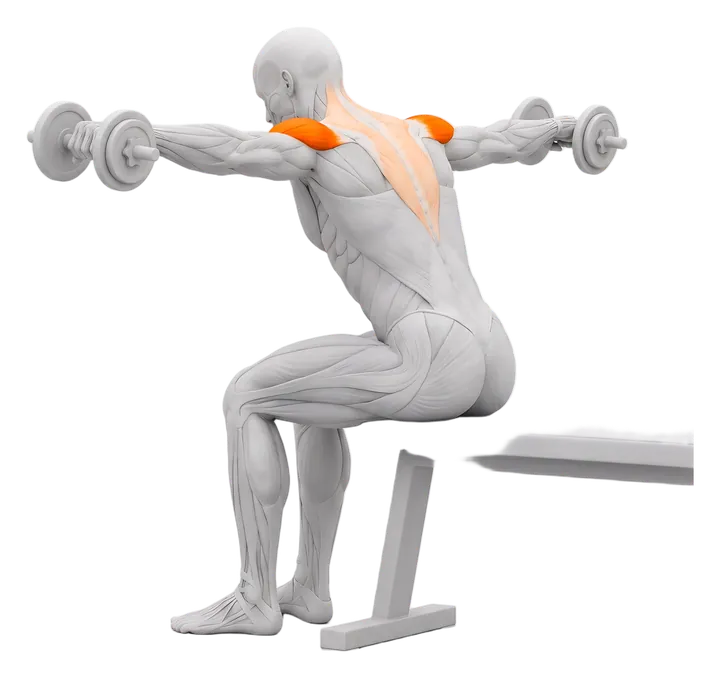
Reverse fly muscles worked
| Muscle | What it does | Role |
|---|---|---|
| Rear delts (posterior deltoid) | Pull the upper arm out and back | Primary |
| Middle traps and rhomboids | Pull the shoulder blades together at the end of the rep | Secondary |
| Infraspinatus and teres minor | Help move the arm back and keep it steady | Secondary |
| Lower back and hamstrings | Hold the hinge in the bent over version | Stabiliser |
The rear delts are small, and in rows and pulldowns the lats and upper back usually take most of the load. A fly isolates the rear delts better because the elbow does not bend, so the lats cannot pull. Most programs press a lot more than they fly backwards, so a few direct sets help balance the front and back of the shoulder. That is why it shows up in most shoulder workout plans next to presses and lateral raises.
The arm path that hits the rear delts
The angle between your arms and your torso decides which muscle does the work. Arms raised straight out from the shoulders, at roughly 90 degrees to the body, put the rear delts in charge. Arms swept back towards the hips turn it into a lat and lower trap movement. Squeezing the shoulder blades hard together moves the work to the upper back.
- Hands out at shoulder level, in line with the shoulders or slightly in front, as if making a T.
- Palms facing down or towards each other. A neutral or slightly pinkie-up grip suits most people.
- Stop when the arms are level with the torso. Going higher only shrugs the traps into the lift.
- Shoulder blades move a little, not a lot. Let them stay mostly still and let the arms move.
How to do a bent over rear delt fly
- Hinge forwardHold a light dumbbell in each hand, feet hip width, knees soft. Push your hips back until your torso is nearly parallel to the floor, back flat, neck in line.
- Hang the armsLet the dumbbells hang under your shoulders, palms facing each other, elbows bent slightly.
- Raise out to the sidesLift the dumbbells out in a wide arc, leading with the elbows, until your upper arms are in line with your torso.
- Pause and lowerHold for a second at the top, then lower slowly to the start. Keep the torso still; if it bobs up to help, the weight is too heavy.
Seated and chest supported rear delt fly
Seated rear delt fly
Sit on the end of a bench with your feet together, lean forward until your chest rests on or near your thighs, and let the dumbbells hang by your ankles. The legs support your torso, so the lower back can relax. It is a simple version for home training with a chair or bench.
Chest supported reverse fly
Lie face down on an incline bench set low, about 15 to 30 degrees, with your chest on the pad. Raise the dumbbells out to the sides from there. The pad stops the body from moving, so cheating is close to impossible. This is often the version people feel the most in the rear delts.
Reverse pec deck: the machine rear delt fly
- Set the handles to the backMost pec deck machines have a lever to move the arms to the rear position. Set them so they start in front of you when you sit facing the pad.
- Set the seat heightAdjust the seat so the handles are at shoulder height or just below.
- Sit with your chest on the padHold the handles with arms straight out in front, a soft bend in the elbows. Neutral handles or an overhand grip both work.
- Sweep the arms backPull the handles out and back in an arc until the arms are in line with the body. Pause and return slowly without letting the stack touch.
The machine keeps tension through the whole range and is easy to load in small steps, which makes it the easiest version to progress. Cables are another option, with the cables crossed and pulled out from shoulder height; see the cable shoulder workout.
Rear delt fly mistakes
- Rowing instead of flying. Bending the elbows more and more as the set goes on turns it into a row with the lats. Keep the elbow angle fixed.
- Too much weight. Swinging the torso to get the dumbbells up hands the work to the lower back. Most people start with the lightest dumbbells in the rack.
- Shrugging. Shoulders creeping towards the ears means the upper traps took over. Keep the neck long.
- Squeezing the shoulder blades first. It feels like hard work, but the rear delts do less. Think "elbows out", not "blades together".
- Rushing the lowering. Two seconds down keeps the tension on a small muscle.
Dumbbell rear delt exercises and back exercises for the rear delts
| Exercise | Equipment | Why use it |
|---|---|---|
| Bent over rear delt fly | Dumbbells | No bench needed |
| Chest supported reverse fly | Dumbbells and incline bench | Strictest version, no cheating |
| Reverse pec deck | Machine | Easy to progress, constant tension |
| Face pull | Cable and rope | Rear delts plus external rotation |
| Rear delt row | Dumbbell or cable, elbow high and wide | Heavier load, upper back too |
| Band pull-apart | Resistance band | Warm up or daily light work |
Many people search for rear delt back exercises because the rear delts get trained on back days. Wide grip rows and the face pull work them too, but the fly is the most direct. Add it to a back workout or to a shoulder day after lateral raises.
Sets and reps for the rear delt fly
| Goal | Sets x reps | Rest | Notes |
|---|---|---|---|
| Muscle growth | 3 x 12 to 20 | 60 s | 1 to 2 reps short of failure, strict form |
| Beginner | 2 x 12 to 15 | 60 s | Seated or chest supported |
| Shoulder balance on a pressing plan | 2 to 3 x 15 to 20 | 45 to 60 s | End of push or pull days |
| Rehab | 2 to 3 x 15 to 20 | 45 s | Very light, pain free range, with professional guidance |
Two to three sessions a week of a few sets each suits a small muscle that recovers fast. Pair it with shrugs or the chest-supported row on a pull day, or alternate it with lateral raises as a superset. It also fits at the end of a dumbbell shoulder workout.
How to progress the rear delt fly
Small muscles make small weight steps feel big. Going from 4 kg to 6 kg (about 9 to 13 lb) per hand is a 50 % increase, which usually breaks your form. Add reps instead, up to 20 in every set, then move up one dumbbell and drop back to 12. On the machine, move one plate at a time. More on this in progressive overload.
Gripp tracks even the small lifts
Log your rear delt flyes and Gripp tells you when to add a rep and when to pick up the next pair. Every exercise in Gripp has a muscle map, so you can see which part of the shoulder you trained, and your shoulders get a strength rating against people of your age and bodyweight.
Join the waitlistRear delt fly alternatives
- Face pull: adds rotator cuff work; good if you have a cable station.
- Band pull-apart: for home and warm ups.
- Prone Y raise: lighter, more lower trap.
- Chest supported row with elbows wide: heavier, upper back focused; see the chest supported row.
Similar exercises
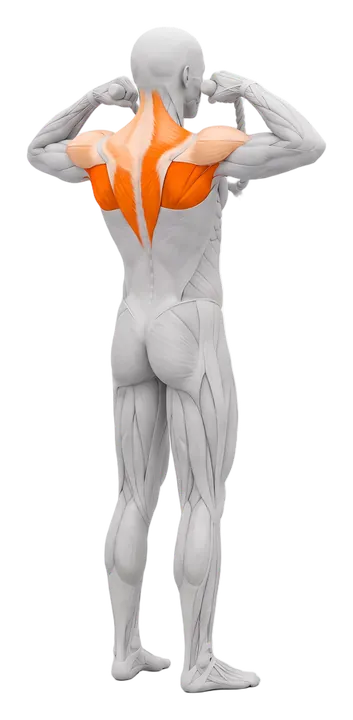 Cable face pullRear delts and upper backGuide
 Band pull-apartRear delts and upper back