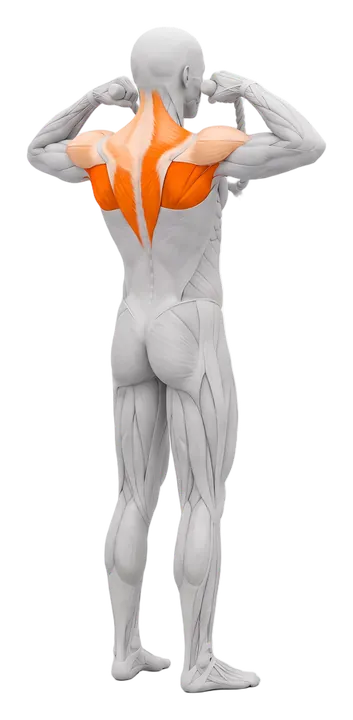
Why cables work so well for delts
Look at a dumbbell lateral raise from the side. At the bottom the weight hangs straight under your shoulder and your side delts do almost nothing. Only near the top, with the arm close to horizontal, is the raise hard. A cable fixes the dead start: with the pulley low and on the opposite side of your body, the cable is already pulling across you when your hand is by your hip, so the delt works from the first centimetre.
The delts are also small muscles that respond well to light, controlled sets with high reps, and the cable stack is easy to change by a single pin. That combination is the reason most cable shoulder exercises are raises and flyes rather than heavy presses. For the barbell and dumbbell side of shoulder training, see the shoulder workout hub.
Cable shoulder exercise guide
The cable shoulder workout
One adjustable pulley does the job, two make it faster. Use single D handles for the raises and press, and a rope for face pulls. Plan about 40 minutes.
| Exercise | Pulley height | Sets x reps | Rest | Target |
|---|---|---|---|---|
| Cable shoulder press, seated or half-kneeling | Low, handles at shoulder level | 4 x 8 to 12 | 2 min | Front delts, triceps |
| Single-arm cable lateral raise | Lowest setting | 3 x 12 to 15 per side | 60 s | Side delts |
| Cable face pull | Eye level or higher | 3 x 12 to 20 | 60 s | Rear delts, upper back |
| Cable reverse fly, crossing the cables | Shoulder height | 3 x 12 to 15 | 60 s | Rear delts |
| Cable Y-raise | Lowest setting | 2 x 12 to 15 | 60 s | Side and rear delts, lower traps |
Two of the three heads get two exercises each, because side and rear delts are the parts most lifters under-train. Front delts already work hard on every bench and incline press, so one press is enough here. For a dumbbell option for the rear delts, see the rear delt fly; for an angled press that is easy on the shoulders, the landmine press. To see how your press compares, check the overhead press standards.
How to do each cable shoulder exercise
- Cable shoulder pressPlace a bench between two low pulleys or sit with your back to a single one. Start with the handles at shoulder height, palms forward or slightly turned in, and press up and a little together. Because the cables pull from below and behind, the load stays on the delts at the top instead of resting on locked elbows. Half-kneeling with one arm at a time also works and trains your core.
- Single-arm cable lateral raiseStand side-on to a low pulley and take the handle in the far hand, so the cable crosses in front of your body. Lean slightly away while holding the column, then raise the arm out to the side until it is level with your shoulder. Lead with the elbow, keep it soft and lower for two seconds.
- Face pullRope at eye level or a bit above. Pull towards your forehead, splitting the rope ends and turning your knuckles to the ceiling at the end. The face pull guide has the full setup and hand position.
- Cable reverse flySet both pulleys at shoulder height and take the left cable in your right hand and the right cable in your left, without handles if your gym allows it. Step back and open your arms wide, like a reverse hug, until your hands are in line with your shoulders. Keep the elbows almost straight and do not let the shoulder blades do the work.
- Cable Y-raiseTwo low pulleys, cables crossed, step back and raise both arms up and out into a Y, thumbs up. Light weight: this is about control at the top, where the lower traps help hold the shoulder blades in place.
Cable shoulder exercises by delt head
| Delt head | Cable exercises | Rep range that works well |
|---|---|---|
| Front | Cable shoulder press, cable front raise (single arm or rope between the legs) | 8 to 12 |
| Side | Single-arm lateral raise, behind-the-back lateral raise, cable upright row with a rope | 12 to 20 |
| Rear | Face pull, cable reverse fly, single-arm cross-body rear delt pull | 12 to 20 |
The cable upright row is an option for side delts and traps. Keep the elbows below shoulder height and the hands wider than a close grip if the movement bothers your shoulders. A cable front raise is rarely needed: if you bench, press and do incline work, your front delts are already busy.
Beginner version
| Exercise | Sets x reps | Rest |
|---|---|---|
| Cable shoulder press, seated | 3 x 10 to 12 | 90 s |
| Single-arm cable lateral raise | 2 x 12 to 15 per side | 60 s |
| Cable face pull | 2 x 15 | 60 s |
Three exercises, one per head. Start light enough to raise without leaning or swinging. On lateral raises most people overestimate what they need: the lightest pin on many stacks is a sensible starting point.
Advanced version
Advanced lifters often put a heavy free-weight press first and use cables for the isolation work, or do a second shoulder session in the week with cables only.
| Exercise | Sets x reps | Rest | Technique |
|---|---|---|---|
| Barbell or dumbbell overhead press | 4 x 5 to 8 | 2 to 3 min | Heavy |
| Single-arm cable lateral raise | 4 x 12 to 15 per side | 45 to 60 s | Last set: two drops of one pin |
| Behind-the-back cable lateral raise | 2 x 15 to 20 per side | 45 s | Cable runs behind you |
| Cable reverse fly | 3 x 15 to 20 | 60 s | 1 second hold with arms wide |
| Cable face pull | 3 x 15 to 20 | 60 s | Slow lowering |
If the press is your main lift, the overhead press guide covers grip and bar path, and the dumbbell shoulder workout gives you a version for days when the cables are taken.
Progression with light cable weights
Progress on lateral raises and reverse flyes is slow and comes in small steps. A move from 5 to 7.5 kg (11 to 16 lb) on a single-arm lateral raise is a 50 percent jump, so you will spend more time adding reps than adding weight. That is normal.
- Use a wide range for isolation work, such as 12 to 20.
- Stay on one pin until every set reaches the top of the range with no body swing.
- Move up one pin, or use the add-on weight if your machine has one.
- If you cannot get 12 on the new weight, go back and add a set or a 2 second pause at the top first.
For the press, use a narrower range like 8 to 12 and the same rule. The progressive overload guide explains why reps before weight works so well for small muscles.
Small jumps, written down
Gripp is coming to iPhone. It logs each set's reps and weight and tells you what to lift next session: last time 14 reps at 5 kg (11 lb) on the cable lateral raise, today go for 15. It keeps an estimated 1RM for your presses on a chart and rates your shoulder strength against people of your age and bodyweight.
Join the waitlistWhere it fits in your week
Shoulders recover fast, so you can train the side and rear delts two or three times a week with a few sets each. On push pull legs, do the press and lateral raises on push day and the face pulls and reverse flyes on pull day. If you train chest on cables the same day, put the cable chest workout first and keep two raises and the face pull for after.