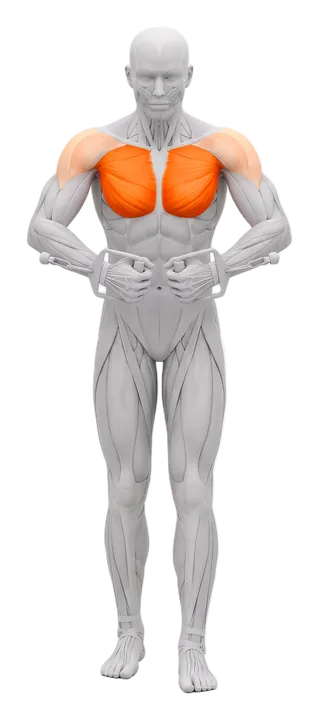
What cables do for the chest that a bench cannot
Lying on a bench, your chest only meets resistance that points straight at the ceiling. Stand between two pulleys and the line of pull follows the cable instead, so you choose the angle of every rep just by moving the pulley up or down the column. That is the whole idea behind this session: one station, three heights, every region of the pecs.
A second difference shows up at the top of a fly. With a dumbbell fly the load fades as your hands meet because the weight is now sitting over your shoulders. A cable still pulls outward at that point, so your pecs have to keep squeezing. Pair that with the long, loaded stretch at the start and you get a fly that works hard from end to end. The chest exercises hub ranks cable moves next to barbell, dumbbell and bodyweight options if you want to mix them.
Cable exercises in this workout
The cable chest workout
You need a dual adjustable pulley (a crossover station or a functional trainer) and two single D handles. Set up once, move only the pulley height between exercises, and plan around 40 minutes.
| Exercise | Pulley height | Sets x reps | Rest |
|---|---|---|---|
| Standing cable chest press, split stance | Chest height | 4 x 8 to 12 | 2 min |
| High to low cable crossover | Top of the column | 3 x 10 to 15 | 90 s |
| Single-arm cable press, kneeling | Chest height | 3 x 10 to 12 per side | 60 to 90 s |
| Low to high cable fly | Bottom of the column | 3 x 12 to 15 | 60 to 90 s |
| Mid cable fly, 1 second squeeze | Chest height | 2 x 15 to 20 | 60 s |
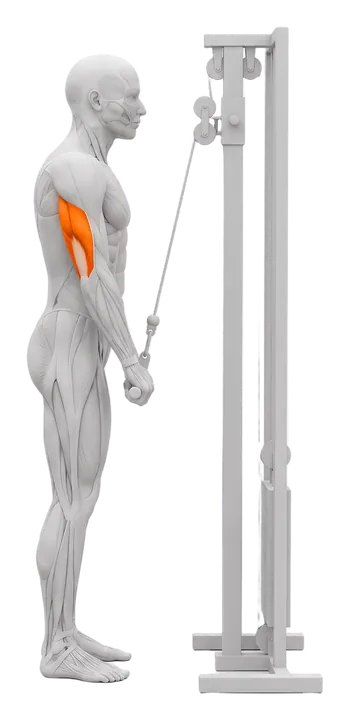
Want a chest and triceps day on cables? Add 3 sets of the tricep pushdown at the end. The presses have already worked the triceps, so you need less direct volume than on an arm day.
Why each exercise is in it
- Standing cable chest press: the heaviest movement of the day, and the one people skip. Stand in a split stance with your back to the column, handles at chest height, and press forward and slightly together. The main limit is balance, not the chest, so a staggered stance and a braced core matter more here than on any other press. If balance still caps the weight, kneel on one knee or move to a bench placed between the pulleys.
- High to low crossover: pulleys at the top, hands sweep down and in to meet in front of your hips. This lines the pull up with the lower, sternal fibres of the pec and is the cable fly most people search for when they want lower chest work.
- Single-arm cable press: one side at a time lets the hand cross a little past your midline, which is a range a two-handed press cannot give. It also shows quickly if one side is lagging.
- Low to high fly: pulleys at the bottom, hands scoop up to meet at chin height. The pull now runs along the upper, clavicular fibres. Keep the palms up and the elbows soft, and stop before the movement turns into a front raise.
- Mid cable fly: the finisher. Lighter weight, higher reps and a pause with the hands together, done when the presses have taken most of your strength.
Setup details for each fly height, plus the arm angle that keeps the shoulders happy, are covered step by step in the cable fly guide.
Matching pulley height to the part of the chest
The chest is one muscle with fibres that fan out in different directions. Pulling in line with a group of fibres puts more of the work on them. It does not isolate a region, but it shifts the emphasis enough to be worth planning for.
| Pulley position | Direction of the pull | Emphasis | Example exercise |
|---|---|---|---|
| High (above head) | Down and in | Lower chest | High to low crossover, decline cable press |
| Middle (chest height) | Straight forward and in | Whole chest, mid fibres | Cable chest press, mid fly |
| Low (near the floor) | Up and in | Upper chest | Low to high fly, incline cable press on a bench |
If you only have time for two flyes, keep the high to low and the low to high. The mid fly sits between them and gets covered by the press anyway.
Beginner version
If cables are new to you, the press and one fly are enough. Learn the stance first: a crossover with a wobbling torso trains your balance more than your chest.
| Exercise | Sets x reps | Rest |
|---|---|---|
| Seated or kneeling cable chest press | 3 x 10 to 12 | 90 s |
| Mid cable fly | 3 x 12 to 15 | 60 s |
| Push-up | 2 x as many as you can with good form, stop 1 to 2 short | 60 s |
Run it twice a week for six to eight weeks. When the press reaches 12 clean reps at a weight that makes your stance work hard, move on to the full session above, or put a heavier bench press in front of it.
Advanced version: cables after a heavy press
Stronger lifters usually get the most from cables after a free-weight press, not instead of one. The barbell or dumbbells bring the heavy load, the cables bring angles and constant tension when you are already tired.
| Exercise | Sets x reps | Rest | Note |
|---|---|---|---|
| Incline barbell or dumbbell press | 4 x 5 to 8 | 2 to 3 min | Heavy, 1 to 2 reps in reserve |
| Standing cable chest press | 3 x 8 to 10 | 2 min | Brace hard, explode out |
| High to low crossover | 3 x 10 to 12 | 90 s | Last set: drop the stack 2 pins and continue |
| Low to high fly | 3 x 12 to 15 | 60 to 90 s | 2 second lowering |
| Single-arm mid fly, across the body | 2 x 12 to 15 per side | 45 s | Pause in the stretch |
That is 15 hard sets, which is a lot for one session. If you train chest twice a week, split it: presses and the high to low crossover on day one, the incline work and low to high fly on day two. Both days slot neatly into push pull legs. On the same push day, the cable shoulder workout runs on the same station.
Cable chest exercise mistakes
- Standing too close to the column. Step forward until the handles pull your arms back at the start. No stretch, little work for the chest.
- Turning flyes into presses. If your elbows bend more as the set gets hard, the triceps are taking over. Lock the elbow angle and lower the weight.
- Chasing the stack on crossovers. A crossover with the whole stack and a rocking torso is a back and shoulder exercise. Moderate weight and a clean squeeze beat a big number here.
- Shrugging at the top. Keep the shoulder blades down and back through the whole set, especially on the low to high fly, where the traps like to join in.
How to progress when the stack jumps
Cable stacks often move in steps of 2.5 to 7 kg (5 to 15 lb), and on a dual pulley each handle has its own stack, so one pin on a fly is a big relative jump. Use double progression: pick a range like 10 to 15 for flyes, keep the weight until every set reaches 15, then move one pin and start at the bottom again.
When the next pin is too far, add reps, add a pause in the stretch, or add a set before you move up. Note which machine you used too: the same pin number can feel very different on two stations because of the pulley ratio. More on the method in the progressive overload guide.
Your cable numbers, kept for you
Gripp is coming to iPhone. It logs the reps and weight of every set and tells you what to aim for next time: last time 13 reps at 15 kg (33 lb) per side on the low to high fly, today go for 14. It keeps an estimated 1RM for your presses on a progress chart and rates your chest against people of your age and bodyweight.
Join the waitlist