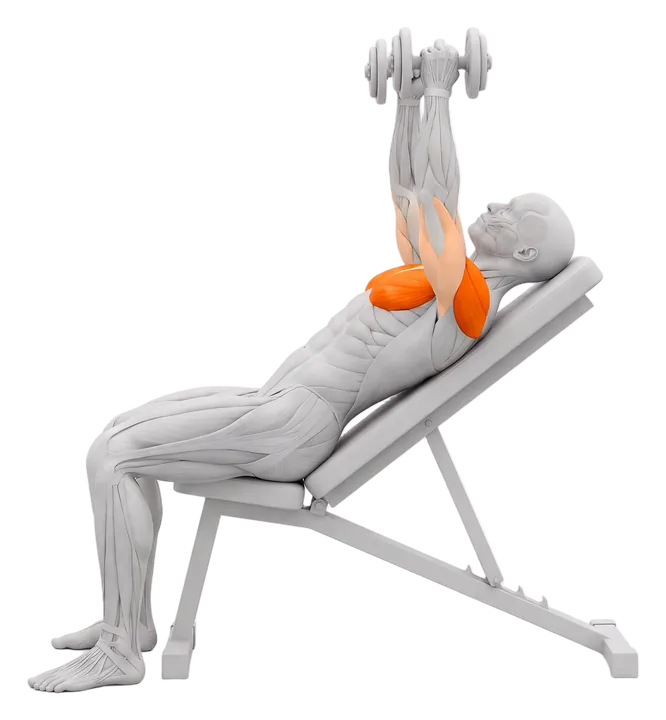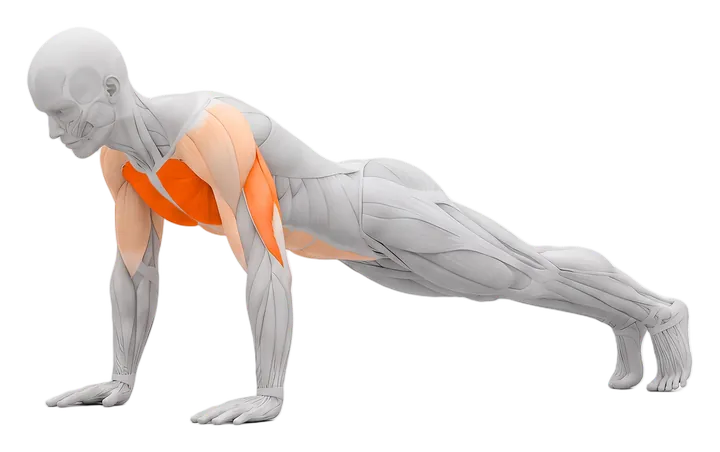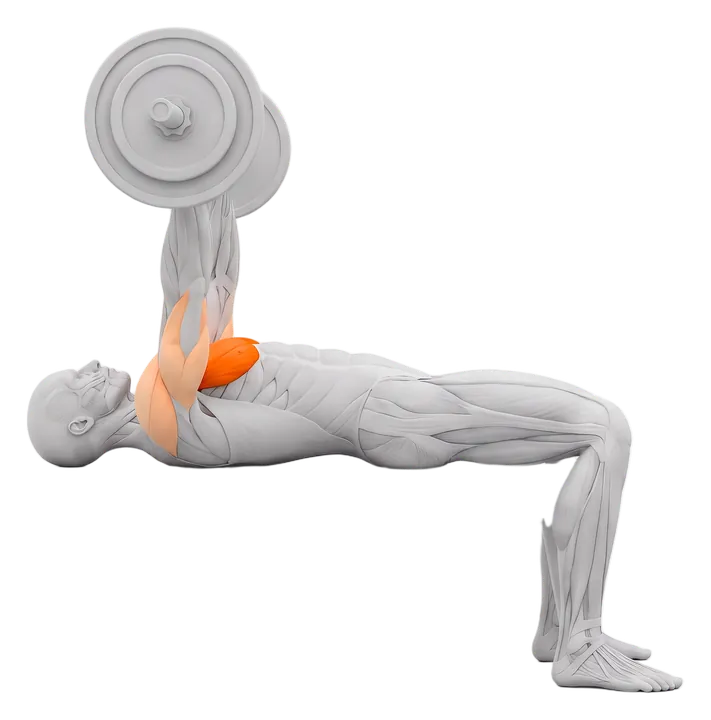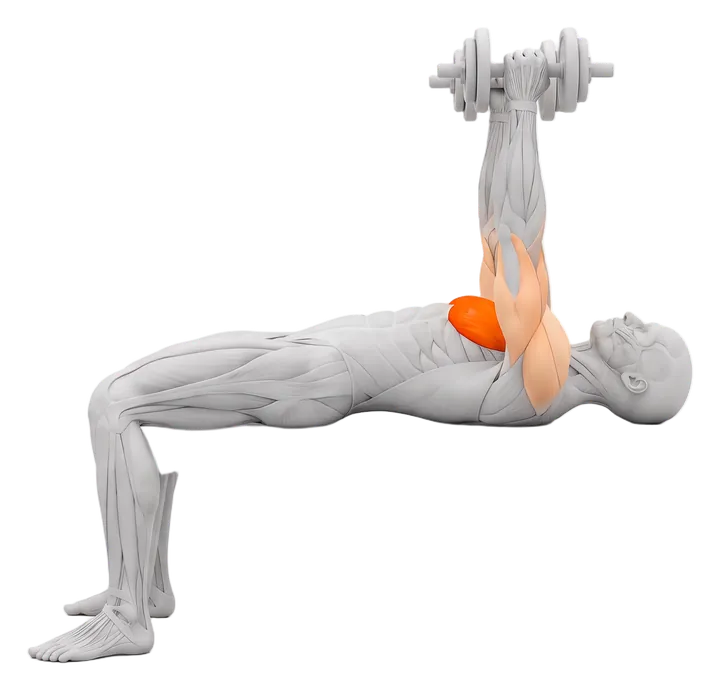
Incline bench press muscles worked
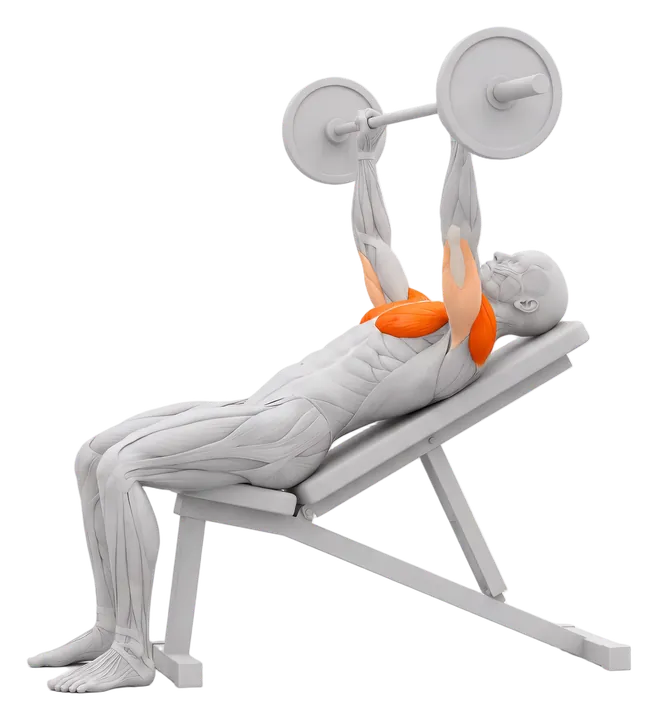
| Muscle | What it does in the lift | Role |
|---|---|---|
| Upper chest (clavicular pec fibres) | Drives the bar up from the touch point below the collarbone | Primary |
| Front delts | Raise the upper arm forward; their share grows with every notch of incline | Primary |
| Middle and lower chest | Still help, though less than on a flat bench | Secondary |
| Triceps | Finish the lockout over the shoulders | Secondary |
| Upper back and lats | Hold the shoulder blades pinned and steer the bar down | Stabiliser |
What is the incline bench press good for? It covers the part of the chest that a flat bench press trains least, while still being a heavy compound lift you can measure over years. That combination is why it sits near the top of most lists of chest exercises: one movement for size, strength and a fuller looking upper chest.
Incline bench press angle: what to set
With a barbell, the angle decides two things at once: which muscles do the work and where the bar has to land. Each step up moves the touch point higher on the chest and shortens the distance the bar can travel before your shoulders take over.
| Angle | Bar touches | Effect |
|---|---|---|
| About 30 degrees | Upper chest, a hand below the collarbones | Upper chest focus with a load close to your flat bench |
| About 45 degrees | Just under the collarbones | More front delt, noticeably less weight |
| Steeper than 45 degrees | Near the throat or chin | Becomes a seated shoulder press; use the overhead press for that |
For most lifters 30 degrees is the place to start. If you train in a power rack with an adjustable bench, count the notches and write the setting down, because the first notch on many benches is already steep. Fixed incline benches with their own uprights vary between models, so check yours once with a phone level instead of guessing.
How to do the incline barbell bench press
- Set the hooks low enoughPlace the bar where you can unrack it with a small press, elbows just short of locked. Hooks set too high force you to reach back behind your head, the weakest position for the shoulders.
- Lie back with the bar over your eyesSlide down until the bar hangs over your eyes or forehead. Pull the shoulder blades back and down into the pad and plant your feet flat, slightly behind the knees.
- Grip a little narrower than on the flat benchMany lifters use their normal bench grip or one finger narrower. The goal is forearms that stand vertical when the bar touches your chest.
- Unrack and settle over the collarbonesLift the bar off and bring it forward until it is stacked over your shoulder joints. Take a breath into your belly and brace.
- Lower to the upper chestBring the bar down to the top of your chest, below the collarbones. Elbows travel slightly forward of the bar and tuck to about 45 to 60 degrees from your body.
- Press straight upDrive the bar up in a nearly vertical line until your arms are straight above the shoulders. Keep your hips on the pad from the first rep to the last.
Incline bench press bar path
On a flat bench the bar travels in a slight diagonal: down to the lower chest, then up and back over the shoulders. On the incline that diagonal almost disappears. The touch point is already high on the chest, close to where the bar finishes, so the bar should move up and down in a line that is close to vertical, drifting perhaps a few centimetres towards your face at the top.
- Bar slides down to the nipples: your hips probably came up, which flattens the bench angle. Glue your butt to the pad.
- Bar drifts towards the throat: the angle is too steep, or the elbows flared out early. Lower the bench one notch and tuck the elbows.
- Bar loops forward off the chest: the shoulder blades lost their position. Reset them before the next rep, not during it.
Filming one set from the side is the quickest way to see your path. The bar should start and end in the same spot over your shoulders on every rep.
Form cues for the incline barbell press
- "Pin the shoulder blades, then lift." Set them before the unrack, because you cannot fix them once the bar is in your hands.
- "Bend the bar." Twisting your hands as if bending the bar into a U keeps the elbows from flaring.
- "Touch, do not bounce." A soft touch high on the chest, then press. Bouncing hides a weak bottom position.
- "Butt down, chest up." A small upper back arch is fine; lifting the hips is not.
- "Finish over the shoulders." Lockout with the bar above the joint, not out over the face.
Common incline bench mistakes
- Bench set too steep. If the bar wants to touch your chin, you are doing a shoulder press. Drop the angle.
- Lifting the hips. Leg drive pushes you into the bench, not up off it. Hips leaving the pad turns the lift into a flat press.
- Unracking from behind the head. Lower the hooks so the bar starts over your eyes.
- Wide, flared elbows. Elbows at 90 degrees from the body load the front of the shoulder hard at the bottom.
- Short reps. Stopping a hand above the chest skips the stretch where the upper chest works hardest.
Smith machine and machine incline press
| Variation | How it differs | Good for |
|---|---|---|
| Incline barbell bench press | Free bar, you control the path | Heaviest loads, long term strength tracking |
| Smith machine incline bench press | Bar runs in fixed rails | Training alone, easy safeties, beginners |
| Incline bench press machine | Plate or stack loaded handles | Pushing close to failure without a spotter |
| Paused incline bench | 1 to 2 s still on the chest | Strength off the chest, cleaner technique |
| Incline dumbbell press | A dumbbell in each hand | Deeper stretch, each side on its own |
In a smith machine, position the bench so the bar lands on your upper chest, not your neck or mid chest. Do a set with an empty bar first and move the bench until it does. The fixed rails mean the bar path is set for you, so the weight you lift will not carry over exactly to the free barbell.
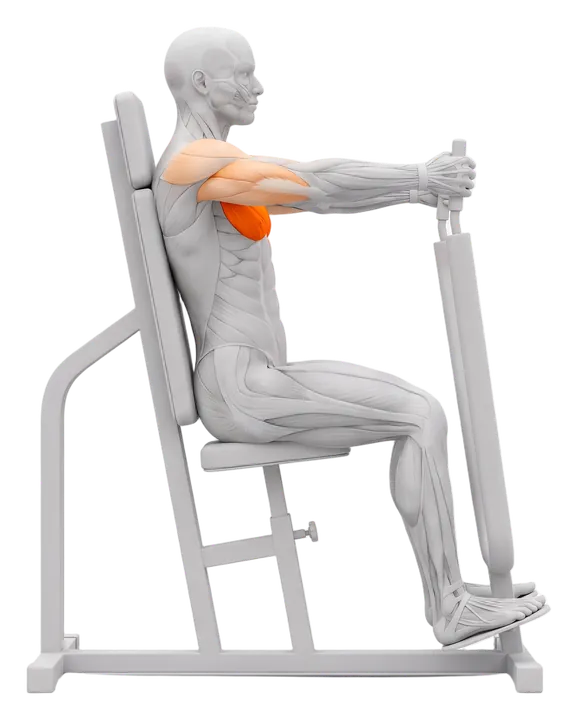
The incline bench press machine, often plate loaded, moves the handles on an arc and lets you set the seat so they start level with your upper chest. It works well later in a session, after the barbell, and follows the same logic as the flat chest press machine.
Sets and reps for the incline bench press
| Goal | Sets x reps | Rest | Notes |
|---|---|---|---|
| Strength | 3 to 5 x 3 to 6 | 3 min | Main press of the day or after the flat bench |
| Muscle growth | 3 to 4 x 6 to 10 | 2 to 3 min | Stop 1 to 2 reps short of failure |
| Beginner | 3 x 8 to 10 | 2 min | Start with the empty 20 kg (45 lb) bar |
| Second press | 2 to 3 x 8 to 10 | 2 min | Lighter, after flat bench or overhead press |
Use the incline once or twice a week. On a push pull legs split it works well as the first press on one push day and the second press on the other, swapping places with the flat bench. Later in the session, a dumbbell bench press or a dumbbell fly fits well, and rest between sets covers how long to wait between heavy sets.
Good incline bench press weight and progression
There is little solid data on average incline numbers. A common rule of thumb is that your incline sits below your flat bench; Gripp's starting model assumes roughly 80 % of it, which is an estimate, not a standard. Steeper benches mean lower numbers, so only compare lifts done at the same angle. For flat bench comparisons, see the bench press strength standards, and use the 1RM calculator to estimate your incline max from a set of 3 to 8 reps instead of testing a single.
Add 2.5 kg (5 lb) when you hit the top of your rep range in every set, then build the reps back up. When small steps stall, a lighter week and a fresh rep range usually get things moving again. The principle behind it is explained in progressive overload.
Gripp remembers your angle and your last set
Log each set of your incline press and Gripp tells you what to lift next time, for example one more rep at the same weight, or 2.5 kg more once every set hits the top of the range. Your estimated 1RM is tracked on a chart, and your chest is rated against people of your age and bodyweight.
Join the waitlistIncline bench press alternatives
- Incline dumbbell press: the closest swap, easier on stiff shoulders.
- Low incline smith press: same angle, fixed path, safe to train alone.
- Landmine press: an angled press for shoulders that dislike steeper pressing; see the landmine press guide.
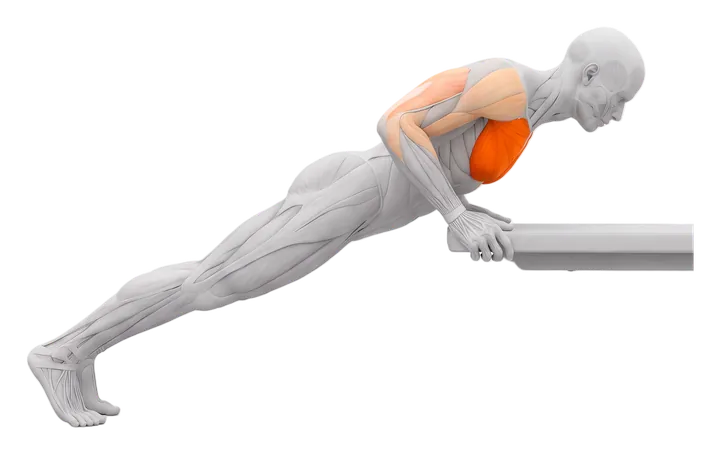
- Feet elevated push-up: an upper chest bodyweight option.
- Low to high cable fly: upper chest isolation to pair with any press.