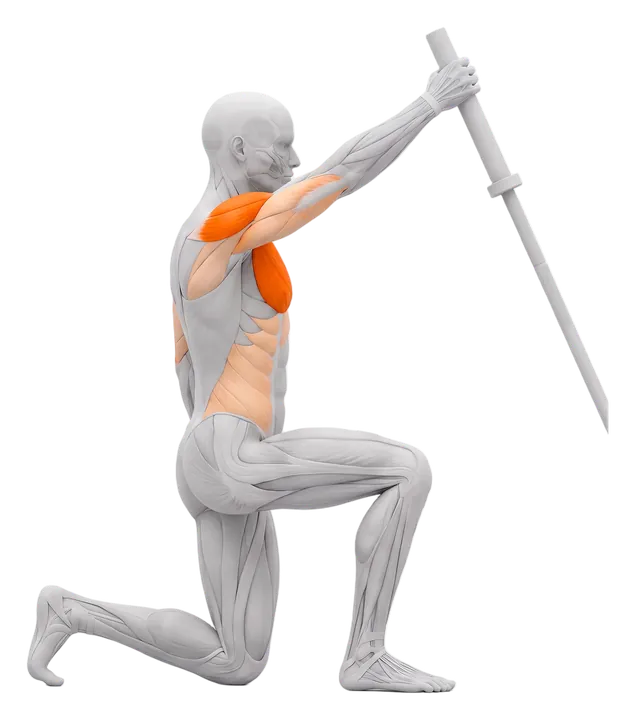
What is a landmine press?
The name comes from the setup: a barbell standing at an angle with one end in a pivot on the floor, the loaded end pointing up at you. The pivot forces the bar to travel on an arc, so the press finishes somewhere between a shoulder press and an incline press. You get pressing strength and shoulder work without having to lift the arm all the way overhead.
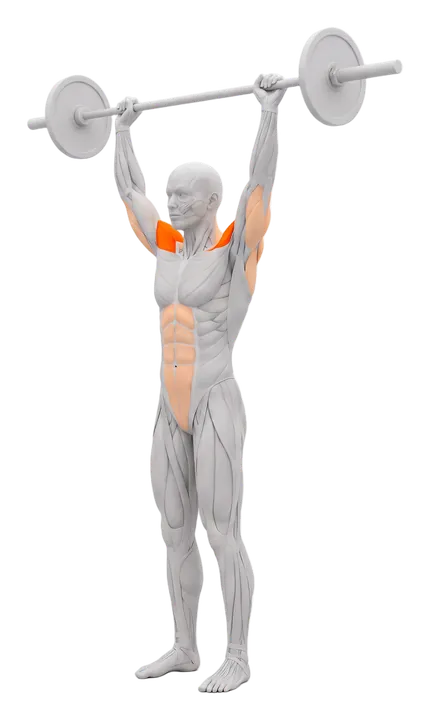
That is the main reason people use it. To press straight overhead, the shoulder needs to reach full flexion and the shoulder blade needs to rotate up freely. If either is limited by stiffness, an old injury or simply the way you are built, the overhead press can pinch. The landmine stops short of that end range, and the shoulder blade is free to move with the arm. The evidence for it being easier on the shoulders is limited; it is a widely used practical choice, not a proven fix.
Landmine press muscles worked
| Muscle | What it does | Role |
|---|---|---|
| Front delts | Drive the arm forward and up | Primary |
| Upper chest | Helps press, more as the bar path gets lower | Primary |
| Triceps | Straighten the elbow at the end | Secondary |
| Side delts | Assist as the arm rises | Secondary |
| Serratus anterior | Rotates and pushes the shoulder blade forward at the top | Secondary |
| Obliques and glutes | Keep the torso from twisting with one arm loaded | Stabiliser |
What does the landmine press work most? It depends on your stance. Standing tall pressing more upward leans towards the shoulders, while leaning into the bar and pressing more forward turns it into a landmine chest press.
Landmine setup: attachment or corner
- Landmine press attachment: a sleeve on a pivot that slots into a rack, a platform or a heavy plate. The bar end sits in the sleeve and cannot slide. This is the cleanest option.
- Corner of the room: wedge the bar end into a corner where two walls meet. Wrap the end in a towel to protect the walls and the bar, and check that it cannot slip out.
- Plate on the floor: put the bar end through the centre hole of a heavy plate lying flat. It works if the plate stays put; stand on it or put a dumbbell on it if it slides.
Load plates on the free end only. Use smaller plates (10 kg (25 lb) or less) so you can hold the end of the sleeve close to your shoulder. Because the pivot carries part of the weight, the load you feel is less than the plates plus the bar. That does not matter for progress: log the plates you put on and use the same setup each time.
How to do the half kneeling landmine press
- Kneel facing the barKneel on a pad a little behind the end of the bar. If you are pressing with the right arm, put the right knee down and the left foot forward, knee at about 90 degrees.
- Pick up the bar endLift the end of the bar to your right shoulder and hold it in your palm, fingers wrapped around the sleeve, elbow tucked under it in front of the body.
- Squeeze the down knee gluteTighten the glute on the side of the knee on the floor. This stops your lower back from arching and keeps the pelvis square.
- Press up and forwardPush the bar up along its arc until your arm is straight and your hand is in front of your forehead or a little higher. Let the shoulder blade glide forward at the top.
- Lower to the shoulderBring the bar back to the front of the shoulder under control. Do all reps on one side, then switch knee and arm.
Landmine press form cues and mistakes
- "Reach at the top." Finish by pushing the bar a little further, as if reaching for a shelf. This trains the serratus and keeps the shoulder healthy.
- "Ribs over hips." Do not lean back to get the bar up. Leaning back turns it into an incline press and loads the lower back.
- "Elbow in front, not out wide." At the start the elbow sits under the bar, in front of the ribs.
- "Face the bar." Twisting the torso towards the working arm is a common way to cheat. Hips and shoulders stay square.
- Mistake: pressing from too far away. Kneel too far back and the bar ends up nearly horizontal, which loads the shoulder in front. Move in until the press feels mostly upward.
Landmine press variations
| Variation | How | Good for |
|---|---|---|
| Half kneeling single arm landmine press | One knee down, one arm | Shoulders, core control, the standard version |
| Tall kneeling landmine press | Both knees down | Harder to stay upright, more core |
| Standing single arm landmine press | Split or square stance | More load, full body |
| Two hand landmine press | Hands stacked on the sleeve, at the chest | Heavier loads, both sides at once |
| Landmine chest press | Both hands, lean forward, press away from the chest | Upper chest, a chest press that is easy on the shoulders |
| Rotational landmine press | Start turned to one side, pivot the back foot as you press | Athletes, power through the hips |
| Landmine push press | Small dip of the knees, then drive and press | Power, more weight than a strict press |
Start with the half kneeling version for a few weeks. Once you can press it cleanly with good control, move to standing or to the push press for heavier work.
Sets and reps for the landmine press
| Goal | Sets x reps | Rest | Notes |
|---|---|---|---|
| Strength | 3 to 4 x 5 to 8 per arm | 2 min | Standing or two hand version |
| Muscle growth | 3 x 8 to 12 per arm | 60 to 90 s between arms | Half kneeling |
| Shoulder friendly main press | 3 x 6 to 10 per arm | 2 min | Replaces the overhead press |
| Rehab | 2 to 3 x 10 to 15 | 60 s | Light, pain free arc, with professional guidance |
Because the landmine is a one arm lift, your weaker side sets the pace. Start every set with that side, and stop the strong side at the same number of reps. On an upper lower split it can be the vertical press on one upper day, with lateral raises after it for the side delts. Pair it with a rear delt fly to balance the pressing, or use the incline bench press on the other upper day.
How to progress the landmine press
Plate jumps on a landmine are relatively large, since going from a 5 kg to a 10 kg plate doubles the added load. Bridge the gap with reps: stay at one load until you reach the top of your rep range on both arms, then add the smallest plate you have. That is double progression. Moving from half kneeling to standing is another step up, because you can use your legs a little.
Gripp tracks each arm
Log your landmine sets and Gripp tells you what to aim for next time, from one more rep to the next plate. If your shoulders do not like the overhead press, the Gripp coach can suggest swapping it for the landmine press in your plan, and the change only happens when you approve it.
Join the waitlistLandmine press alternatives
- Half kneeling single arm dumbbell press: the closest match without a landmine; press slightly forward rather than straight up.
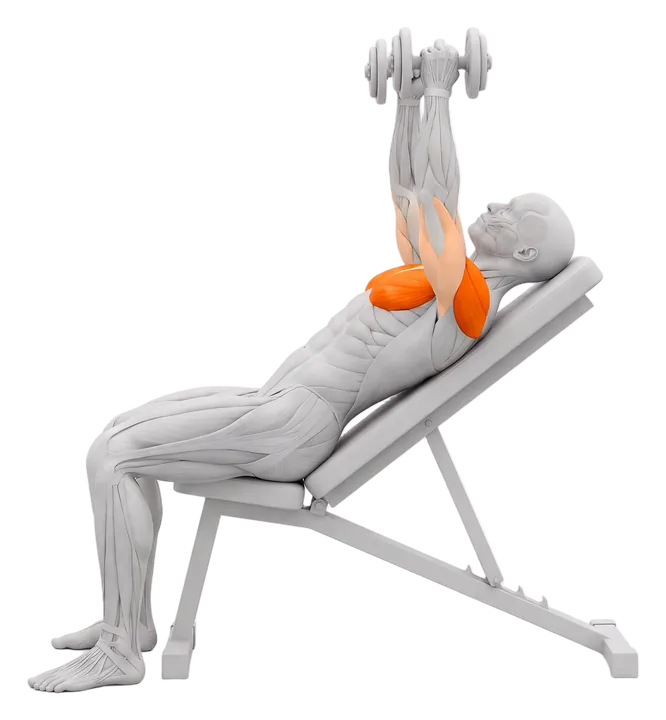
- Incline dumbbell press at 45 degrees: an angled press with both arms. See the incline dumbbell press.
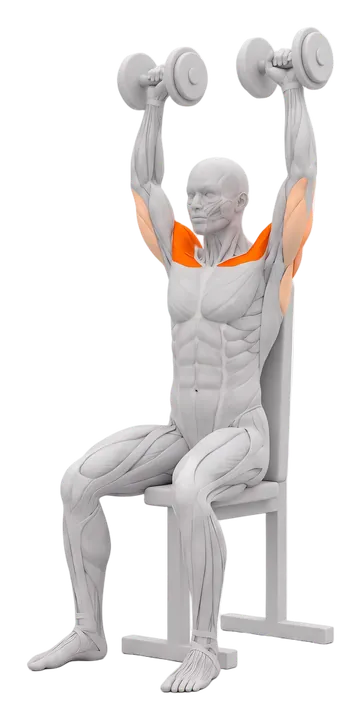
- Neutral grip dumbbell shoulder press: if you can press overhead without pain; see the dumbbell shoulder press.
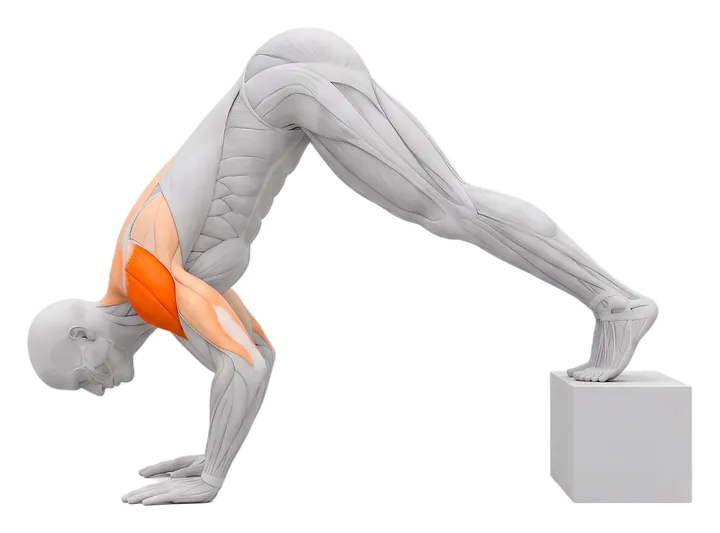
- Pike push-up: a bodyweight press at a similar angle.
- High incline machine press: a fixed path option in many gyms.
For a full session around these, see the shoulder workout.