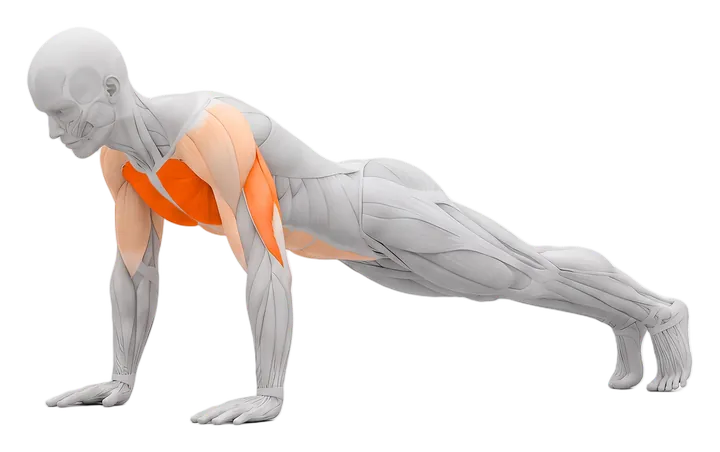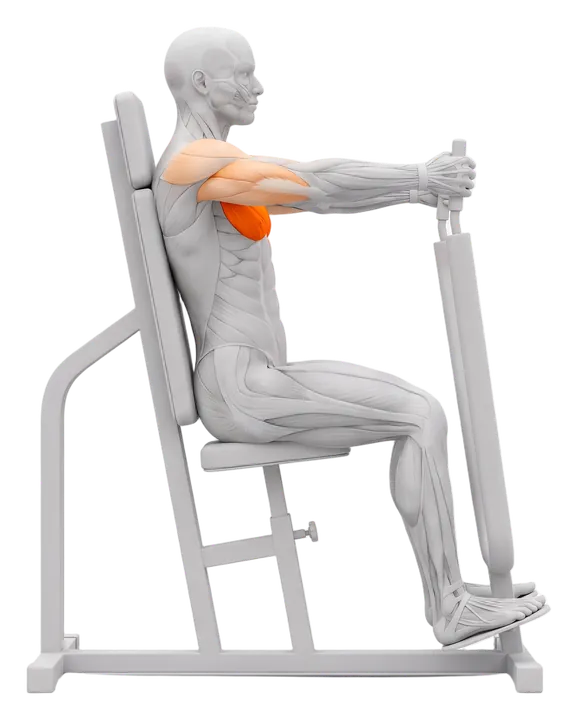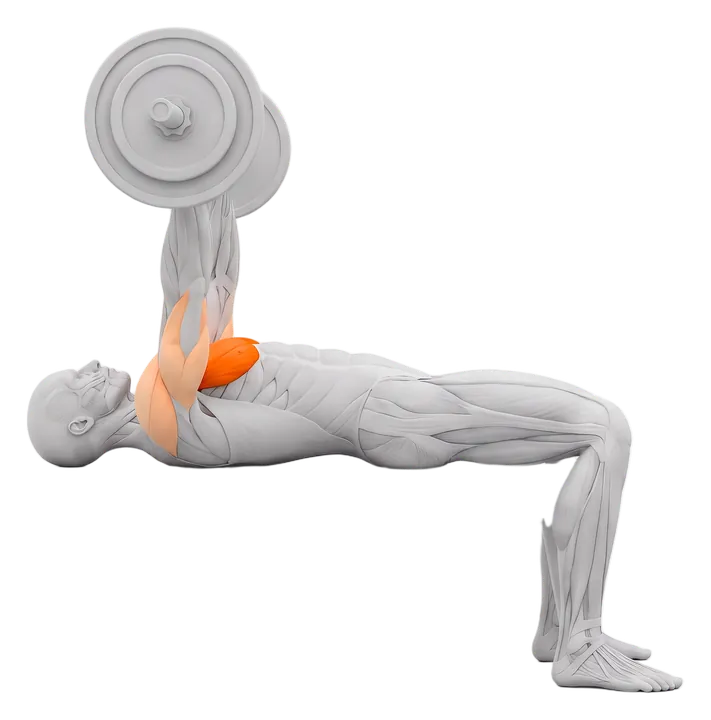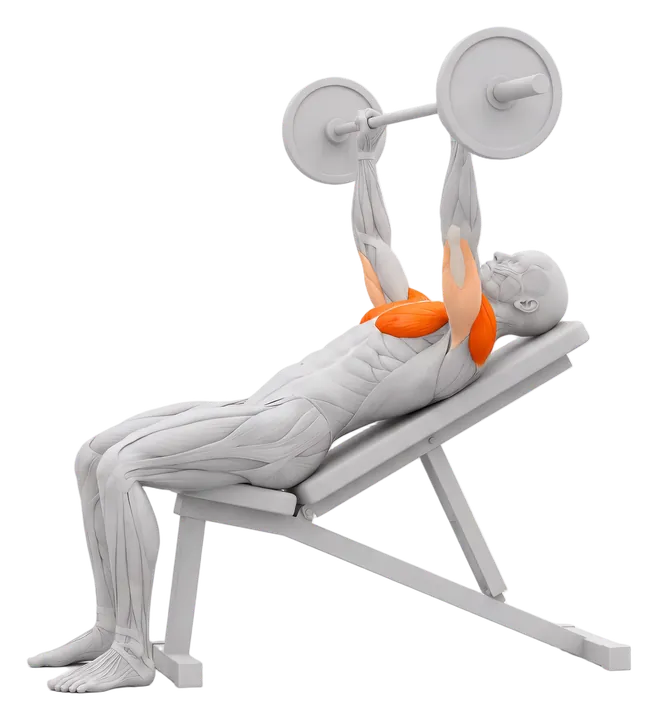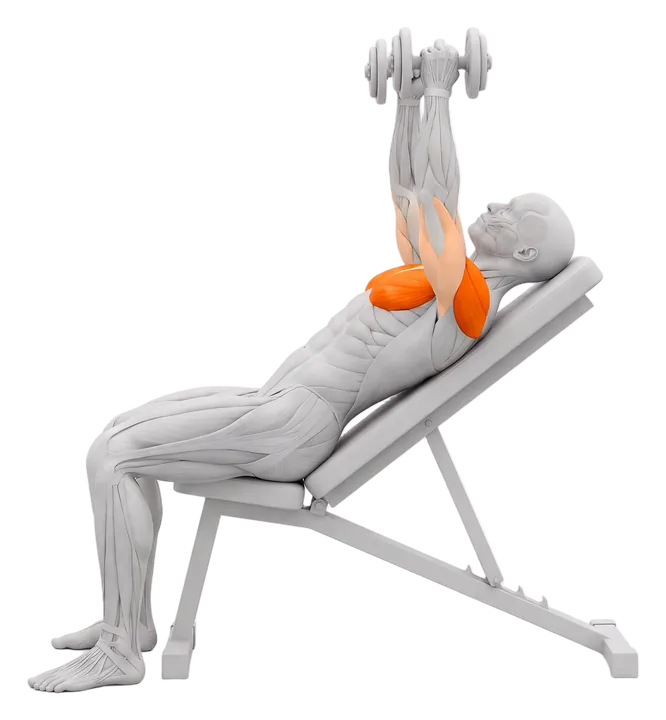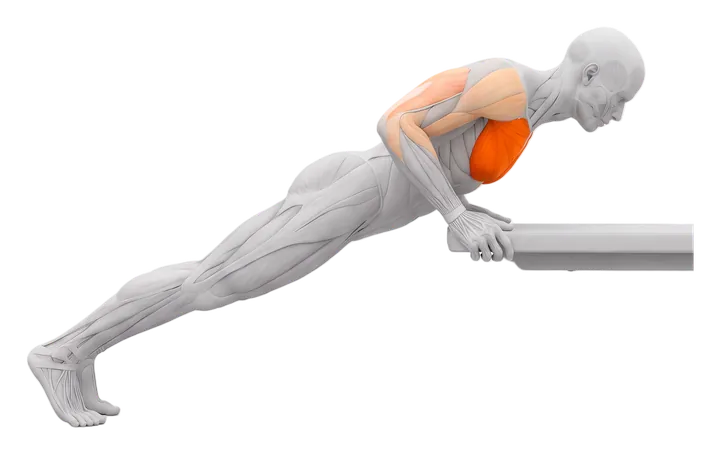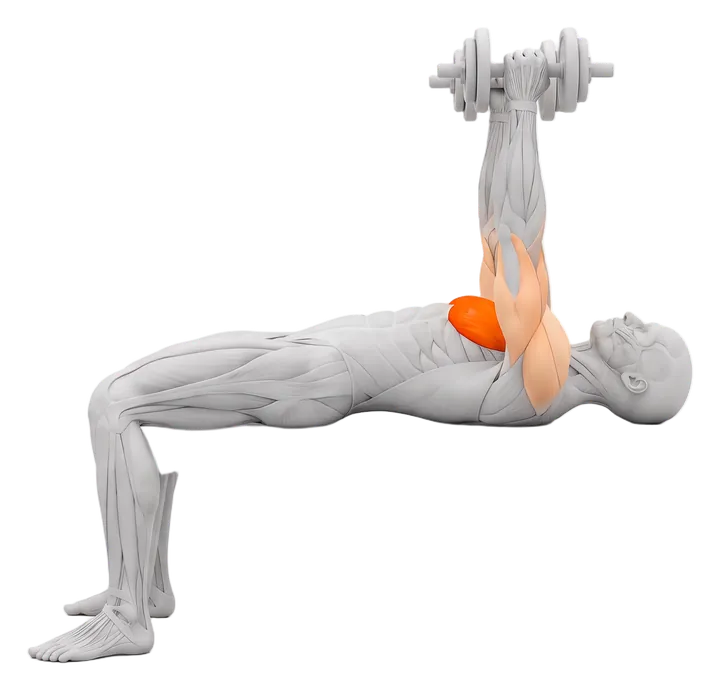
Dumbbell bench press muscles worked
| Muscle | Job | Role |
|---|---|---|
| Pectoralis major | Lowers and presses the arms, working hard in the deep bottom stretch | Primary |
| Front delts | Help push the upper arm forward | Secondary |
| Triceps | Straighten the elbows in the top half | Secondary |
| Biceps and forearms | Keep each dumbbell from tipping | Stabiliser |
| Rotator cuff | Steadies the shoulder while each arm balances its own weight | Stabiliser |
Because nothing joins your hands, each side has to stabilise its own load. That costs you some weight compared with a bar, but it also means a weaker side cannot hide. On a chest exercises list, the flat dumbbell press is often the main press for people who train at home or whose shoulders dislike the barbell.
Getting heavy dumbbells into position
With light dumbbells you can just lie down and lift them. Once they get heavy, the setup decides whether you get a good set at all. Do it the same way every time.
- Pick them up with a flat backStand between the dumbbells, hinge at the hips and lift them like a light deadlift. Carry them to the bench with your arms straight down.
- Stand them on end on your thighsSit near the end of the bench and rest each dumbbell upright on the lower half of your thighs, handles vertical, just above the knees.
- Rock back and use the legsLean back in one smooth motion and lift your knees as your back meets the pad. The thighs push the dumbbells up to your chest, so your arms never have to curl the weight from your lap.
- Start neutral, then turnPress from a palms facing in position. Once the arms are straight over the shoulders, rotate the hands to your working grip.
- Ask for a hand-off near your maxA partner can hand one dumbbell to you at a time while you lie in position. A spotter helps at the wrists or the dumbbells, never by pushing on your elbows.
To finish a set, bring the dumbbells to the lower chest, lift your knees and use their momentum to sit up with the weights back on your thighs. In a crowded gym, lower them to the floor beside the bench instead of dropping them from arm's length.
How to do the dumbbell bench press
- Set your backShoulder blades pulled together and down, chest raised, a small arch in the upper back. Feet flat on the floor.
- Lower out to the sidesBring the dumbbells down to the outside of your chest, elbows about 45 degrees from your body. Forearms stay roughly vertical.
- Sink into the stretchGo as deep as your shoulders allow, usually with the handles level with the chest or a little lower. Stop before the front of the shoulder feels pinched.
- Press up and slightly togetherDrive the dumbbells up so they finish over your shoulders, close but not clanging together. Keep the shoulder blades pinned at the top.
Dumbbell bench press form cues
- "Stack the wrist over the elbow." If the dumbbell drifts past your elbow, the shoulder takes the strain.
- "Same speed both sides." If one arm lags, end the set there.
- "Grip slightly angled." Turning the palms partly in, rather than fully forward, often feels better on the shoulders.
- "Push yourself away from the weights." Thinking about driving your back into the bench keeps the shoulders down.
- "Two seconds down." Control the lowering; dumbbells are easy to lose in a fast drop.
Common dumbbell bench press mistakes
- Curling the dumbbells up from the lap. Use the knee kick described above; curling heavy weights strains the biceps and wastes energy.
- Elbows flared straight out. A T shape puts load on the front of the shoulder. Tuck them to about 45 degrees.
- Banging the dumbbells together at the top. It takes tension off the chest and can knock the weights loose.
- Dropping too deep with heavy weights. A deep stretch is useful, but not past the point your shoulders tolerate.
- Letting the shoulders roll forward at lockout. Keep the shoulder blades on the bench through the whole set.
Dumbbell vs barbell bench press
| Dumbbell bench press | Barbell bench press | |
|---|---|---|
| Load | Less in total | More; the heaviest chest press |
| Range of motion | Hands can go below chest height | Stops when the bar touches the chest |
| Each side | Works on its own, shows imbalances | Stronger side can help the weaker |
| Weight steps | Fixed jumps per dumbbell, often 2 kg or 2.5 kg (5 lb) | As small as 1 kg (2.5 lb) with small plates |
| Failing a rep | Lower the weights to the sides | Needs safeties or a spotter |
| Setup | Bench and dumbbells | Rack, bar, plates and bench |
Neither is better for building muscle. The barbell bench press is easier to load and track for strength; dumbbells are friendlier for shoulders and home gyms. Many plans use both, with the barbell for low reps and dumbbells for moderate reps later in the week.
Close grip and other variations
| Variation | How | Focus |
|---|---|---|
| Close grip dumbbell bench press | Palms facing each other, dumbbells touching, elbows close to the ribs | Triceps and inner chest |
| Neutral grip dumbbell press | Palms in, normal width | Shoulder friendly main press |
| Single arm dumbbell press | One dumbbell, free hand on the bench edge | Core work against rotation, fixing a weaker side |
| Alternating dumbbell press | One arm presses while the other holds at the top | Longer time under tension |
| Floor press with dumbbells | Lying on the floor, elbows stop at the ground | Home training with no bench |
The close grip version, sometimes called a squeeze press, needs much lighter weights. Press the dumbbells together hard the whole rep. For the raised bench version, see the incline dumbbell press.
Sets and reps for the DB bench press
| Goal | Sets x reps | Rest | Notes |
|---|---|---|---|
| Strength | 4 x 5 to 8 | 2 to 3 min | Heaviest pair you can kick up cleanly |
| Muscle growth | 3 to 4 x 8 to 12 | 2 min | 1 to 2 reps short of failure |
| Beginner | 3 x 10 to 12 | 90 s | Learn the setup before adding weight |
| Home, limited dumbbells | 3 x 12 to 20 | 60 to 90 s | Slow lowering, pause at the bottom |
For a full session built around it, the dumbbell chest workout pairs the flat press with an incline press and a dumbbell fly.
Good dumbbell bench press weight and progress
Dumbbell weights are written per dumbbell, so 30 kg dumbbells means 30 kg in each hand. There is no reliable average for this lift. As a rough guide, Gripp's starting model assumes each dumbbell is about 40 % of your barbell bench, so a 100 kg (225 lb) bencher would start testing around 40 kg (90 lb) per hand. This applies the same way to women and men; only the starting weights differ. To estimate a max from a set, enter the weight of one dumbbell in the 1RM calculator.
The jump to the next pair adds 4 to 5 kg in total, which is a big step on a press. Instead of forcing it, add reps first: work from 8 up to 12 reps in every set, then move to the next pair and start again at 8. That is double progression, and it suits fixed dumbbell steps well.
Gripp tracks every pair
Log the weight of one dumbbell and your reps, and Gripp tells you next session whether to go for another rep or move up to the next pair. Your estimated 1RM for the dumbbell press builds a progress chart, and your chest gets a strength rating against people of your age and bodyweight.
Join the waitlistDumbbell bench press alternatives
- Push-up: no equipment, easy to load with a backpack. See the push-up guide.
- Machine chest press: the same push with a fixed path, safe to take to failure.
- Barbell bench press: when you want to load heavier than your dumbbells allow.
- Dumbbell floor press: no bench needed, shorter range.