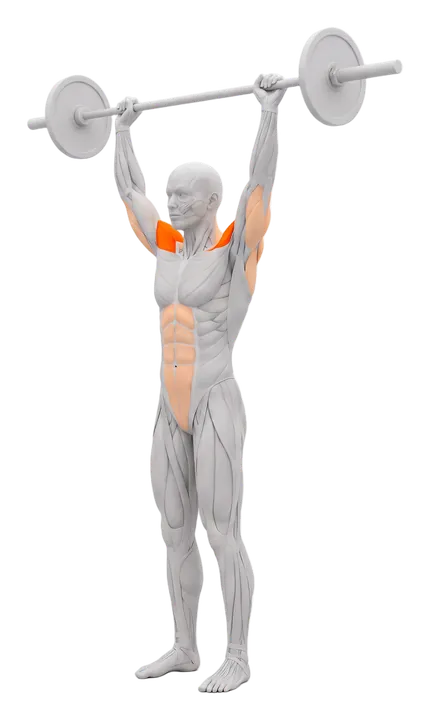
What is a good overhead press weight?
Of the big barbell lifts, the press is the one where you move the least weight. Your shoulders and triceps push a load over your head while your whole body braces underneath it, and every kilo is hard won. That is why the numbers on this page look small next to your squat or deadlift, and why a jump of 2.5 kg (5 lb) on the press can take weeks.
A good target for most lifters is the median line, called Intermediate here: more than half of the people who train press less than you. For men that is roughly two thirds of bodyweight, for women a little under two fifths. Getting the bar overhead for a clean single at bodyweight, as a man, puts you near the top 5 % of people who lift.
Where the overhead press levels come from
Gripp places you on a modelled spread of one rep maxes among people who train regularly. For the press, the centre of that spread is the bench press median multiplied by 0.65, and the width is copied from the bench. The age and bodyweight adjustments are the bench press ones too. The ratio is Gripp's own judgement of how a strict standing press compares with a flat bench for a typical lifter, not a measured value.
| Level | Share of gym-goers you out-press | Men | Women |
|---|---|---|---|
| Beginner | Under 25 % | below 0.55 × BW | below 0.32 × BW |
| Novice | 25 % or more | 0.55 × BW | 0.32 × BW |
| Intermediate | 50 % or more | 0.65 × BW | 0.39 × BW |
| Advanced | 80 % or more | 0.80 × BW | 0.49 × BW |
| Elite | 95 % or more | 0.98 × BW | 0.62 × BW |
Each figure is where a level begins. If you have no tested max, take a recent hard set of 3 to 8 reps and convert it in the 1RM calculator. Gripp uses the Epley formula for this and ignores sets above 10 reps, because estimates from long sets drift too much.
Overhead press standards for men
Pick the row nearest your bodyweight. Cells show the one rep max that opens each level, rounded to the nearest 2.5 kg (5 lb), for a standing barbell press at age 18 to 35.
| Bodyweight | Novice | Intermediate | Advanced | Elite |
|---|---|---|---|---|
| 60 kg (130 lb) | 32.5 kg (70 lb) | 40 kg (90 lb) | 47.5 kg (105 lb) | 57.5 kg (125 lb) |
| 70 kg (155 lb) | 40 kg (90 lb) | 45 kg (100 lb) | 57.5 kg (125 lb) | 70 kg (155 lb) |
| 80 kg (175 lb) | 45 kg (100 lb) | 52.5 kg (115 lb) | 62.5 kg (140 lb) | 77.5 kg (170 lb) |
| 90 kg (200 lb) | 47.5 kg (105 lb) | 57.5 kg (125 lb) | 70 kg (155 lb) | 85 kg (185 lb) |
| 100 kg (220 lb) | 52.5 kg (115 lb) | 60 kg (130 lb) | 75 kg (165 lb) | 92.5 kg (205 lb) |
| 110 kg (245 lb) | 55 kg (120 lb) | 65 kg (145 lb) | 80 kg (175 lb) | 97.5 kg (215 lb) |
| 120 kg (265 lb) | 57.5 kg (125 lb) | 67.5 kg (150 lb) | 82.5 kg (180 lb) | 102.5 kg (225 lb) |
Two milestones men often chase: a 60 kg (130 lb) press, which is the 20 kg bar plus a 20 kg plate per side, and a bodyweight press. At 80 kg (175 lb), the first sits in the Intermediate band and the second just above the Elite line. Below the table, anything under the Novice figure is the Beginner range, which is where almost everyone starts.
Overhead press for women
Women tend to carry less muscle in the shoulders and arms relative to bodyweight, so the gap between men and women is wider on the press than on lower body lifts like the squat standards show. The empty 20 kg (45 lb) bar is already a Novice to Intermediate press for many women.
| Bodyweight | Novice | Intermediate | Advanced | Elite |
|---|---|---|---|---|
| 50 kg (110 lb) | 17.5 kg (40 lb) | 20 kg (45 lb) | 25 kg (55 lb) | 32.5 kg (70 lb) |
| 60 kg (130 lb) | 20 kg (45 lb) | 22.5 kg (50 lb) | 30 kg (65 lb) | 37.5 kg (85 lb) |
| 70 kg (155 lb) | 20 kg (45 lb) | 25 kg (55 lb) | 32.5 kg (70 lb) | 40 kg (90 lb) |
| 80 kg (175 lb) | 22.5 kg (50 lb) | 27.5 kg (60 lb) | 32.5 kg (70 lb) | 42.5 kg (95 lb) |
| 90 kg (200 lb) | 22.5 kg (50 lb) | 27.5 kg (60 lb) | 32.5 kg (70 lb) | 42.5 kg (95 lb) |
If the bar is too heavy to start with, press dumbbells or a 10 to 15 kg technique bar first. Because jumps are so large in relative terms, small plates of 0.5 to 1.25 kg (1 to 2.5 lb) make a real difference: going from 20 to 22.5 kg is a 12.5 % jump in one session, which most shoulders will not keep up with for long.
Overhead press standards by age
The model lowers each level gradually after 35, using the same age curve as the bench press. The examples below are for a man of 80 kg (175 lb) and a woman of 60 kg (130 lb). An older lifter who presses the same weight as a younger one therefore gets a higher rating.
| Age | Man 80 kg: Novice | Man 80 kg: Intermediate | Woman 60 kg: Novice | Woman 60 kg: Intermediate |
|---|---|---|---|---|
| 18 to 35 | 45 kg (100 lb) | 52.5 kg (115 lb) | 20 kg (45 lb) | 22.5 kg (50 lb) |
| 40 | 42.5 kg (95 lb) | 50 kg (110 lb) | 17.5 kg (40 lb) | 22.5 kg (50 lb) |
| 50 | 42.5 kg (95 lb) | 50 kg (110 lb) | 17.5 kg (40 lb) | 22.5 kg (50 lb) |
| 60 | 37.5 kg (85 lb) | 45 kg (100 lb) | 15 kg (35 lb) | 20 kg (45 lb) |
| 70 | 35 kg (75 lb) | 40 kg (90 lb) | 15 kg (35 lb) | 17.5 kg (40 lb) |
Rounding to 2.5 kg hides some of the change between 40 and 50, so the numbers look flat there even though the underlying line keeps moving down slowly.
Strict press, push press, dumbbells and seated press
The standards assume a strict standing press: bar from the front of the shoulders to locked elbows overhead, no knee dip, no big lean back. Other versions change the number:
- Push press: a knee dip and drive lets you lift noticeably more. It is a different lift, so do not compare it with these tables.
- Military press: usually another name for the strict standing press, sometimes with heels together. Use the same tables.
- Seated barbell press: the bench stops leg drive and most of the lean, so lifters often press a little less seated. Compare it with your own history rather than with these levels.
- Dumbbell shoulder press: Gripp rates it separately, per dumbbell. The median line is about 0.27 times bodyweight in each hand for men and 0.16 for women, also a provisional estimate. The dumbbell shoulder press guide covers technique.
Whatever version you use, keep it the same over time. A press that drifts from strict to half push press makes your progress look better than it is.
How to press more overhead
- Press two or three times a weekThe press is a small-muscle lift that recovers fast. Many beginner programs alternate it with the bench every session, so you press about every other workout.
- Use smaller jumps than on any other liftAdd 1 to 1.25 kg (2.5 lb) at a time, or add reps first: work up from 3 sets of 5 to 3 sets of 8 at the same weight, then add load. That is the double progression idea in progressive overload.
- Build the muscles around itTriceps work, lateral raises and upper back rows support the press. The shoulder workout shows how to combine them.
- Fix the bar path before the weightMove your head back slightly so the bar travels straight up, then push your head through once it passes your forehead. The overhead press guide goes through setup and common faults.
Track your press in Gripp
Gripp is coming to iPhone. It logs every set, tells you the weight and reps to aim for next session, and turns your presses into a shoulder rating compared with people of your age and bodyweight.
Join the waitlistShoulder pain that sharpens overhead or lingers for days is a reason to stop pressing and get it looked at by a physiotherapist or doctor.
Sources: the press levels are a Gripp estimate built on top of its bench press model. That model is anchored on the Cooper Institute bench press norms and Falch et al. (2023), with age and bodyweight curves taken from van den Hoek et al. (2024), "Normative data for the squat, bench press and deadlift exercises in powerlifting", J Sci Med Sport 27(10):734-742, used under CC BY 4.0. All press figures are provisional.