Three delt heads, three jobs
The deltoid has three parts that move the arm in different directions. Presses train the front well, but leave the side and especially the rear short. That is why a shoulder workout of only presses gives you strong but narrow-looking shoulders.
| Head | Main job | Best dumbbell exercise | Already trained by |
|---|---|---|---|
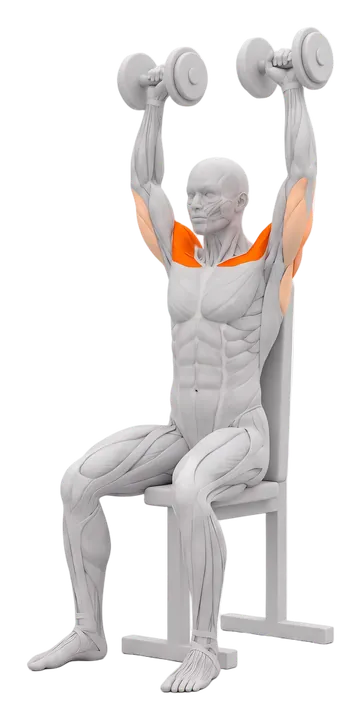
| Front delt | Lifts the arm forward and overhead | Seated dumbbell shoulder press | Every chest press |
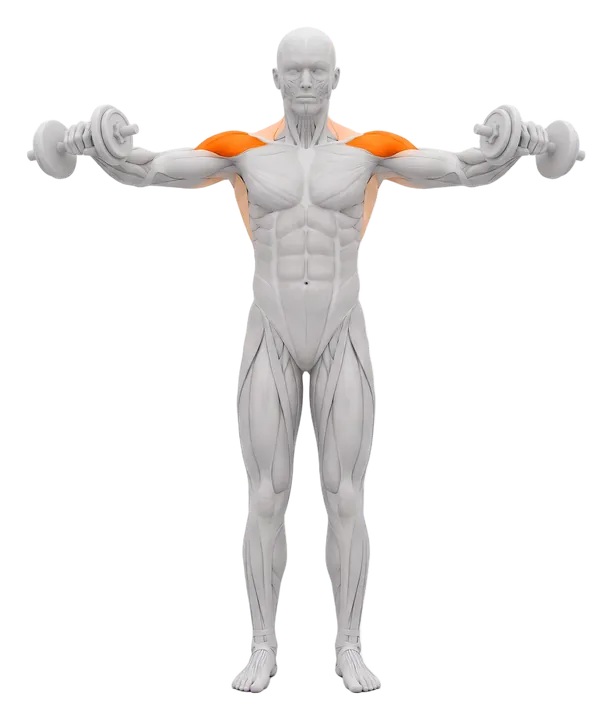
| Side delt | Lifts the arm out to the side | Lateral raise | Presses, a little |
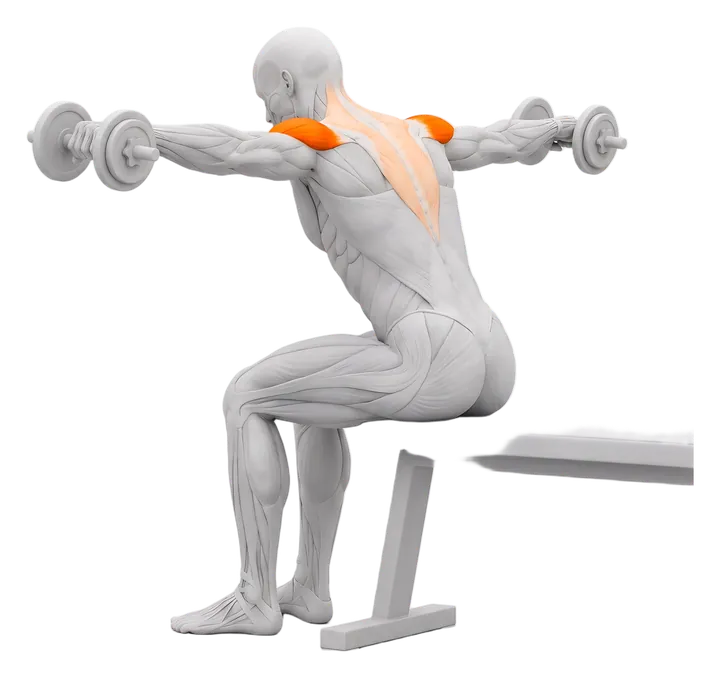
| Rear delt | Pulls the arm back and out | Bent-over rear delt fly | Rows, a little |
If you already bench or do the dumbbell chest workout, your front delts get plenty. Front raises are usually not needed. Spend the extra sets on side and rear delts.
Shoulder exercises with dumbbells
The dumbbell shoulder workout
| Exercise | Sets x reps | Rest | Why it is here |
|---|---|---|---|
| Seated dumbbell shoulder press | 4 x 6 to 10 | 2 min | Heavy press for front delts and triceps |
| Lateral raise | 4 x 12 to 20 | 60 s | Side delts, the width of the shoulder |
| Bent-over rear delt fly | 3 x 12 to 20 | 60 s | Rear delts, balances all the pressing |
| Lean-away lateral raise, one arm | 2 x 12 to 15 per side | 45 s | Side delts with more tension at the bottom |
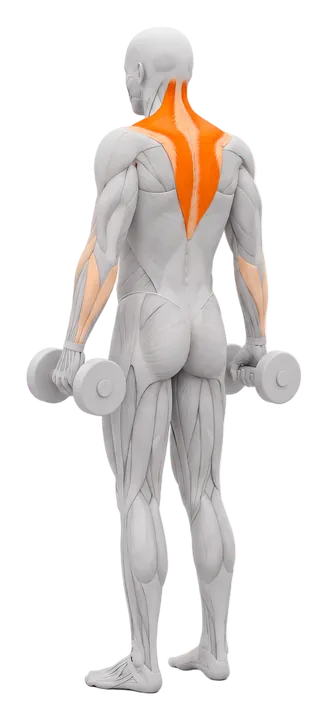
| Dumbbell shrug (optional) | 2 x 10 to 15 | 60 s | Upper traps |
The press comes first so you can push it hard while fresh. The dumbbell shoulder press guide covers elbow position and range. Two lateral raise variations hit the side delts from slightly different angles: the regular one is hardest at the top, the lean-away version holding a post makes the bottom of the rep harder too. The lateral raise guide has the form details.
Seated vs standing dumbbell press
| Seated, back supported | Standing | |
|---|---|---|
| Load | Usually a bit heavier | A bit lighter, the trunk has to stabilise |
| Core and legs | Little | More, the whole body braces |
| Lower back | Supported, easier to stay neutral | Easy to lean back and arch if the weight is too heavy |
| Getting heavy dumbbells up | Kick them up off the thighs | Clean them to the shoulders, harder with heavy weights |
| Best for | Building the delts | General strength, no bench at home |
For muscle, the seated press is the easier one to progress: set the bench upright or one notch back, keep your back against it and press until the dumbbells are over your shoulders. Standing is a good choice when you have no bench, or if you also want the trunk work. Both are fine; pick one and stay with it long enough to see your numbers climb. For a barbell version, see the overhead press.
How heavy should lateral raises be?
Lighter than your ego wants. With the arm held out to the side, the dumbbell sits far from the shoulder, so even a small weight puts a big load on the side delt. As a rule of thumb, expect to raise somewhere around a third of the dumbbell you press: someone pressing 24 kg (55 lb) dumbbells may do good lateral raise sets with 8 kg (18 lb).
- The test: you can raise the dumbbells to shoulder height without swinging your torso, shrugging up or bending the elbows more as the set goes on.
- The rep range: 12 to 20. In this range the side delts give out before your joints and form do.
- The tempo: about 1 second up, a short pause, 2 seconds down.
- Swinging: a little body English on the last rep or two is fine. If every rep needs a swing, go down one dumbbell.
Rear shoulder exercises with dumbbells
The rear delts are small and easy to miss with the upper back. Hinge forward until your torso is almost parallel to the floor, let the dumbbells hang, and raise them out to the sides with soft elbows, leading with the elbows rather than the hands. If you sway, lie chest down on an incline bench instead. A prone Y raise on the same bench (thumbs up, arms in a Y shape) adds lower traps. Rear delts like higher reps: 15 to 20 is a good target.
Beginner and advanced versions
| Level | Workout | Frequency |
|---|---|---|
| Beginner | Seated press 3 x 8 to 12, lateral raise 3 x 12 to 15, rear delt fly 2 x 15 | Twice a week, can sit on an upper body day |
| Intermediate | The full workout above | Once or twice a week |
| Advanced | Day A: seated press 4 x 6 to 8, lateral raise 4 x 15 to 20, rear delt fly 3 x 15 to 20. Day B: standing press 3 x 8 to 10, lean-away lateral raise 3 x 12 to 15, chest-supported rear delt fly 3 x 15 to 20, shrug 3 x 10 to 15 | Twice a week |
Dumbbell shoulder workout at home
Without a bench, press standing or sitting on a chair with your back against the wall. Rear delt flies work bent over. If your heaviest dumbbells are too light for pressing, pike push-ups with your feet on a chair are a strong bodyweight shoulder press.
Back and shoulder workout with dumbbells
Shoulders pair well with back: rows and rear delt flies train neighbouring muscles, and pressing and pulling alternate nicely. Do the press and lateral raise from this page with the rows from the dumbbell back exercises page, and finish with a rear delt fly.
Progression: small muscles, big dumbbell jumps
On the press, the usual 2 to 2.5 kg (5 lb) steps work with normal double progression: add reps from 6 towards 10, and take the next pair when every set reaches 10. On lateral raises, the jump from 8 to 10 kg is 25 percent, which is often too much. Three ways around it:
- Use a wide rep range. Work from 12 up to 20 before you go up, so the next dumbbell still gives you 12.
- Add a set before adding weight. Go from 3 to 4 sets of 20, then move up and drop back to 3 sets.
- Look for in-between weights. Some gyms have 1 kg steps in the light range, or you can use small add-on plates.
The progressive overload guide explains double progression step by step, and the shoulder workout page has the barbell, cable and machine options.
Gripp tracks your raises rep by rep
Gripp is coming to iPhone. Log your sets and Gripp tells you what to do next time: last time 16 reps with 8 kg, today go for 17. When every set reaches the top of the range it moves you to the next dumbbell. Estimated 1RM per exercise sits on a progress chart, and Gripp rates your shoulder strength against people of your age and bodyweight.
Join the waitlist