One row, three targets: the elbow decides
A dumbbell cannot pull from above, so most of your back training with dumbbells is rows. That sounds limited, but the angle of your upper arm changes which muscles do the work. Think about where the elbow goes, not where the hand goes.
| Elbow path | Main target | Dumbbell exercise |
|---|---|---|
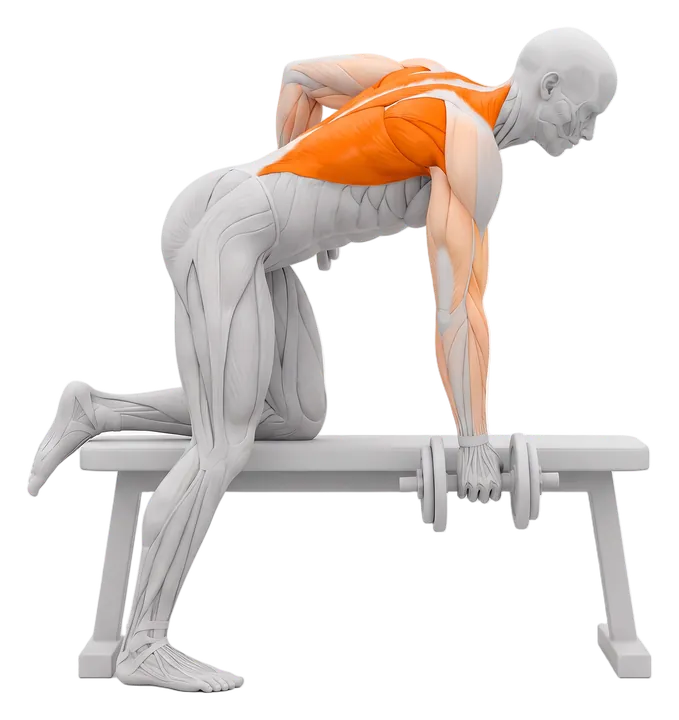
| Close to the side, towards the hip | Lats | One-arm dumbbell row, kneeling lat row |
| Out at about 45 degrees | Lats and upper back together | Two-dumbbell bent-over row |
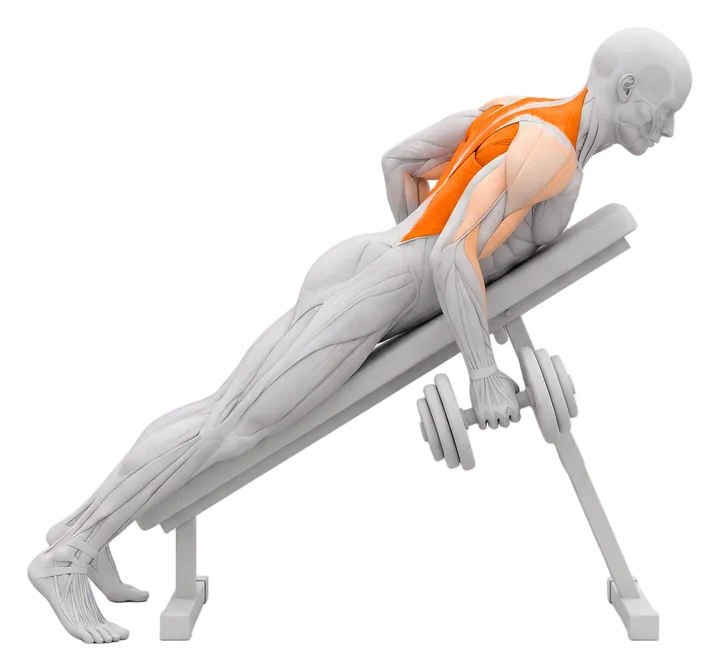
| Out wide, upper arm near 90 degrees | Upper back: mid traps, rhomboids, rear delts | Chest-supported row with wide elbows |
| Arms straight, arcing overhead | Lats in a long stretch | Dumbbell pullover |
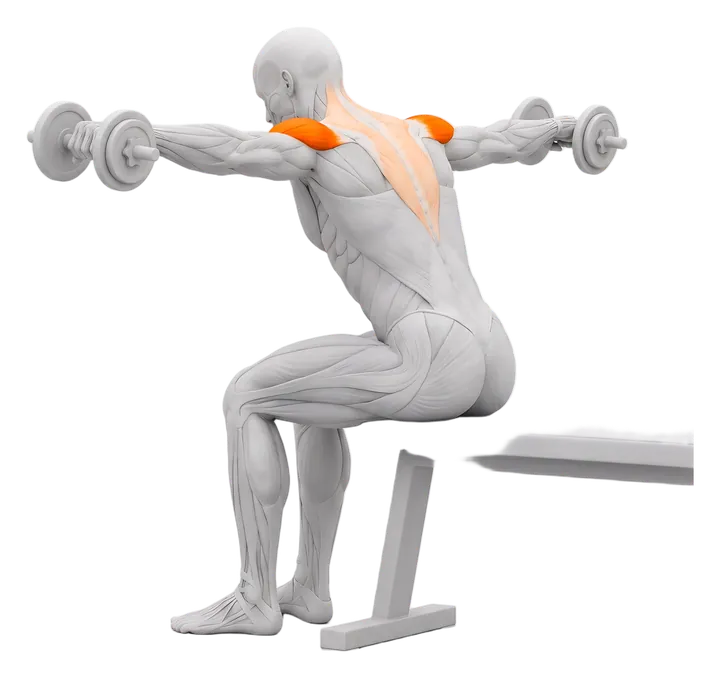
| Arms straight, out to the sides | Rear delts, upper back | Bent-over rear delt fly |
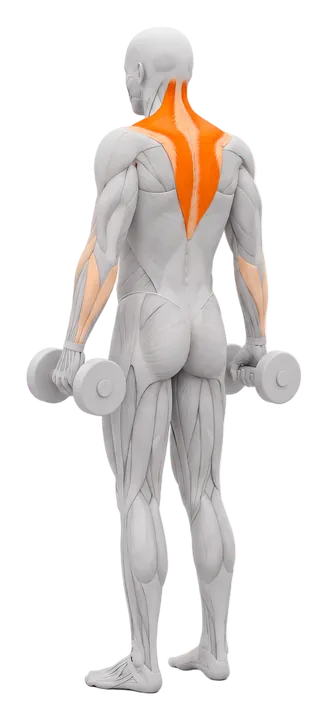
| Arms hanging, shoulders up | Upper traps | Dumbbell shrug |
Dumbbell back exercises
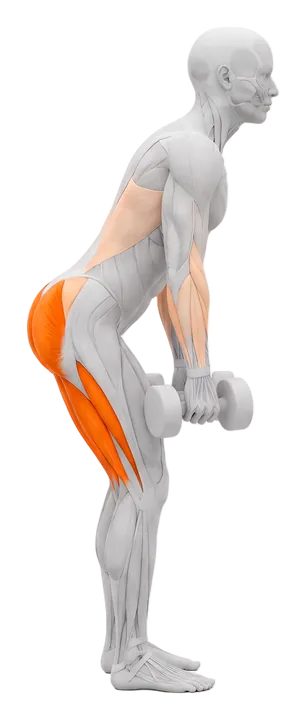
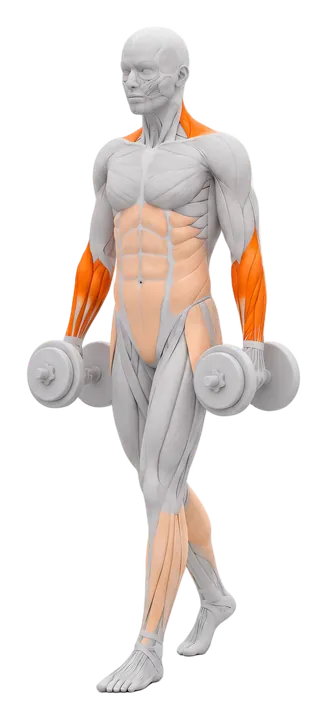
The dumbbell back workout
| Exercise | Sets x reps | Rest | Why it is here |
|---|---|---|---|
| One-arm dumbbell row | 4 x 6 to 10 per side | 90 s | Heaviest pull, lats |
| Chest-supported row, elbows wide | 3 x 10 to 12 | 90 s | Upper back with no lower back strain |
| Dumbbell pullover | 3 x 10 to 15 | 60 to 90 s | Lat stretch, stands in for a pulldown |
| Bent-over rear delt fly | 3 x 12 to 20 | 60 s | Rear delts and posture muscles |
| Dumbbell Romanian deadlift | 3 x 8 to 12 | 2 min | Lower back, glutes and hamstrings |
The one-arm row goes first because it is the pull where you can use the heaviest dumbbell, with one hand and one knee on the bench to brace. The dumbbell row guide goes through the setup. The chest-supported row takes the lower back out of the lift, so the upper back can be trained to fatigue. The pullover trains shoulder extension, the job lats do in a pulldown. The rear delt fly is light work for the back of the shoulders, and the Romanian deadlift covers the lower back that rows barely touch.
Lats vs upper back: what to feel where
If you only feel your biceps when you row, you are probably pulling with the hand. Try these cues instead.
- For the lats: let the dumbbell hang low and slightly forward to start, then pull the elbow back towards your hip pocket in an arc. You should feel it along the side of your ribs, below the armpit.
- For the upper back: lie face down on a bench set to about 30 degrees, let the dumbbells hang, and row with the elbows flared out until the upper arms are level with your torso. Squeeze the shoulder blades together for a second.
- Grip lightly: a death grip brings in more biceps and forearms. Hold the handle like a hook.
- Use straps if grip fails first: on heavy rows and Romanian deadlifts the hands often give out before the back. Straps are fine for back work.
How to replace pulldowns and pull-ups at home
A vertical pull is the one thing dumbbells cannot copy directly. You have a few options, from best to good enough:
- A doorway pull-up bar. The cheapest upgrade to a dumbbell setup. Chin-ups and pull-ups load the lats harder than any dumbbell exercise.
- Band pulldowns. Anchor a resistance band high in a door and pull it to your chest while kneeling. It copies the lat pulldown movement well.
- Dumbbell pullover. Same shoulder movement as a pulldown, loaded in the stretch. Keep a slight bend in the elbow and stop when your arms are in line with your ears.
- Kneeling lat row. A one-arm row with the torso nearly flat and the elbow pulled tight to the hip. It biases the lats more than a standard row.
Dumbbell lower back exercises
Rows hold the lower back still, they do not train it through a range. For that you need a hinge. These dumbbell lower back exercises build the muscles along your spine together with the glutes and hamstrings:
- Dumbbell Romanian deadlift: hips back, dumbbells sliding down the front of the thighs, back flat. The main one.
- Single-leg Romanian deadlift: lighter, and adds balance and side to side control.
- Suitcase carry: one heavy dumbbell in one hand, walk tall for 30 to 40 metres. Trains the side of the trunk to resist bending.
- Bird dog holding a light dumbbell: a gentle option for beginners or a warm-up.
Beginner and advanced versions
| Level | Exercises | Sets x reps | Sessions per week |
|---|---|---|---|
| Beginner | One-arm row, chest-supported row, dumbbell RDL | 3 x 10 to 12 each | 2 |
| Intermediate | The full workout above | As listed | 2 |
| Advanced | Day A: one-arm row 4 x 6 to 8, pullover, RDL. Day B: chest-supported row 4 x 10 to 15, rear delt fly, shrug, suitcase carry | 3 to 4 sets each | 2 to 3 |
Dumbbell back exercises without a bench
Brace one hand on a sturdy chair or your knee for the one-arm row, or do a two-dumbbell bent-over row with the torso at about 45 degrees. A rear delt fly works the same bent over without support. For the chest-supported row, lie face down on the floor across a pillow and row from there, it shortens the range but still trains the upper back.
Dumbbell back and biceps workout
Rows already work the biceps, so two curl exercises are enough after the back work: hammer curls and incline curls for 3 sets of 10 to 12. The dumbbell arm workout has more ideas if you want a longer arm block.
Progressing with fixed dumbbell steps
Rows are one of the easiest lifts to progress with dumbbells, because you can move heavy weights and the 2 to 2.5 kg (5 lb) steps are small in relation. Use double progression: pick a range such as 6 to 10 on the one-arm row, add reps each session, and take the next dumbbell when every set hits 10. On the rear delt fly, jumps are big in percent, so stay in a high range like 12 to 20 and add reps for longer before you move up.
When the heaviest dumbbell you own gets easy on rows, add a 2 second squeeze at the top or a slow 3 second lowering. Read the progressive overload guide for the rules behind it, and the back exercises hub for the barbell and cable options when you are in a full gym.
Log every row in Gripp
Gripp is coming to iPhone. Log each set of rows with the weight and reps and Gripp gives you the target for next time: last time 9 reps with 30 kg, today aim for 10. Hit the top in every set and it moves you up a dumbbell. It tracks an estimated 1RM per exercise on a chart and rates your back strength against people of your age and bodyweight.
Join the waitlist