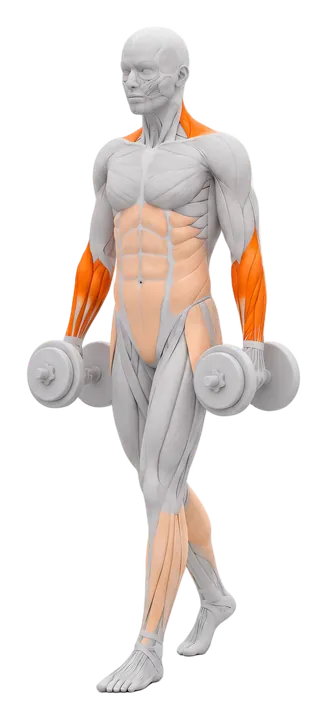
What does the farmers walk work?
| Muscle | What it does while you walk | Role |
|---|---|---|
| Forearms and hand muscles | Crush the handles for the whole set | Primary |
| Upper traps | Hold the shoulders up against the pull of the weights | Primary |
| Abs and obliques | Keep the torso upright and stop side to side sway | Secondary |
| Spinal erectors | Hold the back straight under load | Secondary |
| Glutes and hip muscles | Keep the pelvis level on each step | Secondary |
| Calves and quads | Carry you and the load forward | Secondary |
Unlike most gym exercises, the farmers walk has no reps. The muscles work isometrically, holding a position for time, while the legs move underneath. That is why it shows up in both strongman training and general fitness plans: it trains the parts of you that have to stay rigid when you lift, the same ones that hold a heavy deadlift together.
How to do a farmers walk
- Set up the weightsPlace two dumbbells or kettlebells on the floor, one at each side of your feet. Clear a straight path of at least 15 to 20 m (50 to 65 ft), or plan to turn around.
- Pick them up like a deadliftHinge at the hips, keep a flat back, grip the handles in the middle and stand up by driving through the floor. Do not round your back to grab them.
- Get tallStand up straight, shoulders down and slightly back, chest up, eyes forward. Arms hang straight at your sides with the weights not touching your legs.
- WalkTake short, quick steps, heel to toe, with your feet about hip width. Breathe behind a braced midsection; short breaths are fine.
- Put them down under controlAt the end, stop, hinge and lower the weights to the floor with the same flat back you used to pick them up. Do not drop them from standing.
Posture cues that make it work
- "Proud chest, shoulders packed." If the shoulders round forward, the traps and upper back lose their grip on the load.
- "Ribs over hips." Do not lean back to counter the weight. Stack the ribcage over the pelvis.
- "Crush the handle." A hard grip from the first step makes the whole arm and shoulder more stable.
- "Short steps." Long strides make the weights swing. Quick small steps keep them still.
- "Quiet weights." If the dumbbells bang against your legs or swing, slow down or go lighter.
Common mistakes
- Shrugging the weights up. Shoulders should be set, not lifted to the ears. A shrug is a separate exercise.
- Looking down. The head drops and the upper back rounds. Look at a point ahead.
- Leaning to one side. Usually one hand is weaker. Check that both weights are the same and hold them centred.
- Rounding the back to pick up or set down. Most carry related back complaints happen here, not during the walk.
Farmers walk benefits
- Grip strength. Holding heavy weight for 30 seconds or more trains your grip in a way short sets of curls or rows do not. A stronger grip helps on deadlifts, rows and pull-ups.
- Bigger, stronger traps. The traps work the whole time to keep your shoulders from being pulled down. Pair it with shrugs if the traps are a priority.
- Core stability. The abs, obliques and back muscles fight to keep you upright, much like a moving plank.
- Posture under load. You practise standing tall while something heavy is pulling on you, a skill that carries over to everyday lifting.
- Conditioning. Heavy carries over distance raise the heart rate quickly, so they make a good finisher.
None of this replaces your main lifts. The farmers walk is a supplement: a few sets at the end of a session that fill gaps in grip and stability.
Dumbbell, kettlebell or trap bar farmers walk
| Equipment | What it feels like | Good for |
|---|---|---|
| Dumbbells | Weights hang at your sides, thick plates near the legs | Most gyms, easy to pick a weight |
| Kettlebells | Handle above the bell, weight hangs lower | Home training, slightly more grip challenge |
| Trap bar | One bar, both hands, loaded with plates | Heaviest loads, small jumps |
| Farmer's handles | Strongman style handles loaded with plates | Heavy and long carries |
| Plates (pinch grip) | Hold plates between fingers and thumb | Hard grip variation with light weight |
A trap bar farmers walk lets you load far more than the dumbbell rack allows, and you can add 2.5 kg (5 lb) at a time. The same bar is used for the trap bar deadlift. Walk with it in an open area: a long bar is awkward in tight spaces. Some people walk on a treadmill with weights, but a moving belt plus heavy load is risky. A floor with space is safer. With kettlebells, carries also make a good finisher for a kettlebell workout.
Farmers walk vs suitcase carry
The suitcase carry uses one weight in one hand. The body is pulled to one side, so the obliques and the muscles on the other side of the trunk must work hard to keep you straight.
| Farmers walk | Suitcase carry | |
|---|---|---|
| Weights | One in each hand | One in one hand |
| Total load | Higher | Lower |
| Main challenge | Grip, traps, overall stiffness | Not leaning, side core |
| Best for | Grip and traps, heavy carries | Obliques and anti lean strength |
Do both if you can: farmers walks for load, suitcase carries for the side core. A suitcase carry also works well next to a side plank in an ab workout.
Farmers walk weight, sets and distance
| Goal | Sets x time or distance | Rest | Load |
|---|---|---|---|
| Grip and strength | 3 to 5 x 20 to 30 m | 2 min | Heavy, form must hold |
| Traps and core | 3 to 4 x 30 to 45 s | 90 s | Moderate to heavy |
| Conditioning finisher | 4 to 6 x 30 to 40 m | 60 s | Moderate |
| Beginner | 3 x 20 to 30 s | 90 s | Light to moderate |
How heavy? Start with a weight per hand that feels hard by the end of 30 seconds but never makes your posture break. A common long term goal in strength circles is to carry about your bodyweight in total, half in each hand, for 30 m or so. Treat that as a rule of thumb, not a standard. Put carries at the end of a lower body or full body session, after the heavy lifts, so a tired grip does not cost you reps on the bar.
How to progress the farmers walk
Progress one thing at a time. First add time or distance at the same weight, for example from 30 to 45 seconds. When you can do that for all sets with clean posture, go up one dumbbell size and drop back to the shorter time. It is the same logic as progressive overload with reps, just measured in seconds or metres.
Carries next to your main lifts
Gripp is coming to iPhone. It keeps your training history and each exercise's muscle map in one place, plans your week around your other sport and tells you what to lift next time on your main lifts. For carries, a simple rule works well: add weight once you walk the full distance with good posture.
Join the waitlistSimilar exercises
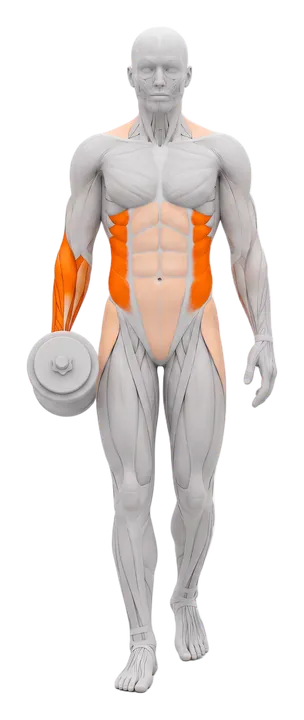 Suitcase carryObliques and forearms
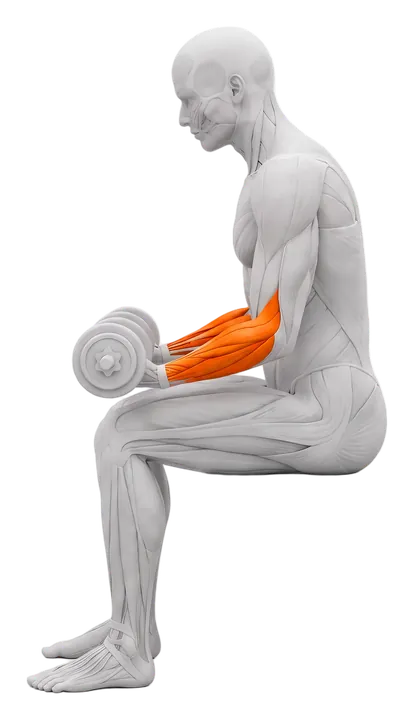 Dumbbell wrist curlForearms