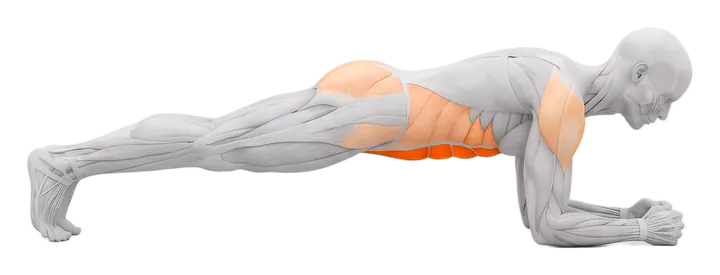
Plank muscles worked
A plank is an anti-extension exercise. Gravity tries to pull your hips towards the floor and bend your lower back into an arch, and your trunk muscles hold the line. Nothing moves, but a lot is working.
| Muscle | What it does in the plank | Role |
|---|---|---|
| Rectus abdominis | Keeps the ribs pulled towards the pelvis so the back does not sag | Primary |
| Transversus abdominis | Braces the trunk like a belt | Primary |
| Obliques | Help resist sagging and stop the hips twisting | Secondary |
| Glutes | Hold the pelvis level and the hips extended | Secondary |
| Front delts and serratus | Keep the shoulders stacked over the elbows | Secondary |
| Quadriceps | Keep the knees straight | Stabiliser |
Because the glutes and shoulders work too, the plank is more of a whole body brace than a pure ab exercise. That is also why it carries over well to bracing under a squat or a deadlift, where the same muscles keep your spine still under load.
Plank exercise proper form, step by step
- Elbows under shouldersKneel on a mat, place your forearms on the floor with your elbows directly below your shoulders and your hands shoulder width apart or lightly clasped.
- Step the feet backStraighten one leg at a time behind you and rest on your toes, feet about hip width. Wider feet make the hold more stable, closer feet make it harder.
- Set the pelvisTilt your pelvis slightly under, as if you were tucking a tail between your legs. You should feel your lower abs switch on and your lower back flatten a little.
- Squeeze glutes and quadsTighten your bum and lock your knees. This takes load off the lower back and makes the body one solid piece.
- Push the floor awayPress your forearms into the mat so your upper back rounds very slightly rather than sinking between the shoulder blades. Look at the floor just ahead of your hands.
- Breathe and holdBreathe in short, quiet breaths through the nose without letting the belly drop. End the set when the position changes, not when the clock says so.
Common plank mistakes
- Hips sagging. The most common fault, and it shifts the load from the abs to the lower back. Tuck the pelvis and squeeze the glutes, or shorten the hold.
- Hips piked up. Feels easier because it is easier. Lower until your body is a straight line.
- Holding your breath. You cannot brace for long without breathing. Keep breathing behind a tight belly.
- Shoulders collapsing. If your chest sinks between your shoulder blades, push the floor away.
- Chasing minutes. A five minute plank with drifting hips trains less than a 40 second plank held perfectly.
How long should you hold a plank?
For most people training for strength or a better looking midsection, holds of 20 to 60 seconds with good form do the job. Shorter, harder holds are not worse; a 20 second plank where you squeeze everything as hard as you can is tougher than a relaxed two minute one. The table below gives rule of thumb ranges.
| Goal | Sets x hold | Rest | Notes |
|---|---|---|---|
| Beginner | 3 x 15 to 30 s | 45 to 60 s | Knees down if the full plank breaks form |
| General fitness | 3 x 30 to 60 s | 60 s | Add 5 s per session until 60 s |
| Strength and bracing | 3 to 5 x 10 to 20 s | 60 to 90 s | Hard squeeze, or a harder variation |
| Rehab goal | 2 to 3 x 15 to 30 s | 60 s | Follow your physio's plan first |
How many sets of planks should I do? Three sets two to four times a week is enough when the plank is one part of a broader ab workout. You do not need planks every day, and adding more sets of an easy hold helps less than making each set harder.
Plank progressions beyond holding longer
Once you can hold 60 seconds with clean form, stop adding time. Make the plank harder instead, so the set stays in the 20 to 45 second range. Work down this list one step at a time.
| Variation | What changes | Try it when |
|---|---|---|
| Knee plank | Knees on the floor, shorter lever | A full plank sags before 15 s |
| Front plank | The standard version | Knee plank feels easy for 45 s |
| RKC plank | Elbows pulled towards toes, maximal squeeze, 10 to 20 s | 60 s holds feel easy |
| Long lever plank | Elbows a hand length in front of the shoulders | You want more ab work without equipment |
| Plank with arm reach | Lift one arm forward, alternate | You want to add anti-rotation |
| Plank with leg lift | Lift one foot a few cm, alternate | Arm reaches are easy |
| Weighted plank | A plate on the upper back, placed by a partner | You want measurable progress in kg |
| Plank row | High plank on dumbbells, row one side at a time | You want a plank that also trains the back |
| Ab wheel rollout | The plank becomes a moving exercise | Long lever planks are solid |
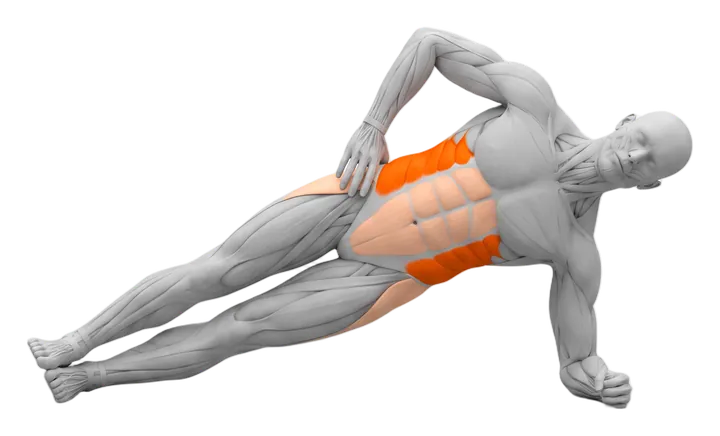
The natural next step is the ab wheel rollout, which is basically a plank that moves in and out of a long lever. For the sides of your trunk, add the side plank; it trains the obliques far better than any front plank variation.
A beginner plank workout
This short ab plank workout fits at the end of any session, two or three times a week. Do it as a circuit and rest 60 seconds between rounds. Two rounds to start, three when it feels manageable.
| Exercise | Time or reps | Cue |
|---|---|---|
| Front plank | 20 to 40 s | Pelvis tucked, glutes tight |
| Side plank, left | 15 to 30 s | Hips high, body in a line |
| Side plank, right | 15 to 30 s | Same height as the left side |
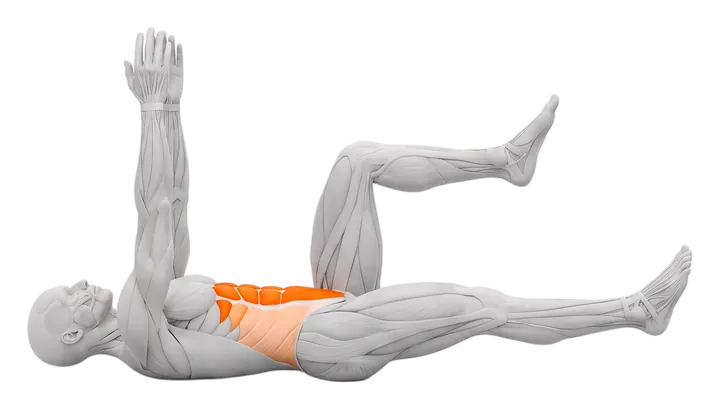
| Dead bug | 6 to 8 per side | Lower back stays on the floor |
If the full plank is hard to hold, start with the dead bug. It trains the same anti-extension job lying on your back, which makes it easier to learn the pelvic tuck before you take it into a plank.
Track your planks like a lift
Planks fail as a training tool mostly because nobody writes them down. Note the variation and the seconds of every set, and set a simple rule: when all three sets reach the top of your time range, move to the next variation and start back at the bottom. That is progressive overload applied to a hold.
Planks in a plan that progresses
Gripp is coming to iPhone. It builds your core work into a weekly plan next to your weighted lifts, tells you what to go for next time and moves you to a harder variation when the easy one stops being a challenge. The exercise page shows which muscles work, and your core gets a strength rating against people of your age and bodyweight.
Join the waitlistPlank alternative exercises
- Dead bug: same job on your back, good if the shoulders do not like forearm support.
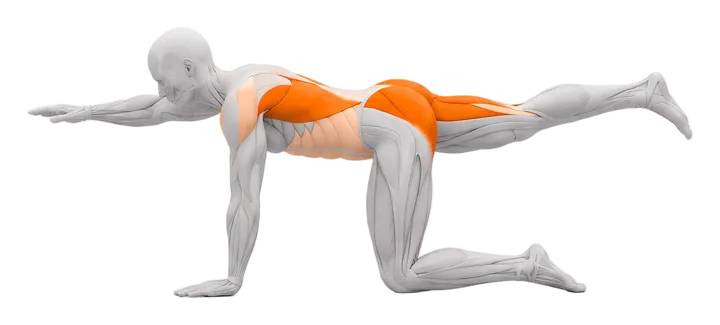
- Bird dog: on hands and knees, reach the opposite arm and leg while keeping the back still.
- Pallof press: a band or cable held in front of the chest while you resist being twisted.
- Farmer's walk: heavy carries make the trunk brace while you walk. See the farmer's walk guide.
- Hollow body hold: a plank turned upside down, with the lower back pressed into the floor.
Similar exercises
 Dead bugAbsGuide
 Side plankObliquesGuide
 Bird dogLower back and glutes
 Pallof pressObliques and abs
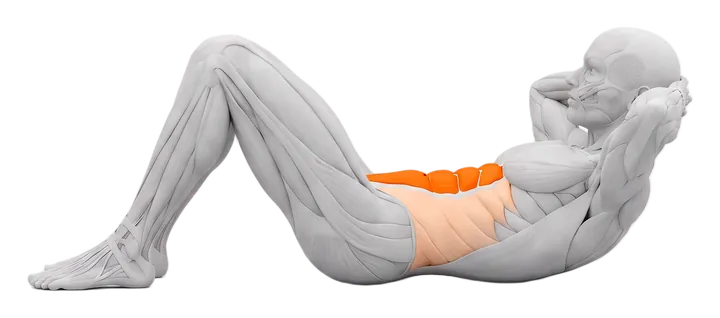 CrunchAbsGuide
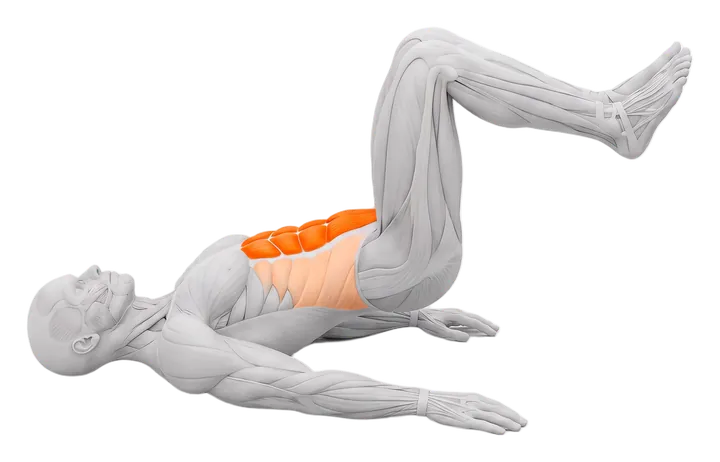 Reverse crunchAbs