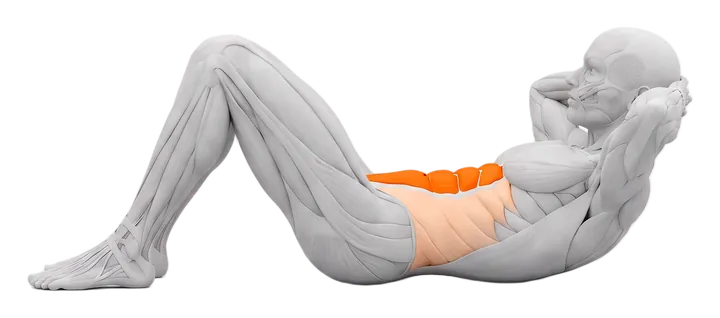
What are crunches, and what do they work?
A crunch is a short range spinal curl. Unlike a plank, which trains your abs to hold the trunk still, the crunch makes them shorten and bend the spine. That is the movement the six pack muscle is built for, which is why some form of crunch belongs in almost every ab workout.
| Muscle | Role in the crunch | How much |
|---|---|---|
| Rectus abdominis | Curls the ribs towards the pelvis | Primary |
| External obliques | Help the curl, more in bicycle and twisting crunches | Secondary |
| Internal obliques | Help the curl and keep the trunk steady | Secondary |
| Transversus abdominis | Holds tension in the abdomen | Stabiliser |
How to do crunches with good form
- Set upLie on your back with your knees bent and feet flat, about hip width apart. Hands lightly at your temples or crossed on your chest.
- Flatten the lower backGently press your lower back into the floor. It stays there for the whole set.
- Breathe out and curlBreathe out as you curl your head, then your shoulders, then your upper back off the floor. Think about pulling the bottom of your ribs towards your belly button.
- Pause at the topStop when your shoulder blades are just off the floor and hold for one second with the abs squeezed. Going higher only brings in the hip flexors.
- Lower slowlyUncurl over 2 seconds until your shoulders touch down, then start the next rep without bouncing.
Common crunch mistakes
- Pulling on your head. Hands at the temples are a guide, not a lever. Keep a fist of space between chin and chest.
- Sitting up too far. Past the shoulder blades, the hip flexors take over and the abs get a break.
- Rushing. Fast, bouncing reps use momentum. A slow lowering is where much of the work happens.
- Holding your breath. Breathe out on the way up; it helps the ribs come down and the abs contract harder.
- Doing hundreds. If you can do 50 in a row, the set is too easy to build muscle. Make the reps harder instead.
Crunch vs sit-up
The two look similar, but they are different exercises. A crunch only curls the spine. A sit-up continues all the way up until the chest reaches the thighs, which means the hip flexors pull the trunk up through the second half.
| Crunch | Sit-up | |
|---|---|---|
| Range | Shoulder blades just off the floor | All the way up to sitting |
| Main muscles | Rectus abdominis, obliques | Abs plus hip flexors |
| Lower back | Stays on the floor | Lifts off as you sit up |
| Easy to load | Yes, plate on the chest or cable | Yes, but heavy sit-ups mostly load the hip flexors |
| Best for | Targeted ab work | Fitness tests, general conditioning |
For building the abs, crunches give you more ab work per rep. Sit-ups are not bad, but if they bother your back, crunches and the dead bug train the abs with less lower back movement.
Crunch variations
| Variation | How | What it adds |
|---|---|---|
| Reverse crunch | Curl the hips off the floor towards the ribs | Starts from the pelvis, a lower ab focus |
| Bicycle crunch | Elbow towards the opposite knee, legs pedal | Rotation, more obliques |
| Cable crunch | Kneel at a cable stack, rope behind the head, curl down | Heavy, easy to add weight |
| Weighted crunch | Hold a plate or dumbbell on the chest | Load on a floor crunch |
| Decline crunch | Crunch on a decline bench, feet hooked | Longer range, harder against gravity |
| Stability ball crunch | Back on a ball, start slightly extended | A stretch at the bottom of the rep |
| Machine crunch | Seated ab machine with a weight stack | Simple loading in the gym |
| Star crunch | From lying spread out, crunch arms and legs together | A harder bodyweight version |
Reverse crunches
Lie on your back with knees bent 90 degrees and lifted. Curl your hips off the floor so your knees move towards your chest, then lower in 3 seconds. The movement is small; the hips should lift a few centimetres, not the legs swing. It is the floor version of the hanging leg raise and the best way to prepare for it.
Bicycle crunches
Hands at the temples, shoulders lifted. Bring one elbow towards the opposite knee while the other leg extends, then switch. The common error is flapping the elbows; rotate from the ribs instead and slow down so each side gets a real squeeze. Count 10 to 20 per side.
Cable crunches
Kneel facing a high cable with a rope attachment held beside your head. Keep your hips still and curl your ribs down towards your hips, then let the weight pull you back up to a stretch. The hips should not sit back to help. Cable crunches are the easiest crunch to load in small, repeatable steps, which makes them the main crunch for most gym-goers.
Weighted crunches
Hold a plate or a dumbbell on your chest, or behind your head for a harder lever. Start with 2.5 to 5 kg (5 to 10 lb) and keep the same slow form you use without weight.
How to make crunches effective and progressive
Crunches get a bad reputation because most people do them the same way for years: bodyweight, as many as possible. Treat them like any other lift and they work. Pick a rep range, finish each set close to failure, and make it harder when you hit the top of the range.
- Choose a range of 10 to 15 reps. If you can do more than 20 clean reps, the exercise is too easy.
- Add reps first. Work up to 3 sets of 15 with a one second pause at the top.
- Then add load. A plate on the chest or the next pin on the cable stack, and drop back to 10 reps.
- Or change the variation. Floor crunch, then decline or weighted crunch, then cable crunch.
- Write it down. Without a log you will not know if this week was harder than last week.
That loop is double progression: a rep range, then load. It works for crunches the same way it does for curls or presses.
Crunches with a target every session
Gripp is coming to iPhone. Log your cable crunches and floor crunches set by set, and Gripp tells you what to go for next session: one more rep, or the next weight once every set hits the top of the range. Your estimated max and a progress chart show if the work is paying off.
Join the waitlistCrunches sets and reps
| Goal | Sets x reps | Rest | Notes |
|---|---|---|---|
| Beginner | 2 to 3 x 10 to 15 | 45 to 60 s | Floor crunch, slow lowering |
| Ab growth | 3 to 4 x 8 to 15 | 60 s | Cable or weighted, close to failure |
| Strength | 3 to 4 x 6 to 10 | 90 s | Heavy cable crunch |
| Bicycle crunches | 2 to 3 x 10 to 20 per side | 45 s | Slow, rotate from the ribs |
Two or three sessions a week, combined with an anti-extension exercise such as the plank or the ab wheel rollout, covers most of what your abs need.
Alternative exercises for crunches
- Dead bug: trains the abs with the lower back still, a good swap if crunches bother your neck or back.
- Hanging knee raise: a pelvis first curl with your bodyweight.
- Ab wheel rollout: a hard anti-extension exercise.
- Pallof press: anti-rotation work for the obliques.
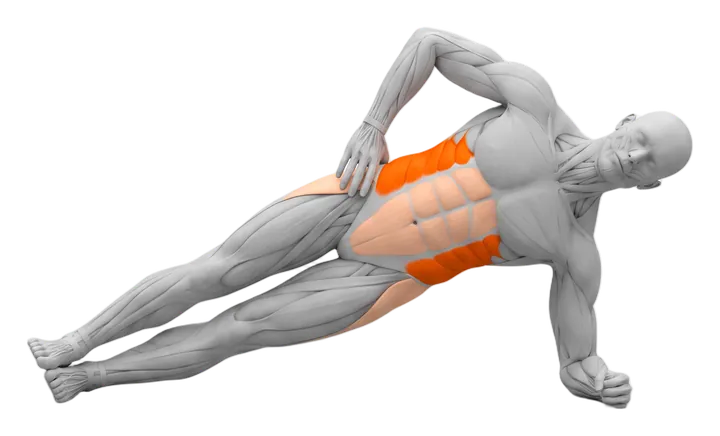
- Side plank: for the sides, see the side plank guide.
Similar exercises
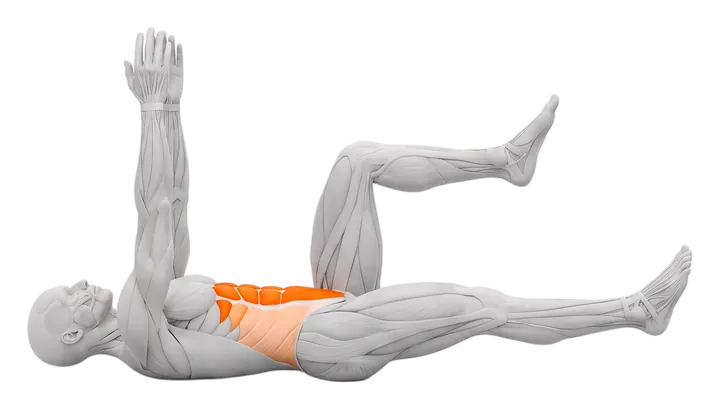 Dead bugAbsGuide
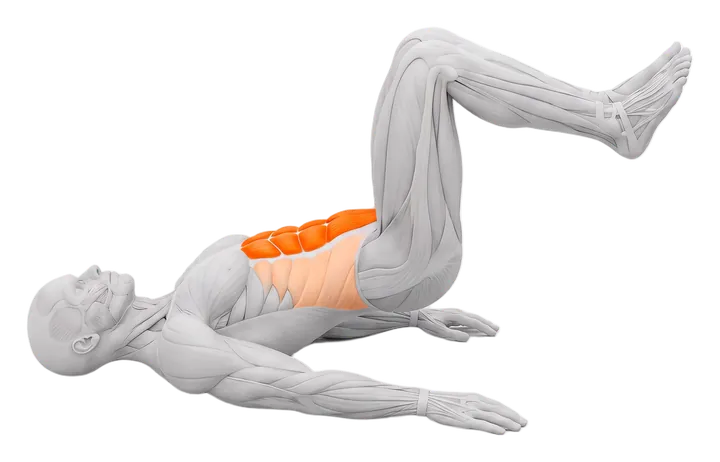 Reverse crunchAbs
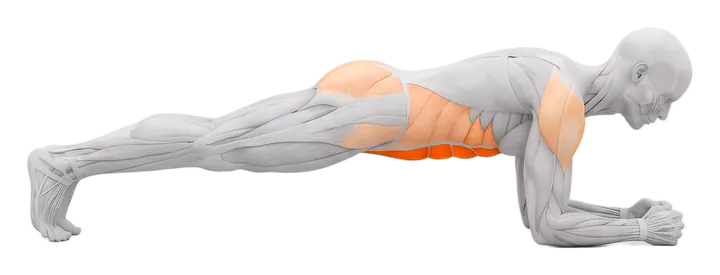 Front plankAbsGuide
 Side plankObliquesGuide
 Bird dogLower back and glutes
 Pallof pressObliques and abs