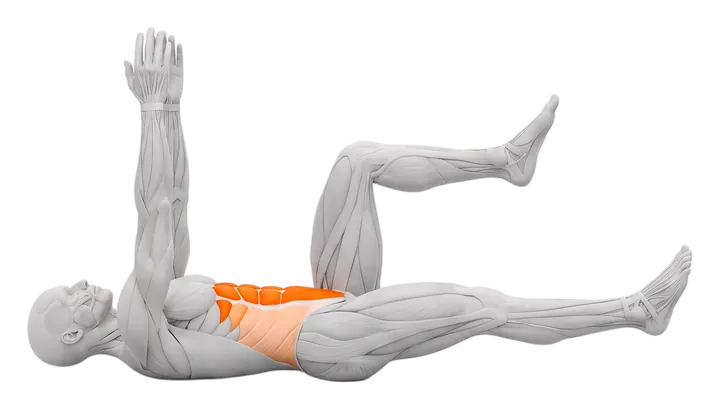
What anti-extension means
When your arms and legs reach away from your body, their weight tries to pull your lower back into an arch. In the dead bug your abs have to hold the pelvis and ribs in place against that pull. It is the same job they do in a plank or an ab wheel rollout, only lying on your back with your body fully supported by the floor.
That support is the point. You can feel straight away when your lower back lifts off the floor, so the dead bug gives you clear feedback that harder core exercises do not. Many coaches use it to teach bracing before heavier lifts.
Dead bug muscles worked
| Muscle | Job in the dead bug | Role |
|---|---|---|
| Rectus abdominis | Holds the ribs down and the lower back flat | Primary |
| Transversus abdominis | Braces the trunk as the limbs move | Primary |
| Obliques | Stop the trunk rotating as one side reaches | Secondary |
| Hip flexors | Lower and lift the moving leg under control | Secondary |
| Shoulders | Hold the arms over the shoulders | Stabiliser |
Dead bug exercise form, step by step
- Lie on your backLie on a mat with your arms pointing straight up over your shoulders. Lift your legs so your knees are bent 90 degrees and stacked above your hips, shins parallel to the floor.
- Set the lower backBreathe out fully and let your ribs drop towards the floor. Your lower back should be gently pressed into the mat. Slide a hand under it: there should be little or no gap.
- Reach opposite arm and legSlowly lower your right arm behind your head and straighten your left leg towards the floor, taking 2 to 3 seconds. Stop with both a few centimetres above the floor.
- Hold the back stillThe moment you feel your lower back start to lift, stop and shorten the reach. Range is decided by your back, not by the floor.
- Return and switchBring the arm and leg back to the start, then repeat with the left arm and right leg. One rep per side counts as one rep each.
Breathing in the dead bug
Breathing is what turns the dead bug from a slow limb exercise into real core training. A long breath out pulls the ribs down and switches on the deep abs. Holding your breath, or breathing high into the chest, lets the ribs flare and the back arch.
- Breathe in through the nose in the start position, into your belly and sides without letting the ribs lift.
- Breathe out slowly through the mouth as you reach the arm and leg away, as if you were blowing up a balloon.
- Finish the breath out at the end of the reach and keep the abs tight.
- Breathe in again as you return to the start.
Common dead bug mistakes
- Lower back arching. The whole exercise is about stopping this. Shorten the reach until it stops.
- Moving fast. Quick reps let momentum do the work. Take 2 to 3 seconds out and back.
- Same side arm and leg. Opposite arm and leg is the standard; same side feels easier because the trunk does not have to resist twisting.
- Head and neck straining. Rest your head on the floor and let the neck relax.
- Knees drifting towards the chest. Keep the non-moving knee stacked over the hip, not pulled in.
Who the dead bug suits
- Beginners. Easy to learn, no equipment, and it teaches the bracing you need for a squat or a deadlift.
- People coming back after a break. A low load way to rebuild core control before harder exercises.
- Lifters who want a warm up drill. Two easy sets wake up the abs before heavy compound lifts.
- Anyone whose back does not like crunches or rollouts. The spine stays still and supported. If you have a back injury, a physiotherapist can tell you whether it fits your situation.
- Rehab goals. It is a common choice in rehab plans; follow the plan your physio gives you.
It is less useful if your goal is bigger, stronger abs and you already handle long lever planks and rollouts. Then the dead bug works best as a warm up, and the main work comes from loaded crunches and leg raises in your ab workout.
Dead bug sets and reps
| Goal | Sets x reps | Rest | Notes |
|---|---|---|---|
| Learning the move | 2 x 5 per side | 30 to 45 s | Short reach, one breath per rep |
| Beginner core | 2 to 3 x 6 to 10 per side | 45 to 60 s | Full reach with a flat back |
| Warm up before lifting | 1 to 2 x 5 per side | None | Easy, focus on breathing |
| Harder core work | 3 x 8 to 12 per side | 60 s | Weighted or banded version |
| Rehab goal | 2 to 3 x 6 to 10 per side | 60 s | Follow your physio's plan first |
How many reps of dead bugs should I do? Fewer, slower reps beat high counts. If you can do more than 12 per side with a perfectly flat back and full breath out, the exercise is too easy and it is time for a harder version.
Dead bug progressions
| Variation | How | Use it when |
|---|---|---|
| Heel taps | Arms still, lower one bent leg until the heel taps the floor | The full version arches your back |
| Arms only or legs only | Move only the arms, or only the legs | You are learning the breathing |
| Standard dead bug | Opposite arm and straight leg | Heel taps are easy |
| Dead bug with a pause | Hold 3 s at the end of each reach | Standard reps feel easy |
| Weighted dead bug | Light dumbbell or kettlebell in each hand | You want measurable load |
| Banded dead bug | Band anchored behind you, pulled down to the hips with straight arms | You want the lats and abs to work together |
| Dead bug with a ball | Squeeze a ball between hand and opposite knee | You want more deep ab tension |
| Hollow body hold | Both arms and legs extended at once | Every dead bug variation is easy |
Progress the way you would with any exercise: add reps up to the top of your range, then step up the variation. The progressive overload guide shows how to plan that over months.
Rehab or strength, Gripp follows the plan
Gripp is coming to iPhone. Rehab can be a goal in the app, so a slow core block like dead bugs and side planks gets planned like any other training. Log your reps per side, and Gripp tells you when it is time for the next variation.
Join the waitlistDead bug exercise alternatives
- Bird dog: the dead bug turned over, on hands and knees. It works the back muscles more.
- Plank: the same anti-extension job, standing on forearms and toes.
- Hollow body hold: a harder lying hold that keeps the lower back pressed down.
- Reverse crunch: if you want the abs to move rather than hold. See the crunches guide.
- Pallof press: anti-rotation from standing or kneeling.
Similar exercises
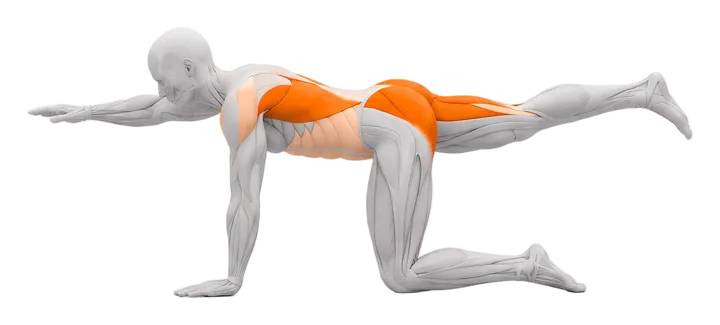 Bird dogLower back and glutes
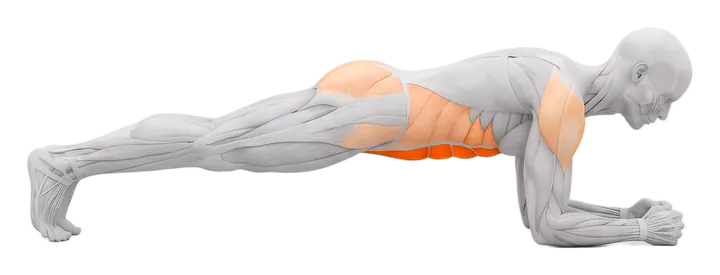 Front plankAbsGuide
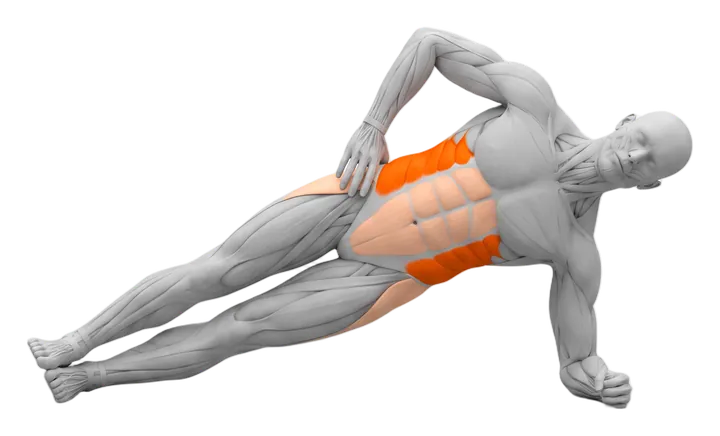 Side plankObliquesGuide
 Pallof pressObliques and abs
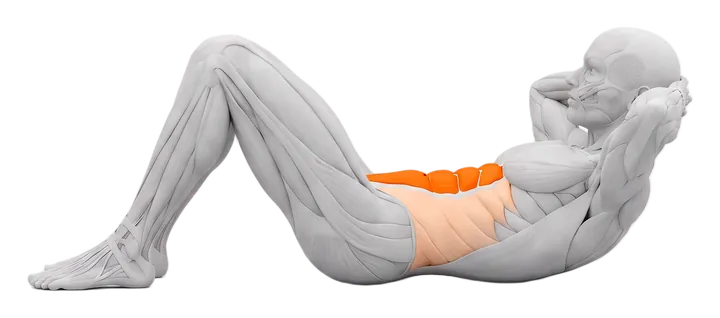 CrunchAbsGuide
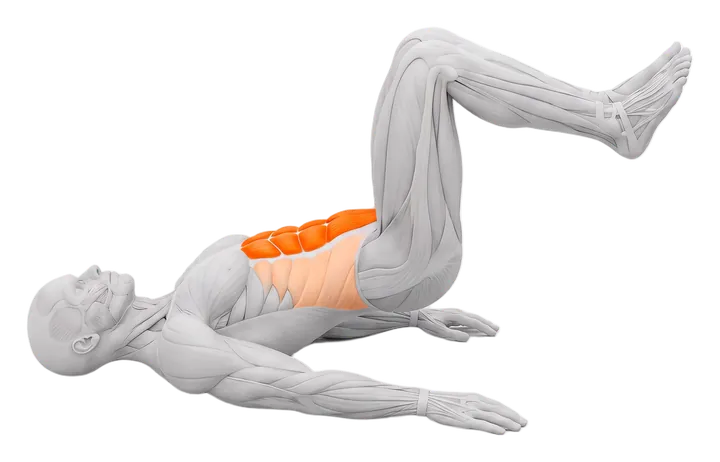 Reverse crunchAbs