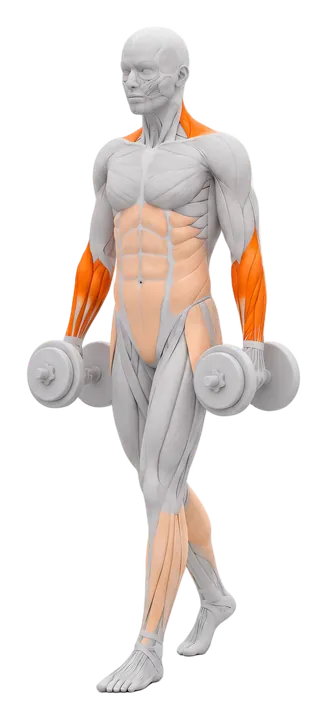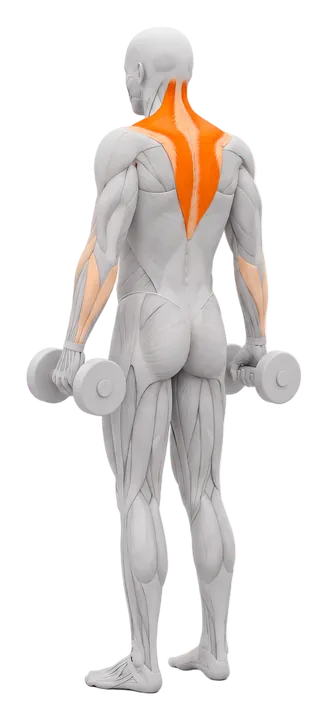
Shrug muscles worked
| Muscle | What it does in a shrug | Role |
|---|---|---|
| Upper trapezius | Lifts the shoulder blades and collarbones up | Primary |
| Levator scapulae | Lifts the shoulder blade, side of the neck | Secondary |
| Middle trapezius | Holds the shoulder blades from sliding forward | Secondary |
| Forearm flexors | Grip the weight for the whole set | Secondary |
| Rhomboids | Help hold the shoulder blades | Stabiliser |
| Core and legs | Keep you standing still under heavy load | Stabiliser |
The trapezius is a big kite shaped muscle with upper, middle and lower parts. Shrugs train the upper part, which elevates the shoulders. The middle and lower traps get more from rows, the face pull and the rear delt fly. Heavy pulls like the deadlift also load the traps a lot, because they have to hold the shoulders in place under the bar.
How to do dumbbell shrugs
- Pick up the dumbbellsStand tall with a heavy dumbbell in each hand at your sides, palms facing your thighs. Feet hip width, knees soft.
- Let the shoulders sinkRelax your shoulders down so the traps are stretched. Arms stay straight for the whole set; they are just hooks.
- Shrug straight upLift your shoulders towards your ears as high as they go. Think "shoulders to ears", not "ears to shoulders": the head stays still and the chin stays level.
- Hold the topPause for one to two seconds at the top and squeeze. This is where most people cut the rep short.
- Lower slowlyTake about two seconds to lower until your shoulders are fully down again, then start the next rep.
Why you should not roll your shoulders
Rolling the shoulders forward or backward in a circle is one of the oldest gym habits. It adds nothing useful. The upper traps lift the shoulders upward, and gravity pulls the weight straight down, so the only direction that loads the muscle is straight up. The rolling part happens with almost no resistance and just adds stress to the shoulder joint.
- Straight up, straight down. If anything, think of lifting slightly up and back, since many people finish with their shoulders rounded forward.
- No head movement. Do not push the chin forward or drop the head to meet the shoulders.
- No elbow bend. Bending the arms turns the shrug into an upright row or a curl.
- No bouncing. Using the knees to bounce the weight up means it is too heavy for the traps alone.
Dumbbell vs barbell shrugs
| Dumbbell shrugs | Barbell shrugs | |
|---|---|---|
| Where the weight hangs | At your sides, in line with the shoulders | In front of your thighs |
| Path | Straight up, natural | Bar can push the shoulders forward |
| Load | Limited by the heaviest dumbbells | Easy to go very heavy |
| Small increments | Fixed dumbbell steps | Small plates, fine steps |
| Grip | Two separate handles | One bar, double overhand or straps |
| Good for | Most people, best range of motion | Heavy loading, gyms with light dumbbells |
For most lifters dumbbell shrugs are the better starting point, because the weight hangs where your arms naturally hang and the shoulders can move straight up. Barbell shrugs win when you outgrow the dumbbell rack. Set the bar in a rack at mid thigh height so you do not have to deadlift it from the floor every set.
Other shrug variations
- Trap bar shrug: the handles sit at your sides like dumbbells, with the loading of a barbell. A good mix of both. The trap bar deadlift uses the same bar.
- Behind the back barbell shrug: the bar sits behind your thighs, which pulls the shoulders slightly back.
- Smith machine or shrug machine: fixed path, easy to load, no balance needed.
- Cable shrug: low pulleys or a straight bar on a low cable, constant tension through the range.
- Incline dumbbell shrug: chest on an incline bench, shrugging up and back. Biases the middle traps more.
Grip and straps
Traps can handle more weight than most people can hold for a long set. When the dumbbells start slipping before your traps are tired, use lifting straps. It changes nothing about the movement, and it lets the target muscle reach a hard set. If you also want stronger hands, do a few sets without straps at the end, or add the farmers walk, which trains grip and traps together.
How many reps for shrugs?
| Goal | Sets x reps | Rest | Notes |
|---|---|---|---|
| Trap growth | 3 to 4 x 10 to 15 | 60 to 90 s | 1 to 2 s hold at the top |
| Heavy | 3 x 8 to 10 | 2 min | Barbell or trap bar, straps |
| Pump, high reps | 2 x 15 to 20 | 60 s | Dumbbells or cable, slow |
| Beginner | 2 to 3 x 12 to 15 | 60 to 90 s | Moderate dumbbells, full range |
Shrugs are an accessory. Do them once or twice a week at the end of a pull day, a back day or a shoulder workout. If you already deadlift heavy, a few sets are enough. A typical working weight is heavier than you might think, because the range is short, so start moderate and add load quickly in the first weeks.
How to progress shrugs
Hold the pause at the top constant, that is the honest part of the rep. Then add reps within your range, and add weight when every set reaches the top with the full hold. Because the movement is short, it is tempting to pile on weight and turn reps into twitches. A heavier dumbbell is only progress if the shoulders still travel the full distance. More on that in progressive overload.
Gripp logs your shrugs like any other lift
Log weight and reps for each set and Gripp tells you what to aim for next time. When every set hits your target reps, the weight goes up. Your estimated 1RM is charted over time, and your strength is rated per muscle group against people of your age and bodyweight.
Join the waitlistShrug alternatives
- Farmers walk: heavy carries keep the traps working to hold the shoulders up.
- Rack pull: a partial deadlift from knee height with heavy trap involvement.
- Face pull: for the middle and lower traps and rear delts.
- Upright row with a wide grip: lifts the shoulders while the arms move; keep it light and stop at chest height if your shoulders are sensitive.
- Overhead press: the upper traps help rotate the shoulder blades as the bar goes up.