What you need (and what you can do without)
This page assumes the kit many people actually have at home: the floor, a sturdy chair or sofa, maybe a resistance band and one pair of dumbbells, often in the 5 to 15 kg (10 to 35 lb) range. No bench, no rack, no adjustable dumbbells required. Every exercise below works with nothing at all, and the band and dumbbells only add options.
- Floor and a sofa or chair: enough for every push-up variation from easiest to hardest.
- Resistance band: a long loop band anchored in a closed door or around a post gives you a standing chest press and fly that pull from behind, like a cable.
- A pair of dumbbells: lets you press and fly lying on the floor, and makes push-ups deeper when you hold the handles.
- A backpack: filled with books or water bottles, it turns into weight for push-ups once your reps get high.
Bodyweight chest exercises for home
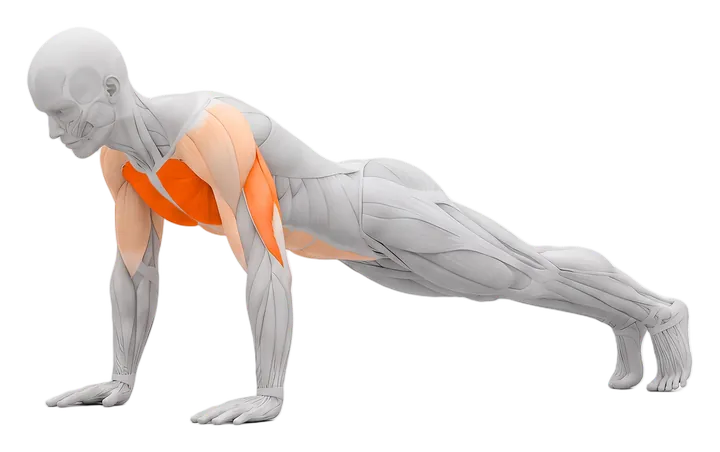
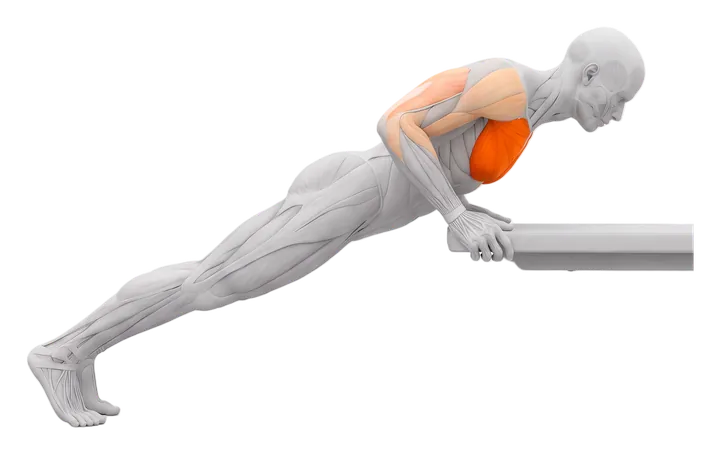

The chest workout at home
Two to three sessions a week, 25 to 35 minutes each. Pick the push-up variation from the ladder below that you can do for 6 to 15 reps with clean form, not the hardest one you can grind out.
| Exercise | Sets x reps | Rest | No equipment option |
|---|---|---|---|
| Push-up, your ladder level | 4 x 6 to 15 | 90 s | Yes |
| Dumbbell floor press or band chest press | 3 x 10 to 20 | 90 s | Swap for a second push-up variation |
| Dumbbell floor fly or band fly | 3 x 12 to 20 | 60 s | Slider fly on a towel on a smooth floor |
| Feet-elevated or deficit push-up, slow | 2 x 8 to 12, 3 second lowering | 60 s | Yes |
| Close-grip push-up | 2 x as many as you can, stop 1 short | 60 s | Yes |
Add the close-grip push-up and you have chest and triceps exercises at home in one session. The push-up guide covers hand width, elbow angle and the plank position that the whole workout depends on. With a pair of dumbbells, the dumbbell bench press and the dumbbell fly are the next step.
The push-up ladder: from wall to weighted
With no weights to add, you make the push-up harder by changing leverage, range or speed. Move up one step when you can do 3 sets of 15 with good form at your current level.
| Level | Variation | Why it is harder |
|---|---|---|
| 1 | Wall push-up | Easiest leverage, almost upright |
| 2 | Incline push-up, hands on a kitchen counter or table | Body more horizontal |
| 3 | Incline push-up, hands on a sofa seat or chair | Lower incline, more bodyweight on the hands |
| 4 | Floor push-up | The standard |
| 5 | Deficit push-up, hands on two books or dumbbells | Chest goes below the hands, longer stretch |
| 6 | Feet-elevated push-up, feet on a chair | More load and more upper chest |
| 7 | Backpack or band-resisted push-up | Added load, like adding plates |
| 8 | Archer push-up | One arm does most of the work |
The deficit and feet-elevated steps are the most useful for building the chest. A deeper stretch at the bottom is something you can always get at home, even when you cannot get heavier. For a band-resisted push-up, loop the band across your upper back and hold one end under each hand.
Dumbbell chest exercises without a bench
Lying on the floor is enough for presses and flyes. The floor stops your elbows a bit earlier than a bench would, so you lose some stretch, and that is why this plan pairs floor work with deep push-ups.
- Dumbbell floor press: lie with knees bent, press both dumbbells up from the floor and pause briefly each time the upper arms touch down. Light dumbbells? Press one at a time and hold the other at the top, which keeps tension on each side longer.
- Floor fly: palms facing, elbows slightly bent, open the arms until the backs of the upper arms touch the floor, then squeeze back up. The floor sets a safe end point.
- Squeeze press: press the two dumbbells together hard the whole rep. Even light dumbbells feel heavy because the chest works to push them inward.
- Glute-bridge floor press: lift your hips into a bridge while you press. The torso tilts, and the press moves towards the lower chest.
If you have a bench and heavier dumbbells, the dumbbell chest workout is built for that setup instead.
Band chest press and fly
A resistance band anchored behind you at chest height is the closest thing to a cable machine at home. Shut it in a door with a door anchor or loop it around something that cannot move, face away, and press forward in a split stance. For a fly, keep the arms almost straight and bring the hands together in front of your chest.
Bands get harder as they stretch, so the hardest point is at the end of the press. Step further from the anchor to make the whole rep harder, or use a stronger band. Change the anchor height to aim the work: low anchor and press up for the upper chest, high anchor and press down for the lower chest, the same idea as on a cable chest workout.
Beginner and advanced versions
Beginner: no equipment, three times a week
| Exercise | Sets x reps | Rest |
|---|---|---|
| Incline push-up on a table or sofa | 3 x 8 to 15 | 90 s |
| Wall push-up, slow, 3 second lowering | 2 x 10 to 15 | 60 s |
| Incline close-grip push-up | 2 x 8 to 12 | 60 s |
Lower the incline as soon as 3 x 15 feels steady. Most beginners reach floor push-ups within a couple of months of regular practice, but there is no fixed timeline.
Advanced: when floor push-ups are easy
| Exercise | Sets x reps | Rest | Technique |
|---|---|---|---|
| Backpack deficit push-up | 4 x 6 to 12 | 2 min | Loaded, full depth |
| Dumbbell floor press, one and a half reps | 3 x 8 to 12 | 90 s | Lower, press halfway, lower, press up |
| Feet-elevated push-up | 3 x 8 to 15 | 90 s | 3 second lowering, pause at the bottom |
| Band fly or floor fly | 3 x 15 to 20 | 60 s | 1 second squeeze |
| Push-up mechanical drop set | 1 set | Done | Feet elevated, then floor, then incline, no rest |
If you have a sturdy dip station at home, dips make a strong replacement for the feet-elevated push-up. Do not dip between two kitchen chairs: they can tip or slide.
How to progress without heavy weights
Progressive overload is the same at home as in the gym: give the muscle a bit more to do over time. With light equipment you have five levers, and you should pull them roughly in this order.
- Reps: add a rep or two to a set until you reach the top of your range.
- Harder variation: move one step up the push-up ladder, or press with one arm.
- Tempo: lower for 3 to 4 seconds and pause at the bottom. The same weight gets much harder.
- Range: add a deficit so the chest goes lower.
- Load: a backpack, a band, or a stronger band.
The one rule: the last few reps of each set should be hard. Sets of 25 easy push-ups do much less than sets of 12 that end close to failure. More on why this works in the progressive overload guide, and a full plan for the rest of your body is on the home workout plan page. For a full body session with no equipment at all, see the bodyweight workout.
Gripp tracks push-ups like barbell lifts
Gripp is coming to iPhone. It logs the reps and weight of every set, including push-ups and a 10 kg backpack, and tells you what to aim for next time: last time 11 deficit push-ups, today go for 12. Your schedule can mix home sessions with runs, and the AI coach in the app can suggest a home swap for an exercise that you approve before anything changes.
Join the waitlist