Drop set meaning
The drop set definition is simple: one exercise, several weights, no rest in between. You start with a weight you can lift for your target reps, reach failure or one rep short of it, strip some weight, and continue. The lighter weight lets your tired muscle produce more reps, so you extend the set past the point where it would normally end.
It is sometimes called stripping, running the rack or a descending set. On a dumbbell rack you literally walk down the rack; on a machine you move the pin; with a barbell, training partners pull plates off each side.
How to do a drop set
- Pick the right exerciseMachines, cables and dumbbells. Changing the weight must take seconds, and failing must be safe.
- Do your normal last setUse your usual working weight and take it to failure or about one rep short, with good form.
- Drop 20 to 30 % of the weightThat is a rule of thumb, not a law. A smaller drop gives fewer extra reps; a bigger drop gives more.
- Continue straight awayRest no more than the 5 to 10 seconds it takes to change the weight, then go to failure or close to it again.
- Repeat once or twice, then stopOne or two drops cover most of the benefit. Write down the reps for each drop so next time has a target.
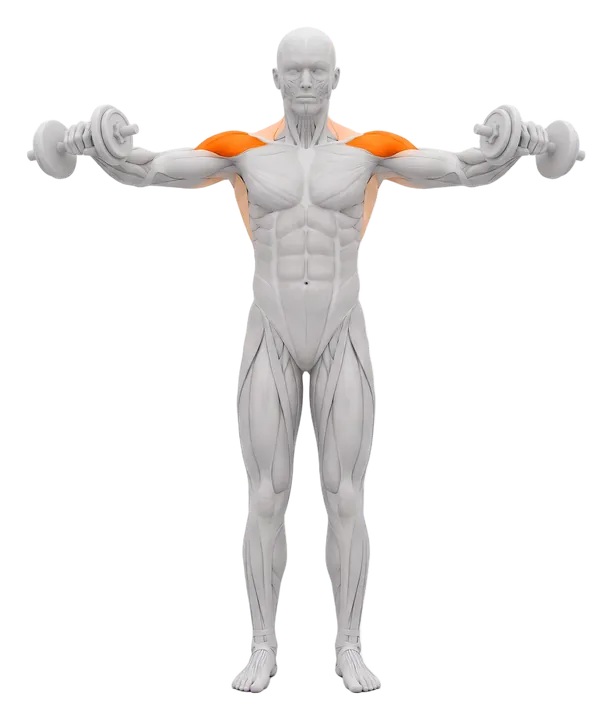
Drop set example: lateral raise
The lateral raise is one of the most searched drop set exercises, and it suits the method well: light dumbbells, a small muscle, and nothing dangerous about failing. Here is a typical lateral raise drop set as the last of three sets.
| Part | Weight | Reps | Rest |
|---|---|---|---|
| Main set | 12 kg (25 lb) | 12 to 15, near failure | None |
| Drop 1 | 9 kg (20 lb) | As many good reps as possible | None |
| Drop 2 | 6 kg (15 lb) | As many good reps as possible | Done |
That is a triple drop set if you count the main set and two drops, though some people use the name only when there are three drops after the main set. Either way, your side delts get a lot of work in about a minute. More shoulder options are in the shoulder workout guide.
Mechanical drop set
A mechanical drop set keeps the same weight but switches to an easier version of the exercise when you hit failure. You change the leverage instead of the load, so it works even when you only have one pair of dumbbells.
| Start with | Then switch to | Then (optional) |
|---|---|---|
| Lateral raise, straight arms | Lateral raise, bent elbows | Partial reps from the bottom |
| Incline dumbbell press | Flat dumbbell press | Close grip dumbbell press |
| Decline or feet-up push up | Regular push up | Incline push up |
| Wide grip pull up | Chin up | Negatives only |
The lateral raise mechanical drop set is popular for a reason: bending the elbows shortens the lever, so the same dumbbells suddenly feel lighter and you can squeeze out several more reps.
Drop set benefits: what the research says
A 2023 systematic review and meta-analysis by Sødal and colleagues in Sports Medicine Open compared drop sets with traditional sets for muscle growth. Both approaches built muscle, and the difference between them was not significant. The authors noted that drop set protocols took less time, which makes them an option for people who are short on time.
So the honest summary of drop set benefits is this: they are not a secret to extra growth, but they are an efficient way to do hard sets. Drop set for hypertrophy works because it adds close to failure work to a muscle quickly. The downside is fatigue: they are demanding, and too many drop sets can eat into your recovery. Our hypertrophy guide covers the bigger picture of what drives growth.
- Good for: saving time, small muscles like delts and arms, machine work at the end of a session, and adding a few extra hard reps when you are short on sets.
- Less useful for: maximal strength, heavy compound lifts and beginners who still need practice at lifting with good technique.
Best drop set exercises
| Muscle | Exercise | Why it works |
|---|---|---|
| Shoulders | Lateral raise | Light dumbbells, quick to change |
| Quads | Leg extension | Move the pin in seconds; leg extension drop set burns the quads |
| Hamstrings | Leg curl | Machine, safe to fail |
| Chest | Chest press machine | No spotter needed |
| Back | Lat pulldown | Pin stack, stable |
| Biceps | Cable curl | Cable curl drop set on a stack is quick and smooth |
| Triceps | Tricep pushdown | Same cable, just move the pin |
Avoid drop sets on barbell squats, deadlifts and bench presses without a spotter. Failing there is risky, and form tends to break down well before the muscle is truly done. For a cable based arm session that uses them, see the cable bicep workout.
Drop set vs superset
| Drop set | Superset | |
|---|---|---|
| Exercises | One | Two (or more) |
| Weight | Goes down during the set | Each exercise has its own weight |
| Effort | To or near failure, several times | Normal hard sets |
| Main use | Extra hard work for one muscle | Saving time across two muscles |
| Fatigue | High | Moderate |
Both save time, but in different ways. A superset fills your rest period with another exercise; a drop set removes the rest period from one exercise. You can use both in the same workout: supersets for the main work, then a drop set as a finisher.
A drop set workout and how to progress it
Keep progression simple: progress the main set, not the drops. Use the same rep range and the same rules you use for your other exercises, and let the drops fall where they fall. If the main set of leg extensions goes from 10 to 12 reps at the same weight, that is progress; the drops will follow.
| Exercise | Sets x reps | Drop set |
|---|---|---|
| Chest press machine | 3 x 8 to 12 | Last set, 1 drop |
| Lat pulldown | 3 x 8 to 12 | Last set, 1 drop |
| Lateral raise | 3 x 12 to 15 | Last set, 2 drops |
| Tricep pushdown | 2 x 10 to 15 | Last set, 1 drop |
If you feel run down after a few weeks of this, cut back to one drop set per session, or take a deload week. To pick a sensible rep range for the main set, see the rep ranges guide.
Progress the set that matters
Gripp logs the reps and weight of every set and sets your target for next session: last time 7 reps at 105 kg, today go for 8. Track your main set there and the drops become a bonus on top of real, measurable progress. Gripp is coming soon to iPhone.
Join the waitlist