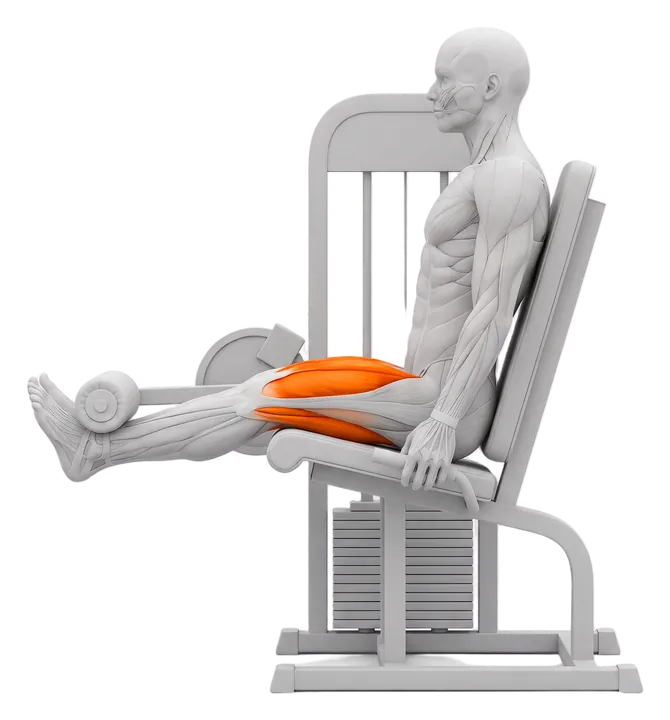
Leg extension muscles worked
| Muscle | Role | How much |
|---|---|---|
| Rectus femoris | Straightens the knee; also crosses the hip | Primary |
| Vastus lateralis | Straightens the knee, outer thigh | Primary |
| Vastus medialis | Straightens the knee, inner thigh above the kneecap | Primary |
| Vastus intermedius | Straightens the knee, deep under the rectus femoris | Primary |
| Core and grip | Keep you seated as the weight rises | Stabiliser |
All four quad muscles straighten the knee, and that is the only job the leg extension asks of them. The rectus femoris also flexes the hip, which is why it gets less work in a squat, where the hip and knee extend together. In a leg extension you sit with the hip bent, so the rectus femoris has to work along with the other three. That is the main reason the machine is worth a place in a leg workout that already has squats or a leg press.
Leg extension machine setup
A good set starts before the first rep. Most discomfort on this machine comes from a seat or pad in the wrong place.
- Line up the knee with the pivotMove the backrest until the side of your knee lines up with the machine's pivot point, usually marked with a coloured dot or arrow. If the knee is in front of or behind the pivot, the pad slides along your shin as you lift.
- Set the shin padPut the pad on the lower shin, just above the ankle, where it sits on the front of the leg rather than on the top of the foot. Low on the shin gives the most leverage and feels smoother.
- Set the start angleMany machines have a range limiter. Start with the knees bent to about 90 degrees. You can go deeper later if it feels comfortable.
- Hold on and sit backGrip the side handles and keep your back and hips against the seat. Your hips should not lift off the seat as you extend.
How to do a leg extension
- Brace lightly and point your toes up towards the ceiling.
- Straighten your knees in one smooth movement until your legs are close to straight.
- Hold the top for about one second and squeeze the front of your thighs.
- Lower the pad over two to three seconds, back to the start angle, without letting the weight stack touch down between reps.
- Breathe out on the way up, in on the way down.
Leg extension form cues
- "Knee on the dot." Re-check the pivot every time you change machines or someone else used it before you.
- "Kick and pause, don't swing." If the pad bounces at the top, the weight is moving you.
- "Stay glued to the seat." Pull down on the handles so the hips stay down.
- "Slow back down." The lowering is half the set, so take your time with it.
Common leg extension mistakes
- Swinging the weight up. A jerk at the start puts a sudden load on the knee and takes work away from the quads. Lighter and smoother is better.
- Hips lifting off the seat. A sign the weight is too heavy. Pull on the handles and drop the stack.
- Pad on the foot instead of the shin. It slips and makes the ankle do work it should not do.
- Dropping the weight. Letting the stack crash between reps wastes the lowering part of each rep.
- Short reps. Stopping halfway up skips the fully shortened position, which is the part this exercise trains best.
Are leg extensions bad for your knees?
For most healthy lifters, no. Leg extensions are a common part of gym programmes and of knee rehab plans, where they are used to build quad strength under controlled conditions. The machine does put load on the knee joint, especially when the leg is close to straight, which is why some people find them uncomfortable and others do not notice anything.
A conservative approach works for most people:
- Start light and use moderate to higher reps, such as 12 to 20, rather than heavy sets of 5.
- Use a smooth tempo with no bouncing or kicking.
- Limit the range with the start angle if the bottom of the rep bothers you.
- Try one leg at a time with a lighter load, which some people find more comfortable.
Leg extension vs leg curl
The two machines are often next to each other, sometimes as one combo machine, but they train opposite sides of the thigh.
| Leg extension | Leg curl | |
|---|---|---|
| Muscle | Quads, front of the thigh | Hamstrings, back of the thigh |
| Movement | Straightens the knee | Bends the knee |
| Pairs with | Squat, leg press, lunges | Romanian deadlift, hip thrust |
| Typical reps | 10 to 15 | 8 to 15 |
Neither replaces the other. A balanced leg day usually includes both, often done back to back as a superset at the end. Read the hamstring curl guide for the other half. Both are part of the leg machine workout.
Leg extension variations
- Single leg extension: one leg at a time. Useful if one quad is weaker, for example after an injury, and to keep the stronger leg from doing more of the work.
- Paused leg extension: hold the top for two to three seconds. Makes light weights hard and teaches control.
- Toes in or out: often suggested to target the inner or outer quad. The effect is small; pick the position that feels best for your knees.
- Leg extension without a machine: loop a resistance band around a bench leg and your ankle while seated, or use an ankle weight. Harder to load, but fine at home.
- Sissy squat: a bodyweight quad isolation exercise with a similar knee motion. Hard, and not for sensitive knees.
Sets and reps for the leg extension
| Goal | Sets x reps | Rest | Notes |
|---|---|---|---|
| Quad growth | 3 x 10 to 15 | 60 to 90 s | 1 to 2 reps short of failure |
| Finisher | 2 x 15 to 20 | 60 s | Pause at the top |
| Pre-exhaust | 1 to 2 x 12 to 15 | 60 s | Before squats or leg press, light |
| Beginner or sensitive knees | 2 x 12 to 20 | 60 s | Light, slow, limited range if needed |
Do leg extensions once or twice a week, usually after your main lower body lift. On the lower days of an upper lower split they fit well after squats or Bulgarian split squats, paired with a leg curl.
How to progress the leg extension
Treat it as a rep driven lift. Pick a range such as 12 to 15, add reps from session to session, and add one plate on the stack only when you get 15 controlled reps in every set. Heavier is not the goal here: a smooth set close to failure is. If you stall, add a pause at the top before you add load. More on this in progressive overload.
Gripp tracks the stack, you do the reps
Log each set of leg extensions and Gripp shows what you did last time and what to aim for today. When every set hits the top of your rep range, it tells you to add weight. Rehab can be a goal in Gripp too, if you are building a knee back up.
Join the waitlistLeg extension alternatives
- Wall sit: a static quad hold with no equipment and very little knee movement.
- Box squat: a squat to a box that lets you control depth.
- Goblet squat: a quad heavy squat with a dumbbell. See the goblet squat guide.
- Reverse lunge or split squat: single leg options that work the quads and glutes.
- Banded leg extension: a band anchored low behind you while seated.
Similar exercises
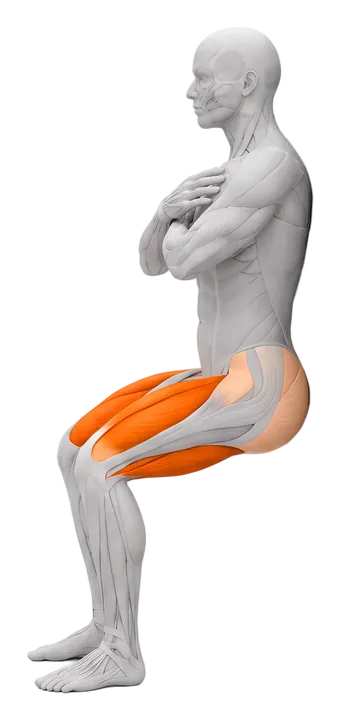 Wall sitQuads
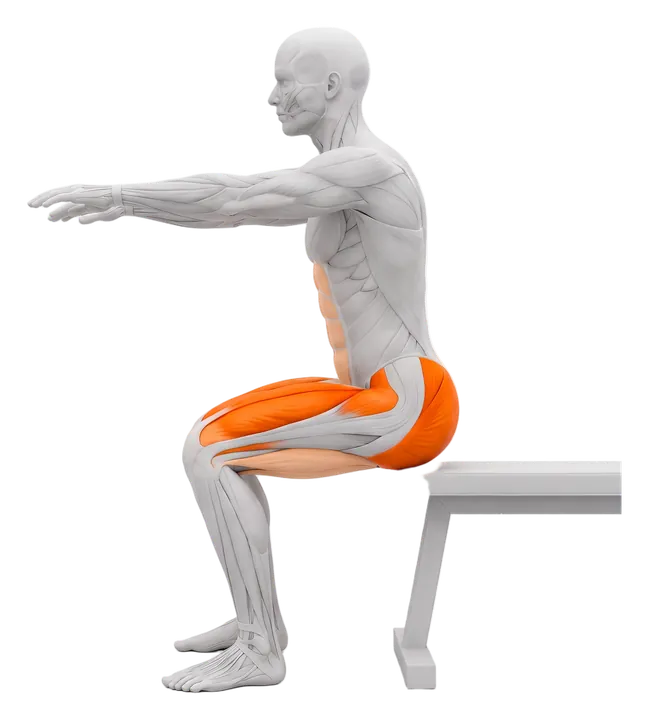 Box squat to benchQuads and glutesGuide
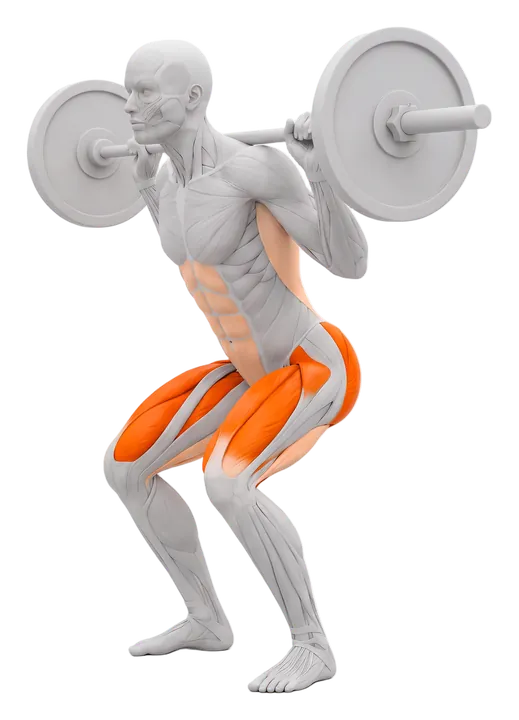 Barbell back squatQuads and glutesGuide
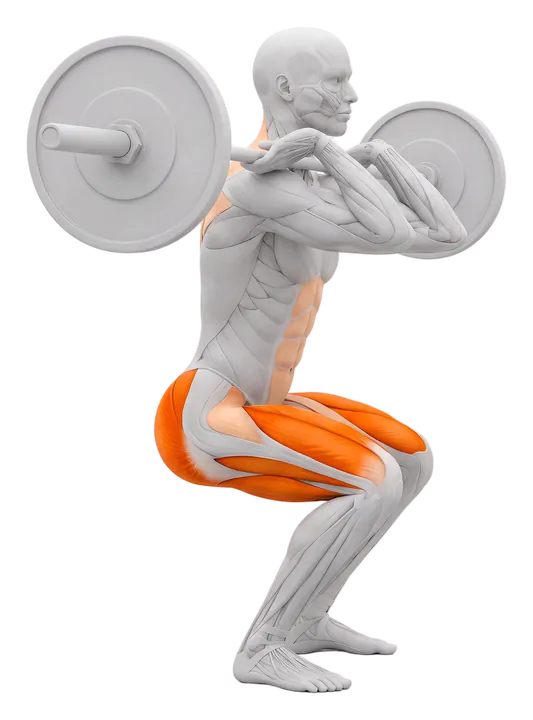 Barbell front squatQuads and glutesGuide
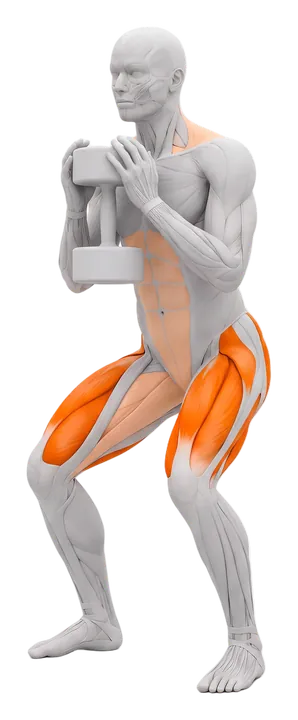 Goblet squatQuads and glutesGuide
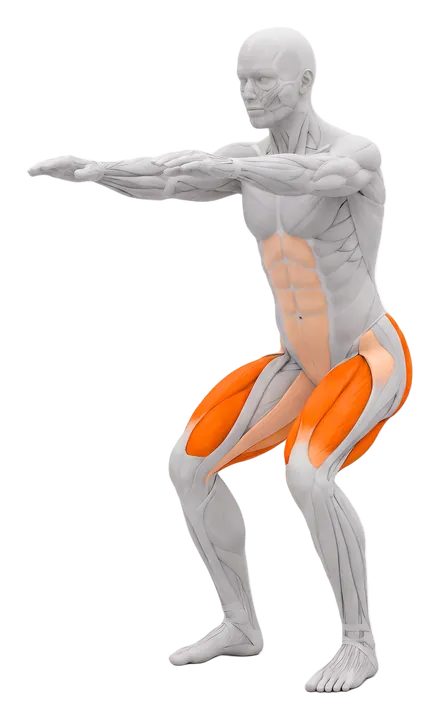 Bodyweight squatQuads and glutes