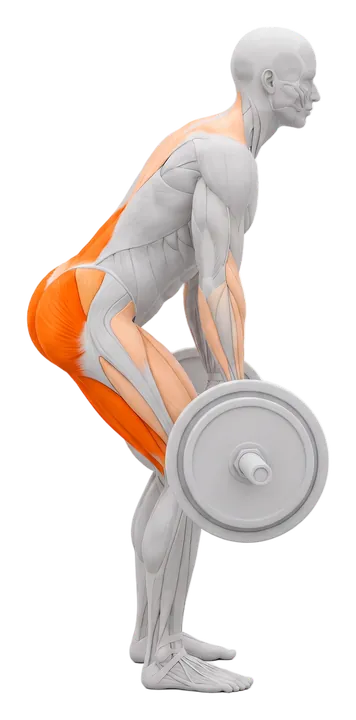
Why deadlift reps estimate differently
A deadlift set is not quite like a set of squats or bench presses. Every rep starts from a dead stop on the floor, the grip has to hold the full load the whole time, and the lower back tires quickly. Those things pull the estimate in both directions, so be a little conservative with the result.
| Factor | What happens | Effect on the estimate |
|---|---|---|
| Grip gives out | The bar slips before the legs and back are done | Too low |
| Touch-and-go reps | Bouncing the plates off the floor gives each rep a head start | Too high |
| Back and breathing fatigue | Reps 6 and up get slower and form breaks down | Too low, and riskier |
| Straps | Removes the grip limit, so you get more reps | Higher than your strapless max |
| Hitching or a soft lockout | The last rep is not a full rep | Too high |
The practical fix: use a set of 2 to 5 reps, reset each rep on the floor, and only count reps you locked out cleanly. If you trained with straps, remember the result is your strapped max. If you will test without straps, expect a lower number on the day.
Deadlift max from common sets
These are the calculator's estimates for typical deadlift sets, using the same formulas as the general one rep max calculator. Low rep sets are listed on purpose; they are the most trustworthy for this lift.
| Set | Estimated deadlift max |
|---|---|
| 100 kg (220 lb) × 5 | 114.5 kg (255 lb) |
| 120 kg (265 lb) × 8 | 150.5 kg (330 lb) |
| 140 kg (310 lb) × 5 | 160.5 kg (355 lb) |
| 160 kg (355 lb) × 3 | 172.5 kg (380 lb) |
| 180 kg (395 lb) × 2 | 188.5 kg (415 lb) |
| 220 kg (485 lb) × 3 | 237.5 kg (525 lb) |
The 8 rep row is there to show the problem: grip and breathing usually limit an 8 rep deadlift set long before the legs do, so that estimate is the least reliable on the list.
How much should you deadlift?
The deadlift is the heaviest of the three big lifts for nearly everyone. In Gripp's model of regular gym-goers aged 18 to 35, the median deadlift is about 1.6 times bodyweight for men and 1.15 times for women.
| Level | Man, 80 kg (175 lb) | Woman, 60 kg (130 lb) |
|---|---|---|
| Novice | 105 kg (230 lb) | 55 kg (120 lb) |
| Intermediate (median) | 127.5 kg (280 lb) | 70 kg (155 lb) |
| Advanced | 160 kg (355 lb) | 90 kg (200 lb) |
| Elite | 197.5 kg (435 lb) | 117.5 kg (260 lb) |
Every bodyweight and age is on the deadlift strength standards page. A useful sanity check is your squat: most lifters deadlift somewhat more than they squat, and the squat max calculator gives you that number from a recent set. A deadlift far below your squat usually points to a grip or technique limit, not weak legs.
Trap bar, sumo and Romanian deadlift
- Trap bar deadlift: enter trap bar sets as they are and you get a trap bar max. Most people lift more with a trap bar than a straight bar, but trap bars differ in weight and handle height, so do not convert between them. Remember to count the bar itself, which is often heavier than 20 kg; the plate calculator helps with the loading.
- Sumo deadlift: works with the calculator in the same way. Track sumo and conventional as separate lifts, because many lifters are clearly stronger in one stance.
- Romanian deadlift: starts from the top and stops short of the floor, so it is lighter than a full deadlift. Use it as its own lift; the Romanian deadlift guide has typical sets and reps.
Deadlift percentages for training
The deadlift recovers slowly, so most programs deadlift heavy once a week and keep the reps low. Here is how the percentage table under the result maps to typical deadlift work, based on a 160.5 kg (355 lb) max.
| Goal | Sets × reps | % of max | Weight | Rest |
|---|---|---|---|---|
| Heavy strength work | 3 × 2 to 3 | 85 to 90 % | 137.5 to 145 kg (305 to 320 lb) | 3 to 5 min |
| Strength | 3 × 5 | 75 to 80 % | 120 to 127.5 kg (265 to 280 lb) | 3 min |
| Technique practice | 5 × 1 to 2 | 70 % | 112.5 kg (250 lb) | 2 min |
| Back-off volume | 2 × 6 | 65 to 70 % | 105 to 112.5 kg (230 to 250 lb) | 2 to 3 min |
Higher reps for the hamstrings and glutes are usually better spent on Romanian deadlifts, hip thrusts and leg curls than on 10 rep conventional deadlifts. Programs such as Wendler 5/3/1 run the deadlift from a training max of about 90 % of your estimated max; this calculator gives you the starting number.
How to raise your deadlift
- Fix the grip first. Use a mixed or hook grip for heavy sets, chalk if your gym allows it, and hold the top of your last rep for a few seconds to train it.
- Pull from the floor every rep. Dead-stop reps build the start of the lift, where most deadlifts fail.
- Add weight slowly. 2.5 to 5 kg (5 to 10 lb) a week is plenty after the first months. Small, steady jumps are progressive overload that lasts.
- Learn the setup. Bar over midfoot, shoulders just in front of the bar, lats tight, push the floor away. The deadlift guide goes through it step by step.
Gripp keeps your deadlift max current
Log your deadlift sets in Gripp and your estimated max updates after every session, charted over time. Gripp tells you what to pull next: last time 4 reps at 140 kg, today go for 5. Hit your reps in every set and the weight goes up.
Join the waitlist