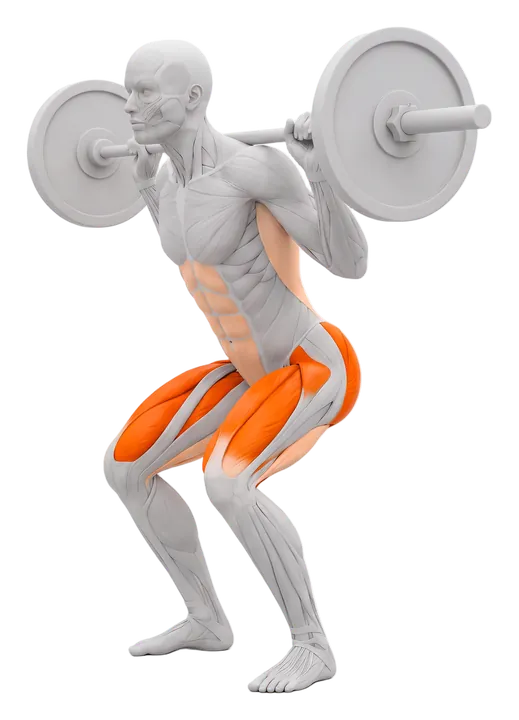
What counts as a rep for the squat calculator
Squats are easy to shorten without noticing, and a shallow rep makes any estimate meaningless. Before you trust the number, check that your set meets these rules.
- Depth: the crease of your hip goes at least level with the top of your knee. If you are unsure, film one set from the side. Most people squat higher than they think.
- Full stand at the top: hips and knees locked out before the next rep starts.
- No help: a spotter touching the bar or a bounce off the safety pins ends the set.
- Close to failure: the last rep should be slow. A set that stopped with three reps left gives a low estimate. If you rate your sets by RPE, the RPE calculator accounts for the reps you had left.
Sets of 3 to 6 reps give the most reliable squat max. Higher rep squats test your breathing and leg endurance as much as your strength, so a set of 12 to 15 tends to overestimate the max of a well conditioned lifter and underestimate that of someone who rarely does high reps.
Squat max from common sets
Here is what the calculator gives for some typical squat sets. It uses the average of the Epley and Brzycki formulas, rounded to the nearest 0.5 kg. The one rep max calculator page explains both formulas in detail.
| Set | Estimated squat max |
|---|---|
| 60 kg (135 lb) × 8 | 75 kg (165 lb) |
| 80 kg (175 lb) × 5 | 91.5 kg (200 lb) |
| 100 kg (220 lb) × 3 | 108 kg (240 lb) |
| 100 kg (220 lb) × 8 | 125.5 kg (275 lb) |
| 120 kg (265 lb) × 5 | 137.5 kg (305 lb) |
| 140 kg (310 lb) × 3 | 151 kg (335 lb) |
| 180 kg (395 lb) × 5 | 206 kg (455 lb) |
Notice that 100 kg for 8 and 120 kg for 5 land close together. Many lifters find that their high rep sets predict a bigger squat than their low rep sets. That is normal: the squat uses a lot of muscle, and people tend to get more reps at a given percentage than on presses.
What is a good squat?
The calculator tells you your max; the next question is usually how it compares. In Gripp's model of people who train regularly, the median squat for ages 18 to 35 is about 1.35 times bodyweight for men and 0.95 times bodyweight for women. To compare a whole squat, bench and deadlift total across bodyweights, use the DOTS score calculator.
| Level | Men | Women |
|---|---|---|
| Novice (from the 25th percentile) | 1.13 × bodyweight | 0.77 × bodyweight |
| Intermediate (median) | 1.35 × bodyweight | 0.95 × bodyweight |
| Advanced (top 20 %) | 1.69 × bodyweight | 1.24 × bodyweight |
| Elite (top 5 %) | 2.10 × bodyweight | 1.60 × bodyweight |
So an 80 kg (175 lb) man with a 114.5 kg squat sits a little above the median of regular gym-goers. The full tables by bodyweight and age are on the squat strength standards page. These are modelled estimates, not results from a single study, so treat them as a guide.
Using percentages to program your squat
Once you know your squat max, the percentage table in the calculator becomes your programming tool. Many lifters set their training max a bit below their estimated max, around 90 %, so that every percentage is slightly conservative and the program lasts longer.
| Goal | Sets × reps | % of max | Weight | Rest |
|---|---|---|---|---|
| Strength | 5 × 3 | 85 to 88 % | 97.5 to 100 kg (215 to 220 lb) | 3 to 4 min |
| Strength and size | 4 × 5 | 78 to 82 % | 90 to 92.5 kg (200 to 205 lb) | 3 min |
| Muscle growth | 3 × 8 | 70 to 75 % | 80 to 85 kg (175 to 185 lb) | 2 to 3 min |
| Volume or technique day | 3 × 10 | 60 to 65 % | 70 to 75 kg (155 to 165 lb) | 2 min |
Squatting twice a week, with one heavier day and one lighter day, suits most lifters. It fits a leg workout in a split or the lower days of an upper lower split. Programs like 5/3/1 take this further and set every squat set from a training max.
Front squat, leg press and other conversions
People often want to convert between squat variations. There is no exact formula, so use these as starting points and adjust after a session or two.
- Front squat: many lifters front squat roughly 80 to 85 % of their back squat. You can also put a front squat set straight into the calculator for a front squat max.
- Leg press to squat: there is no reliable conversion. Machines differ in angle, sled weight and range of motion, and the leg press takes balance and the back out of the lift. Use the calculator on your leg press sets for a leg press max, and compare leg press with leg press.
- Hack squat: the same problem as the leg press: it depends on the machine. Track it as its own lift.
- Box squat: to a parallel box, most people are close to their regular squat, but a high box allows much more weight.
The squat guide covers technique, depth and the main variations. If knees or back limit your back squat, the leg press and the bulgarian split squat are good ways to keep training your legs hard.
How to raise your squat max
- Add weight in small, regular steps. When you hit all your reps in every set, add 2.5 to 5 kg (5 to 10 lb) next time. That is progressive overload, and in the first year it is most of what you need.
- Squat to the same depth every time. A deeper squat is harder, so changing depth from session to session hides real progress.
- Strengthen the back and hips. Romanian deadlifts and hip thrusts help you stay upright and drive out of the bottom.
- Sleep and eat enough. Leg training is demanding, and squats are often the first lift to stall when recovery is poor.
Gripp updates your squat max after every set
Log your squats in Gripp and it keeps an estimated squat max that updates with every session, shown as a chart over time. It tells you what to lift next: last time 5 reps at 100 kg, today go for 6. Hit your reps in every set and the weight goes up.
Join the waitlist