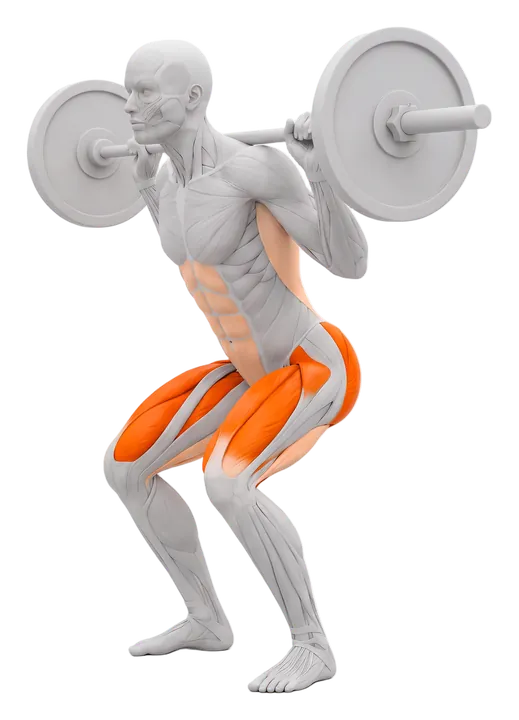
Why warm up before lifting
A warm-up raises muscle temperature, gets your heart rate up and lets you rehearse the exact movement you are about to load. A 2010 systematic review and meta-analysis by Fradkin and colleagues looked at 32 studies and found that warming up improved performance in most of the outcomes measured, with little evidence that it hurt performance. For injury prevention the evidence is thinner, but no serious coach skips the warm-up before heavy lifts.
For lifters the biggest benefit is practical: your first working set feels like a working set, not like the fourth warm-up. Groove the pattern with an empty bar and you will notice a stiff hip or a cranky shoulder before there are 100 kg (220 lb) on your back.
The 10 minute warm up routine
- General warm-up, 3 to 5 minutesBike, rower, brisk incline walk or skipping. Go easy: you should be slightly warm and breathing a bit harder, not tired.
- Dynamic drills, 2 to 3 minutesPick 2 or 3 drills for today's main joints: leg swings, bodyweight squats and hip openers for a leg day; arm circles, band pull-aparts and scapular push ups for an upper day. Around 8 to 10 reps each.
- Activation, 1 to 2 minutes (optional)A set or two of a light exercise that wakes up a muscle you tend to under-use, like a glute bridge before squats or a face pull before pressing.
- Specific warm-up setsStart your first exercise with an empty bar or a light weight, then climb in a few jumps to your working weight. This is the part you should never skip.
How many warm-up sets should I do?
The heavier your first working set, the more steps you need to get there. A useful rule of thumb: start light, cut the reps as the weight goes up, and keep every warm-up set easy enough that it does not tire you.
| Working set | Warm-up sets | Example |
|---|---|---|
| Light (under about 40 kg (90 lb), or isolation work) | 0 to 1 | One easy set of 10 to 12 |
| Moderate (sets of 8 to 15) | 2 | 50 % x 8, 75 % x 4 |
| Heavy (sets of 3 to 6) | 3 to 4 | Bar x 10, 50 % x 5, 70 % x 3, 85 % x 1 to 2 |
| Testing a max | 5 to 7 | See the 1RM ramp below |
Only your first exercise for a body part needs the full ramp. If you squat and then do leg press, the squat already warmed you up, so one feeler set on the leg press is plenty.
Example: warming up for a 100 kg squat
| Set | Weight | Reps | Rest after |
|---|---|---|---|
| 1 | 20 kg (45 lb) bar | 10 | 30 s |
| 2 | 50 kg (110 lb) | 5 | 45 s |
| 3 | 70 kg (155 lb) | 3 | 60 s |
| 4 | 85 kg (185 lb) | 2 | 90 s |
| Work | 100 kg (220 lb) | 3 x 5 | 2 to 3 min |
Loading the bar for each step is quicker with a plate calculator, especially when you jump between kilos and pounds.
Reps, RPE and rest between warm-up sets
- Reps for warm-up sets: high at the start (8 to 10 with the bar), then down to 1 to 3 on the last steps. The goal is practice, not fatigue.
- Warm up RPE: if you rate effort with RPE, keep early warm-ups around RPE 3 to 5 and the last one no higher than about RPE 6 to 7. Nothing should feel like a grind. The RPE calculator explains the scale.
- Rest between warm-up sets: as long as it takes to load the next weight for the light steps, then 60 to 90 seconds for the last one or two. Before your first working set, rest about as long as you would between working sets; our guide to rest between sets has the numbers.
How to warm up for a 1RM
Testing a one rep max needs a longer, more careful ramp. You want to be fully warm, but you cannot afford to leave strength in the warm-ups. Base the steps on your expected max, which you can estimate from a recent set with the 1RM calculator.
| Step | Load | Reps | Rest |
|---|---|---|---|
| 1 | Empty bar | 8 to 10 | 1 min |
| 2 | 40 % | 5 | 1 to 2 min |
| 3 | 60 % | 3 | 2 min |
| 4 | 75 % | 2 | 2 to 3 min |
| 5 | 85 % | 1 | 3 min |
| 6 | 90 to 93 % | 1 | 3 to 5 min |
| Attempt | 100 % or a small PR | 1 | 3 to 5 min between attempts |
For a max bench press, the percentage jumps stay the same, but because the numbers are smaller, the last steps may be only 5 kg (10 lb) apart. If 90 % feels slow, take that as your answer for the day and do not chase the attempt.
Shoulder warm up exercises
Before pressing or overhead work, spend two minutes on the shoulders. Pick three of these and do 10 to 15 easy reps of each:
- Band pull-aparts: wakes up the upper back and rear delts that keep the shoulder blades in place.
- Band external rotations: elbow at your side, rotate the forearm out against light tension.
- Arm circles and wall slides: move the shoulder through its full range without load.
- Light face pulls or lateral raises: a set with a weight you could lift 30 times.
- Push ups: a set of push ups is a fine general warm-up before bench, but it does not replace a few lighter sets with the bar.
Glute warm up exercises
Before squats, deadlifts or a glute day, these get the hips moving and the glutes working:
- Glute bridges: 10 to 15 reps with a two second squeeze at the top.
- Banded side steps: 10 steps each way with a mini band above the knees.
- Bodyweight squats: 10 slow reps, sitting as deep as you comfortably can.
- Hip airplanes or leg swings: 8 per side to open the hips.
- Bird dogs: 6 per side to switch on the trunk before a heavy deadlift.
Warm-ups in Starting Strength, StrongLifts and 5/3/1
Popular programs come with their own warm-up habits, and they all follow the same logic as the tables above:
- Starting Strength warm up: start with the empty bar for a couple of sets, then add weight in a few even jumps, with fewer reps as you approach the work sets.
- StrongLifts 5x5 warm up: the same idea, two sets with the empty bar first, then a few lighter sets. Early on, when the work weight is light, you need very few.
- 5/3/1 warm up: Jim Wendler's program uses a ramp at 40, 50 and 60 % of the training max before the main sets.
Your working weight is ready before you warm up
Gripp logs every set and tells you what to lift today, for example 8 reps at 105 kg after you did 7 last time. Knowing the target before you start makes the warm-up ramp easy to plan. Gripp is coming soon to iPhone.
Join the waitlist