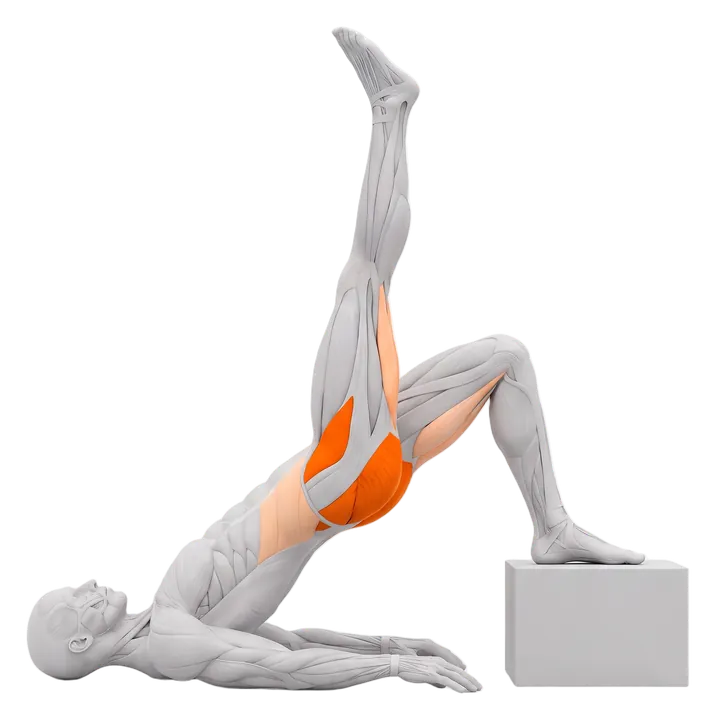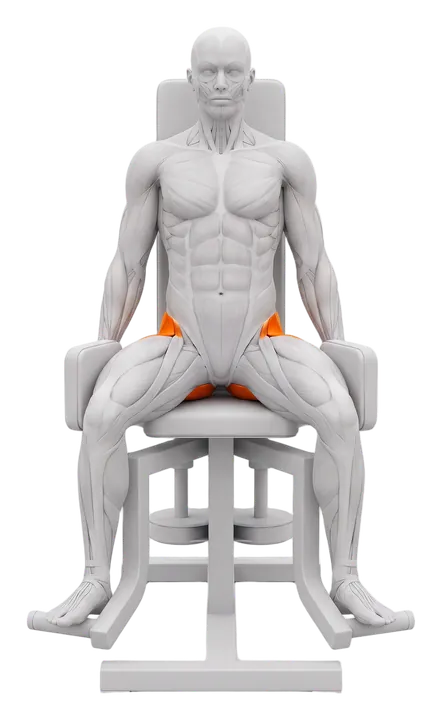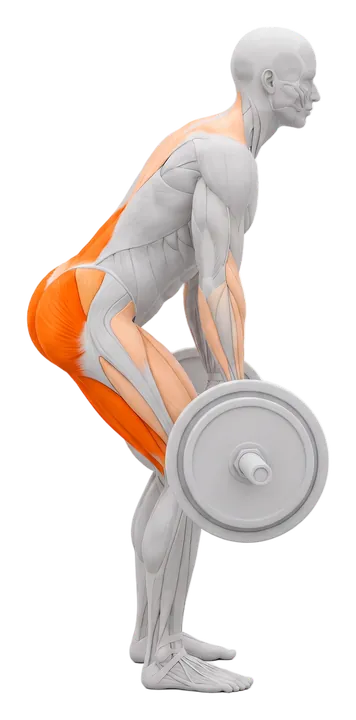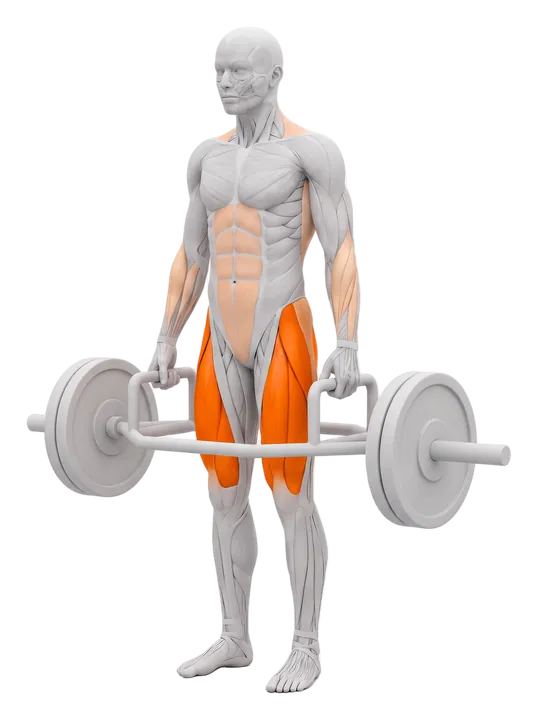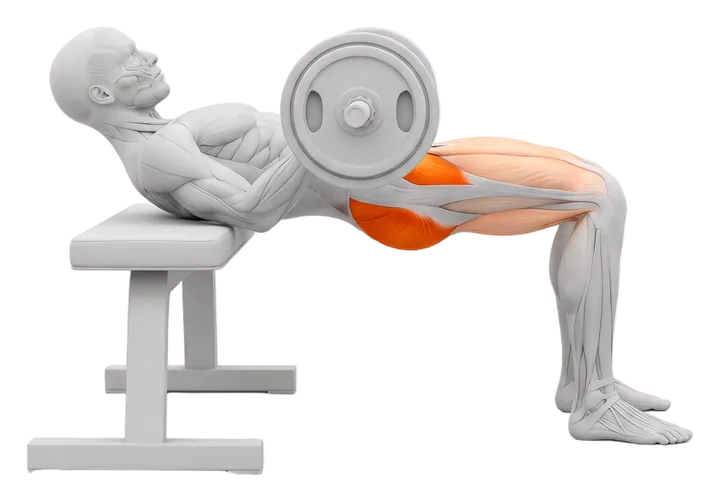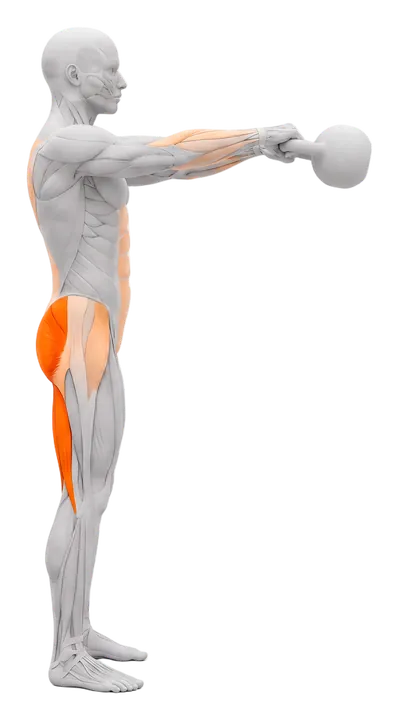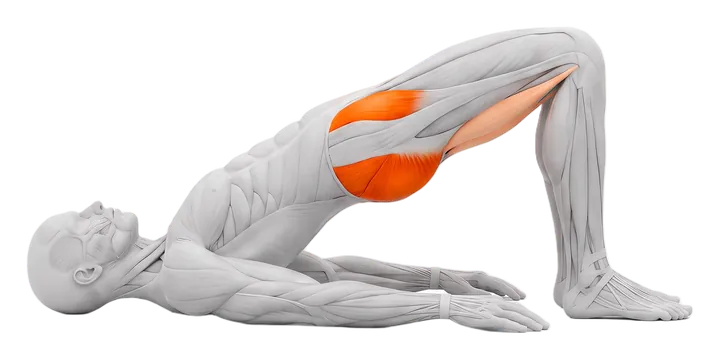
Glute bridge muscles worked
| Muscle | Job in the bridge | Role |
|---|---|---|
| Gluteus maximus | Lifts the hips off the floor | Primary |
| Hamstrings | Help lift the hips, more as the feet move away | Secondary |
| Gluteus medius and minimus | Keep the knees apart and the pelvis level, especially on one leg | Stabiliser |
| Abs | Stop the lower back from arching at the top | Stabiliser |
Because you lie on the floor, the lower back is supported and the spine carries no load from above. That is why bridges are often used early in rehab and by people who are not ready for heavy hinges. The trade-off is a short range of motion, which limits how much the bridge can build on its own once you get stronger.
How to do a glute bridge
- Lie down and place your feetLie on your back, knees bent, feet flat and about hip width apart. Slide your heels towards you until your fingertips can just brush them with your arms at your sides.
- Flatten the lower backGently tilt your pelvis so your lower back presses lightly into the floor. Keep that position as you lift.
- Press through the heelsPush the floor away with your heels and lift your hips. Let your shoulders and arms stay on the floor.
- Squeeze at the topStop when your shoulders, hips and knees form a straight line. Hold for one to two seconds and squeeze your glutes hard.
- Lower slowlyRoll the hips down over two to three seconds and touch the floor lightly before the next rep.
Glute bridge cues and mistakes
- Arching to get higher. If your ribs flare and the lower back bends, you lose glute tension. Stop at a straight line.
- Cramping hamstrings. A common complaint. Bring the feet closer to your hips and push more through the heels and midfoot, less through the toes.
- Knees falling in. Push the knees out gently, or put a light band around your thighs to feel it.
- Rushing. A bridge with no pause at the top is mostly momentum. Hold each rep.
- Pushing with the neck. Keep your head relaxed on the floor; the effort comes from the hips.
Glute bridge variations, easiest to hardest
The bridge is easy to scale. Work down this list as each one gets easy for 15 to 20 controlled reps.
| Variation | How | Why use it |
|---|---|---|
| Bodyweight glute bridge | Both feet down, no load | Learn the movement, warm up |
| Banded glute bridge | Mini band just above the knees | Extra work for the side glutes |
| Marching glute bridge | Hold the top and lift one foot at a time | Hip stability and core control |
| Feet elevated glute bridge | Heels on a step or bench | Longer range, more hamstrings |
| Single leg glute bridge | One foot down, the other leg lifted | Twice the load per side, finds left and right differences |
| Dumbbell glute bridge | Dumbbell or plate on the hips | Simple loading at home |
| Barbell glute bridge | Padded barbell across the hips | Heavy loading from the floor |
Single leg glute bridge
Set up as normal, then lift one foot and straighten that leg, or hug the knee to your chest to stop the lower back from helping. Push through the heel on the floor and keep your hips level. If one side drops, you have found a weak spot. Do the weaker side first and match the reps on the other side.
Barbell glute bridge
Roll a padded barbell over your thighs to the hip crease while lying down, then bridge as normal. With bumper plates the bar sits high enough to roll in. It lets you load the bridge heavily without a bench, which suits crowded gyms where benches are always taken.
KAS glute bridge
A variation done from the hip thrust position with the shoulders on a bench, but moving only through the top part of the range. The hips never drop far, so the glutes stay under tension the whole set. It is an intermediate option and works well with a barbell.
Glute bridge vs hip thrust
The difference between the glute bridge and the hip thrust is where your upper back rests. In a bridge it is on the floor; in a hip thrust it is on a bench. Raising the shoulders lets the hips travel further down, so the hip thrust has a bigger range and handles more weight over time.
When the glute bridge is the better choice
- You are new to glute training and want to learn to feel the glutes working.
- You train at home or in a hotel room with nothing but a floor.
- You want a warm up before squats or deadlifts that takes two minutes.
- You are coming back from lower back or knee pain and need a low load option.
- No bench is free and you still want to train heavy: the barbell bridge works from the floor.
When to move on to the hip thrust
Once you can do 20 slow single leg bridges per side, or your barbell bridge is getting heavy enough that the short range feels like the limit, switch your main glute exercise to the hip thrust and keep bridges as a warm up or finisher. Both work the same muscles; neither is a must. Use whichever you will do consistently and can keep adding to.
Glute bridge sets and reps
| Goal | Version | Sets x reps | Rest |
|---|---|---|---|
| Warm up | Bodyweight or banded | 1 to 2 x 10 to 15 | 30 s |
| Beginner glute training | Bodyweight, 2 s hold at top | 3 x 12 to 20 | 60 s |
| Muscle growth at home | Single leg or dumbbell | 3 to 4 x 10 to 15 per side | 60 to 90 s |
| Muscle growth in the gym | Barbell glute bridge | 3 to 4 x 8 to 12 | 90 s to 2 min |
| Rehab | Bodyweight, slow | 2 to 3 x 8 to 15 | 60 s |
Two or three bridge sessions a week is fine at bodyweight, because the load is low. Heavier barbell bridges count as real glute training and fit once or twice a week next to the rest of your glute exercises. For a home routine, combine bridges with split squats and RDLs from the dumbbell glute workout.
How to progress the glute bridge
Without weights, progress in this order: add reps, add a pause at the top, slow the lowering, then move to the next variation in the table. With weight, use the same double progression as any other lift: work up to the top of your rep range in all sets, then add load.
Gripp moves you up the bridge ladder
Log your reps and Gripp tells you what to do next session. When you hit the top of the rep range in every set, it suggests the harder version, for example from the two leg bridge to the single leg glute bridge. You also get a strength rating for your glutes against people of your age and bodyweight.
Join the waitlistGlute bridge alternatives
- Hip thrust: the bench version with a longer range.
- Cable pull-through: a standing hinge that finishes with a glute squeeze.
- Back extension: done with a rounded upper back, it becomes a glute exercise. See back extensions.
- Step-up: single leg strength with plenty of glute work.
- Box squat: a squat with controlled depth for beginners and sore knees.