Why some exercises hit the glutes and some hit the quads
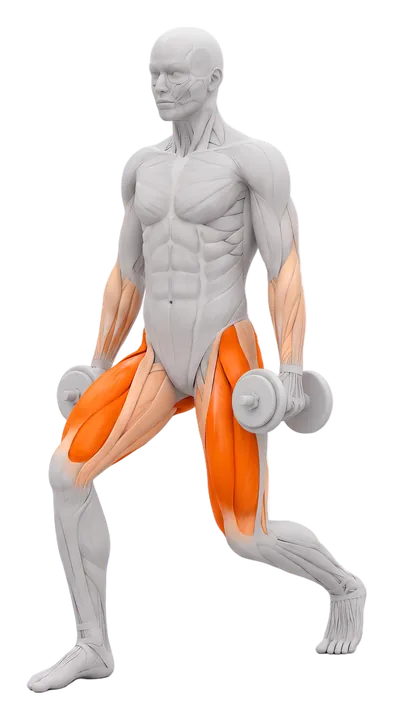
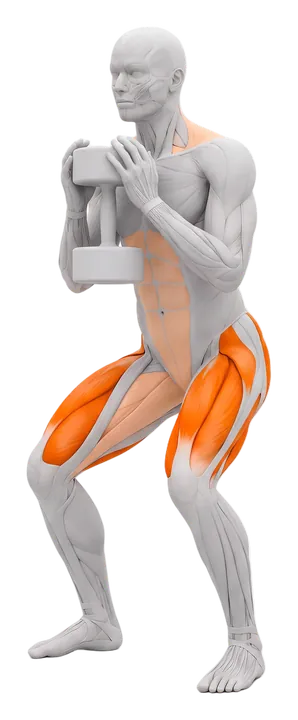
The gluteus maximus extends the hip: it pulls your thigh back from a bent hip. The quads straighten the knee. Squats, lunges and step-ups do both at once, so how much each muscle works depends on how far your hip bends compared to your knee. More hip bend means more glutes.
| Exercise | More glutes | More quads |
|---|---|---|
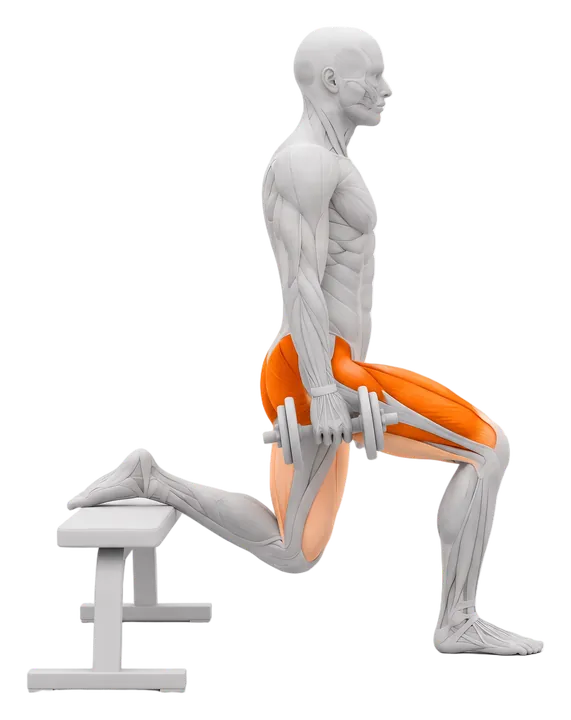
| Bulgarian split squat | Front foot further forward, torso leaned forward about 30 degrees | Front foot closer, torso upright, knee travels far forward |
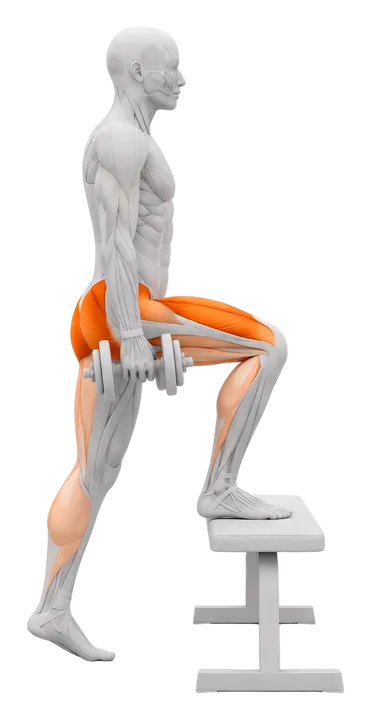
| Step-up | Higher box, lean in, drive through the whole front foot | Lower box, upright, push off the back foot |
| Walking lunge | Long step, chest slightly over the front thigh | Short step, upright torso |
| Goblet squat | Sit back and wide, deep | Narrow stance, knees forward |
| Hip thrust | Shins vertical at the top, chin tucked | Feet close to the hips |
Hinges like the Romanian deadlift are already mostly hip work, so they train glutes and hamstrings with little quad help. The hub page for glute exercises covers the barbell and machine options.
Glute exercises with dumbbells
The dumbbell glute workout
| Exercise | Sets x reps | Rest | Why it is here |
|---|---|---|---|
| Dumbbell hip thrust | 3 x 10 to 20 | 90 s | Glutes hardest at the top, fully shortened |
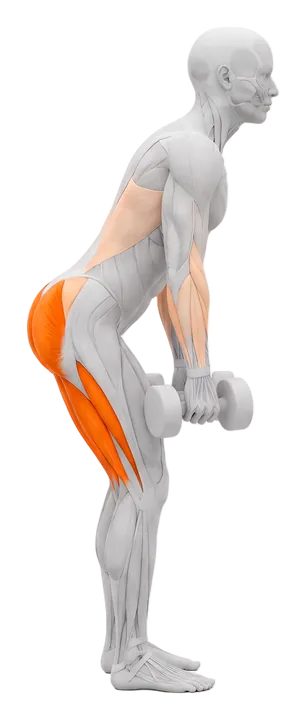
| Dumbbell Romanian deadlift | 3 x 8 to 12 | 2 min | Glutes and hamstrings under a deep stretch |
| Bulgarian split squat, glute setup | 3 x 8 to 12 per leg | 90 s between legs | Heavy single leg work, long stretch |
| Dumbbell step-up, knee-height box | 2 x 10 to 12 per leg | 60 s | Hip extension on one leg, side glutes stabilise |
| Side-lying hip abduction or banded side walk | 2 x 15 to 20 per side | 45 s | Upper and side glutes (gluteus medius) |
The order puts the hip thrust first while you can focus on the squeeze, then the heavier stretch exercises. If grip is your weak point, move the Romanian deadlift to the start. The Bulgarian split squat guide covers foot placement in detail.
How to do a dumbbell hip thrust
- Set up against a benchSit on the floor with the bottom of your shoulder blades on the edge of a bench or sofa that cannot slide.
- Place the dumbbellLay one dumbbell across your hip crease and hold each end. A folded towel underneath makes it more comfortable.
- Drive the hips upFeet flat, about hip width. Push through your heels and midfoot until your body is a straight line from knees to shoulders, chin tucked.
- Squeeze, then lowerHold the top for 1 to 2 seconds, then lower until the dumbbell nearly touches the floor.
A single dumbbell runs out quickly because your glutes are strong in this position. Once 20 reps are easy, switch to a single-leg hip thrust with the dumbbell on the working side, or add a 3 second pause at the top. With a barbell available, the barbell hip thrust lets you keep adding load.
How to feel your glutes instead of your quads
- Lean forward on single leg exercises. A slight forward lean of the torso, with a flat back, increases hip bend and puts the glutes on stretch.
- Go deep. The glutes work hardest through the bottom half of a split squat or step-up. Half reps are mostly quads.
- Push through the whole foot. Keep the heel down on the front foot. Rising on to the toes moves work to the quads.
- Do not push off the back leg. On step-ups and split squats, the back foot is for balance only.
- Slow the lowering. A 3 second descent on a Romanian deadlift makes a light dumbbell hard and lets you feel the stretch.
- Hamstrings cramping on hip thrusts? Bring your feet a bit closer. Feel it in the lower back? Tuck your chin and keep the ribs down.
Upper glute exercises with dumbbells
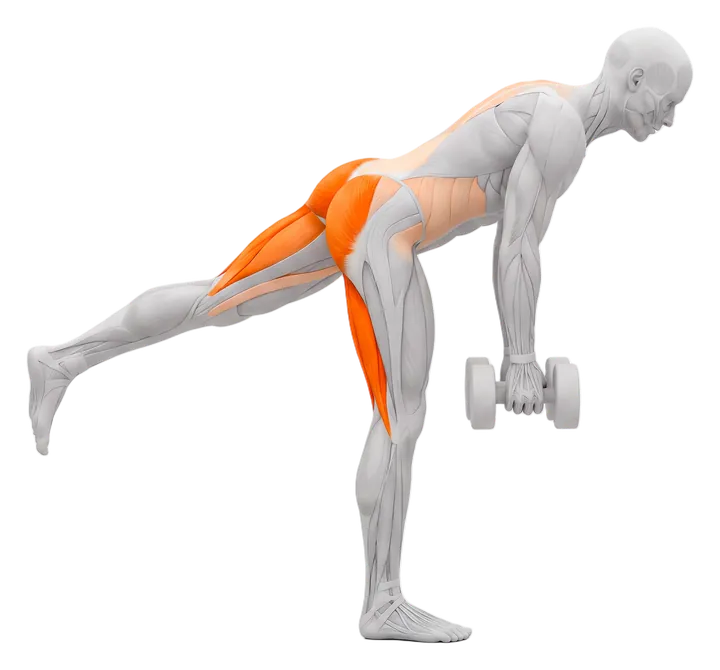
"Upper glutes" usually means the gluteus medius and the top fibres of the gluteus maximus, which lift the leg out to the side and keep the pelvis level on one leg. Single leg exercises train them as stabilisers; side raises train them directly.
- Single-leg Romanian deadlift: hold the dumbbell in the hand opposite the standing leg and keep the hips square.
- Side-lying hip abduction: lie on your side and raise the top leg with a light dumbbell resting on the outer thigh.
- Lateral lunge: hold one dumbbell goblet style and step wide to the side, sitting back into the hip.
- Step-up: the side glutes work hard to keep the knee from caving in on the way up.
Beginner and advanced versions
| Level | Workout | Frequency |
|---|---|---|
| Beginner | Glute bridge with a dumbbell 3 x 12 to 15, dumbbell Romanian deadlift 3 x 10 to 12, reverse lunge 2 x 10 per leg, side-lying hip abduction 2 x 15 | 2 times a week |
| Intermediate | The full workout above | 2 times a week |
| Advanced | Day A: Bulgarian split squat 4 x 8 to 12, dumbbell Romanian deadlift 4 x 8 to 12, side-lying abduction 3 x 20. Day B: single-leg hip thrust 4 x 10 to 15, step-up 3 x 10 to 12, single-leg Romanian deadlift 3 x 10, lateral lunge 2 x 10 | 2 to 3 times a week |
For a full leg and glute workout with dumbbells, add a goblet squat and a hamstring curl from the dumbbell leg workout.
Progressing with fixed dumbbell steps
Use double progression: pick a range like 8 to 12, add reps each session and move to the next dumbbell, usually 2 to 2.5 kg (5 lb) heavier, when every set hits 12. On single leg exercises the jump feels bigger, so a wider range such as 10 to 15 helps. If you run out of dumbbells, move to a harder variation, slow the tempo or add a set. The progressive overload guide explains each step.
Gripp keeps your glute work moving up
Gripp is coming to iPhone. Log every set and Gripp tells you what to lift next time: last time 10 reps per leg with 14 kg, today go for 11. When every set reaches the top of your range it moves you up a dumbbell. Your estimated 1RM per exercise sits on a chart, and Gripp rates your glute strength against people of your age and bodyweight.
Join the waitlist