Hip abduction machine muscles worked
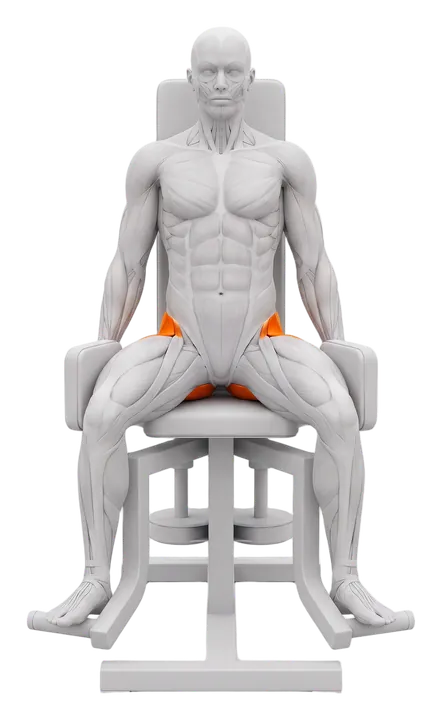
Abduction means moving the leg away from the middle of the body. On the machine both legs do it at once, with the hips bent because you are sitting.
| Muscle | Where | Role on the machine |
|---|---|---|
| Gluteus medius | Side of the hip, under the top of the back pocket | Primary |
| Gluteus minimus | Under the glute medius | Primary |
| Upper gluteus maximus | Top part of the big glute | Secondary, more when you lean forward |
| Tensor fasciae latae (TFL) | Front of the outer hip | Secondary, more when you sit upright |
| Piriformis and other deep rotators | Deep in the hip | Assist when the hip is bent |
In daily life the glute medius mostly works as a stabiliser. Every time you stand on one leg, walk or run, it stops the opposite hip from dropping. That same job shows up in the gym in single leg work like the Bulgarian split squat and the single leg RDL, where a knee that wobbles inwards is often a sign the side glutes need more work.
How to use the hip abduction machine
- Set the start widthMost machines have a lever or pin for the starting position. Choose a width where you feel a light stretch on the outside of the hips, not a narrow start that makes the first part free.
- Sit and place the padsBack against the seat, feet on the foot rests, pads on the outside of your knees or just above. Hold the handles.
- Push the knees outPress out with the knees, not the feet, until you reach your end range. Keep the hips planted on the seat.
- Hold and return slowlyPause for a second at the widest point, then let the pads come back over 2 to 3 seconds. Stop just before the weights touch so the muscles stay loaded.
Upright or leaning forward?
You will see people in the gym doing hip abductions bent forward over their knees, sometimes with their hips lifted off the seat. It is not wrong. Changing your torso angle changes how much your hip is bent, and that changes which fibres of the glutes can help.
| Position | What it feels like | Use it for |
|---|---|---|
| Sitting tall, back on the pad | Outside of the hip, close to the hip bone | Glute medius and minimus, steady strict sets |
| Leaning forward, chest towards the knees | Higher on the back of the glutes | More upper glute max, a different feel at the same weight |
| Hips slightly off the seat | Upper glutes, harder to stabilise | Advanced, usually lighter loads |
A simple way to get both is a mechanical drop set: do your reps upright, and when you cannot do more, lean forward and keep going for a few more reps. Pick one style as your main logged exercise so the numbers stay comparable from week to week.
Common hip abduction mistakes
- Swinging the weight. The stack slams back and forth and momentum does the work. Slow the return.
- Tiny range. Heavy weight pushed out a few centimetres. Lower the load and use your whole range.
- Rocking the torso. Throwing the upper body forward on every rep to get the weight out. Choose your angle and keep it.
- Doing it first in the session. Isolation work for small muscles belongs after squats, hinges and lunges.
- Expecting it to fix knee pain. Stronger hips can help how your knees track, but pain needs a proper assessment by a physiotherapist.
Sets and reps for hip abduction
| Goal | Sets x reps | Rest | Notes |
|---|---|---|---|
| Glute growth | 3 x 12 to 20 | 60 to 90 s | Last reps should burn, 1 to 2 reps left |
| Strength and control | 3 x 8 to 12 | 90 s | 2 s pause at the widest point |
| Warm up before squats | 1 to 2 x 15 light | None | Wakes up the side glutes |
| Beginner | 2 x 15 | 60 s | Learn the slow return first |
Put it near the end of a lower body day, after the heavy work. A glute focused session could be hip thrusts, then a hinge or split squat, then hip abductions as the finisher. Two to six hard sets a week is enough for most people, since squats and lunges train the same muscles indirectly. See the glute exercises hub for the full picture. On a machine only day, the leg machine workout pairs it with the adduction machine.
How to progress on the abduction machine
Small muscles mean small jumps. Add reps first, then move one pin up once you reach the top of your rep range in all sets with a clean pause. If the stack jumps are too big, add a set or slow the return instead. This is the same idea as all progressive overload: the number goes up only when the quality stays.
One pin at a time, logged
Gripp logs the weight and reps of every set and tells you when you have earned the next pin: hit the top of your range in every set and it suggests more weight. Your glute rating compares your strength with people of your age and bodyweight.
Join the waitlistHip abduction alternatives without the machine
- Banded seated abduction: a loop band above the knees, sitting on a bench. The closest copy of the machine at home.
- Side lying leg raise: lie on your side and lift the top leg slightly behind you, toes pointing forward.
- Cable hip abduction: standing, ankle strap on the outside leg, move the leg out to the side.
- Side plank with top leg raised: hard on the bottom side glute as a stabiliser. See the side plank.
- Glute bridge with a band: push the knees out against the band during every rep.
The opposite machine squeezes the knees together and trains the inner thighs: read the hip adduction machine guide.