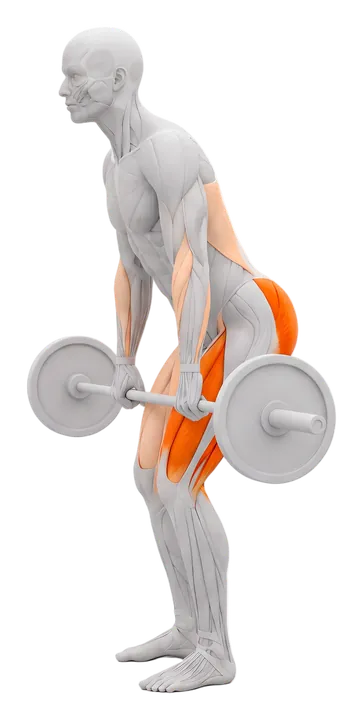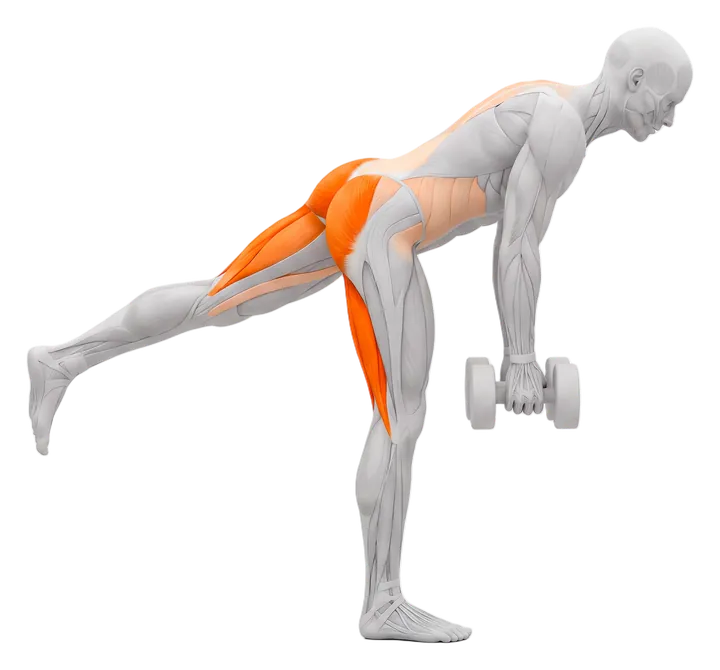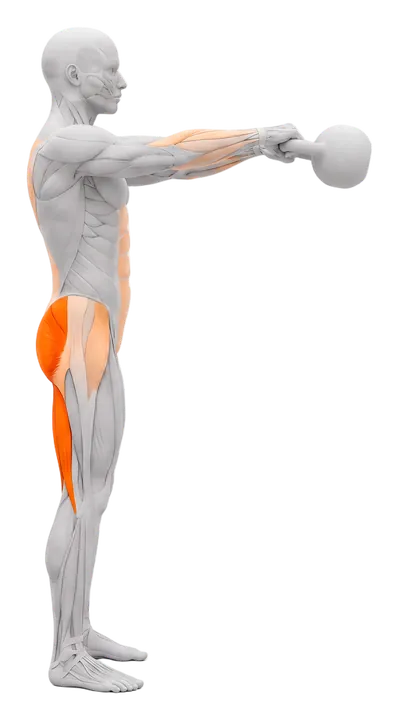
What muscles does the kettlebell swing work?
| Muscle | What it does | Role |
|---|---|---|
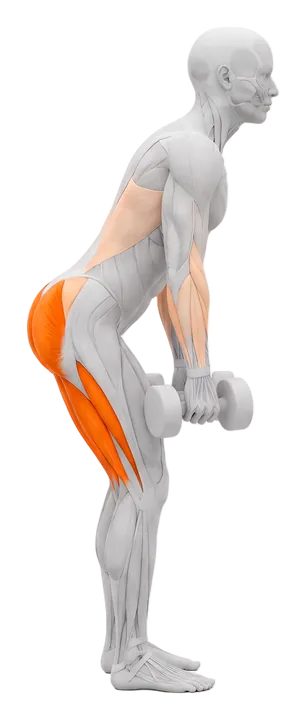
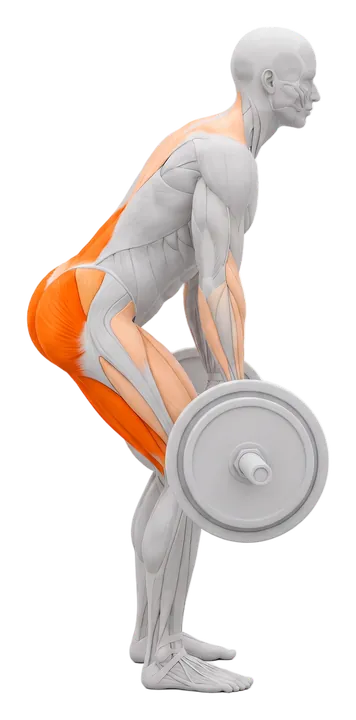
| Glutes | Snap the hips forward to drive the bell | Primary |
| Hamstrings | Load up in the backswing and help extend the hips | Primary |
| Lower back | Holds the spine neutral as the bell pulls on you | Secondary |
| Abs and obliques | Lock the trunk at the top so you do not lean back | Secondary |
| Forearms and grip | Hold the handle through the swing | Secondary |
| Lats and shoulders | Guide the bell and keep the arms connected to the body | Stabiliser |
| Heart and lungs | Long or fast sets raise the heart rate hard | Conditioning |
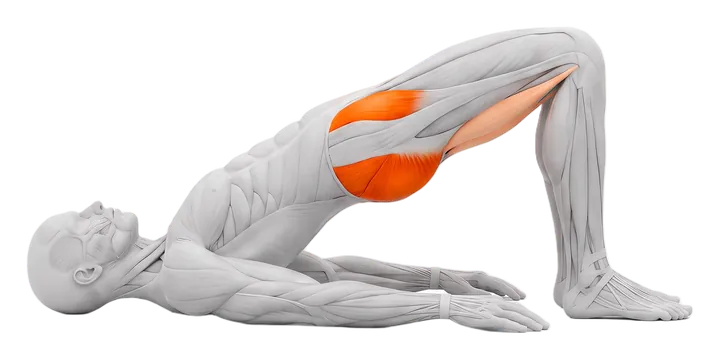
The swing trains the same hip extension as a Romanian deadlift or a hip thrust, but fast and with a lighter load. It complements those lifts rather than replacing them: heavy slow hinges build strength, swings build power and work capacity.
Hinge, not squat: the key to the swing
Most bad swings are squats with a kettlebell. In a squat the knees bend a lot and the hips go down. In a hinge, the hips go back, the knees bend only a little, and the torso tips forward with a flat back. The swing is a hinge.
| Kettlebell swing | Squat | |
|---|---|---|
| Main joint | Hips | Hips and knees |
| Knees | Soft bend | Deep bend |
| Torso | Leans forward, back flat | Stays more upright |
| Where you feel it | Hamstrings and glutes | Quads and glutes |
| Bell at the bottom | High between the thighs | Close to the floor |
Drill: the wall hinge
Stand a foot length in front of a wall, facing away. Push your hips back to touch the wall while keeping your shins nearly vertical and your back flat. When that is easy, step a little further away. If your knees shoot forward or you sit down, you are squatting. Practise this until it feels natural before you pick up a heavy bell.
How to do a kettlebell swing
- Set the bell in front of youPlace the kettlebell about 30 cm (one foot) in front of your toes. Feet a bit wider than hip width.
- Hinge and gripPush your hips back, keep your back flat and grab the handle with both hands. Tilt the bell towards you so it is ready to be hiked.
- Hike it backLike a centre snap in American football, pull the bell back high between your thighs. Your forearms should touch your inner thighs.
- Snap the hipsDrive your hips forward hard and stand up tall. The bell floats forward and up because of that hip snap; your arms just hold on.
- Stand like a plank at the topGlutes squeezed, knees straight, ribs down, body in a straight vertical line. The bell should reach roughly chest height with straight arms.
- Let it fall and hinge lateLet the bell drop. Wait until your arms touch your body, then hinge back to receive it high between the thighs and go straight into the next rep.
- Park itTo finish, swing it back one last time and let it come forward to the floor in front of you, same position you started from.
Kettlebell swing form mistakes
- Lifting with the arms. If your shoulders burn first, you are doing a front raise. Let the hips do the work and keep the arms relaxed.
- Squatting the swing. Deep knee bend and low hips make it a quad exercise. Think hips back, not down.
- Leaning back at the top. Overextending the lower back to finish the rep. Stop at standing tall and squeeze the glutes.
- Bell too low in the backswing. If it swings below your knees, the lower back takes the strain. Keep it high between the thighs.
- Hinging too early. Bending forward before the bell gets back to you makes it pull you off balance.
- Rounded back. Keep a neutral spine through the whole rep. Lighten the bell if you cannot.
Russian vs American kettlebell swing
The Russian kettlebell swing stops at about chest or eye height with the arms straight in front of you. The American kettlebell swing keeps going until the bell is directly overhead, bottom pointing at the ceiling.
| Russian swing | American swing | |
|---|---|---|
| Top position | Chest to eye height | Overhead |
| Main driver | Hip snap | Hip snap plus shoulders |
| Load you can use | Heavier | Lighter |
| Shoulder demand | Low | High, needs good overhead mobility |
| Where you see it | Kettlebell and strength training | CrossFit style workouts |
For most people training for strength and general fitness, the Russian swing is the better default: it lets you use a heavier bell and keeps the focus on the hips. The American swing only makes sense if your shoulders are comfortable fully overhead and you have a reason to train it, such as a workout that requires it.
Kettlebell weight for beginners
A swing is a power exercise, so the bell needs to be heavy enough that you have to snap your hips, but light enough to keep your back flat for every rep. Too light and you end up lifting it with your arms.
| You are | Start with | Then |
|---|---|---|
| New to training, smaller or older | 8 to 12 kg (18 to 26 lb) | Move up in 4 kg steps |
| New to swings but used to lifting | 12 to 16 kg (26 to 35 lb) | Move up in 4 kg steps |
| Experienced | 16 to 24 kg (35 to 53 lb) | Heavier bells or one arm swings |
These are typical starting points, not standards. Kettlebells usually come in 4 kg steps, which is a big jump on a light bell. Use the reps to bridge the gap: add reps or sets before going up a size.
Kettlebell swing sets and reps
| Goal | Sets x reps | Rest | Notes |
|---|---|---|---|
| Learning | 5 to 8 x 5 | 60 s | Park the bell after each set and reset |
| Power | 6 to 10 x 5 to 8 | 60 to 90 s | Heavy bell, every rep as hard as possible |
| Strength endurance | 4 to 5 x 10 to 15 | 60 to 90 s | Moderate bell |
| Conditioning | 10 x 10, one set every minute | Rest of the minute | Stop the set when form slips |
Swings go well at the end of a lower body session or as the main piece of a short kettlebell workout. Two or three sessions a week is enough for most people. They also fit into a home workout plan when one bell is all you have.
Kettlebell swing benefits
- Power from the hips. The fast hip extension carries over to jumping, sprinting and heavy pulls.
- Conditioning without running. High rep swing sets get your heart rate up with little impact on the joints.
- Grip and posture. Holding the bell for long sets trains grip and upper back endurance.
- Small space, one tool. All you need is a bell and two metres of floor.
- Fat loss: swings burn energy like any hard work, but fat loss comes from your overall diet and activity, not from one exercise.
Progressing the swing
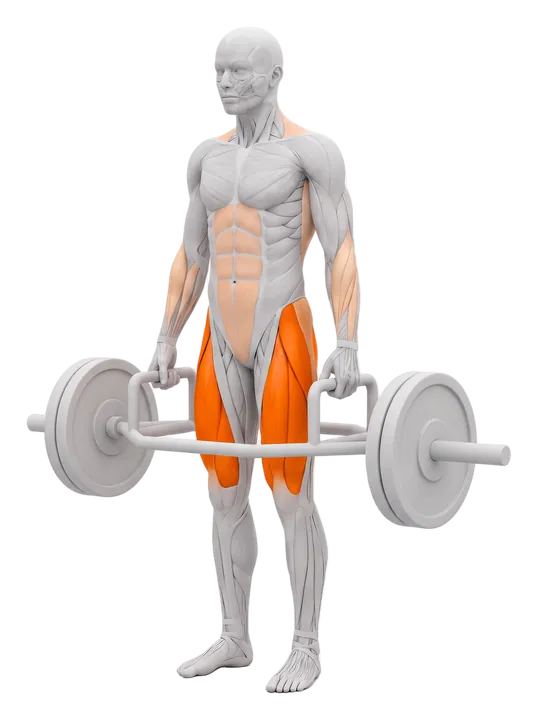
Progress in this order: more reps per set, more total sets, shorter rest, then a heavier bell. A one arm swing is a step up in difficulty with the same bell, because one side has to resist rotation. Swings pair well with a heavier hinge like the trap bar deadlift or a slow single-leg Romanian deadlift. For the general rules, read progressive overload.
Gripp tracks your swings rep by rep
Log each set and Gripp tells you what to do next session: more reps until you top your range, then a heavier bell. Every set lands in your log, so you can see your swing volume and bell size climb over the months.
Join the waitlistKettlebell swing alternatives
- Romanian deadlift: the slow, heavy version of the same hinge.
- Glute bridge or hip thrust: hip extension without the speed or the load on the back. See the glute bridge.
- Dumbbell swing: works if you only have dumbbells; hold one end with both hands.
- Cable pull-through: a hinge with constant cable tension.
- Trap bar jump or broad jump: other ways to train hip power.